The Dawn of Landscape: Early Representations & Romantic Ideals Richard Parkes Bonington: A Brief but Brilliant Career – Romantic Landscapes & the Dawn of Plein Air Painting Explore the short but impactful career of Richard Parkes Bonington, a pivotal...
Landscape painting has functioned as a tool for documenting specific geographies since its earliest iterations. In the Roman era, landscapes appeared in frescos and mosaics, often incorporating rivers, lakes, or seas to provide context to larger scenes. The development of a systematic approach to perspective and scaling for distance can be traced back to the Hellenistic period in Ancient Greece. These early methods allowed artists to establish a sense of depth, though the primary focus remained on the depiction of actual, specific locations. Such works are categorized as topographical views, where the inclusion of buildings and recognizable landmarks is paramount for accuracy.
In contrast to this Western focus on literal representation, the Chinese ink painting tradition, known as shan shui, developed a different approach to the natural world. These artists utilized sophisticated backgrounds of mountains and water to frame their subjects, often employing mist or dead ground to bridge the gap between foreground elements and distant vistas. This technique avoided the technical difficulty of creating a continuous, realistic transition across the canvas. While Western traditions eventually moved toward the emotional intensity of Romanticism, East Asian traditions maintained a high level of prestige through the creation of imaginary, spiritual landscapes.
The distinction between recording a place and interpreting an environment is fundamental to selecting art for professional spaces. Whether a work depicts a precise topographical site or an imagined vista, the intent behind the composition dictates its impact on a room's narrative.
Takeaway: Identify whether your project requires the literal documentation of a location or the atmospheric qualities of an imaginary scene.
The En Plein Air Revolution: Technical Shifts in Light and Atmosphere
Introduction Close your eyes for a moment and imagine the world not as a collection of fixed lines and rigid shapes, but as a shimmering dance of light and atmosphere. Imagine the way a morning mist clings to the reeds of a pond, or how the setting s...
The late 19th century introduced a significant technical shift with the emergence of en plein airpainting. This method, which translates to painting "in the open air," moved artists away from the controlled, often somber environments of the studio and into direct engagement with nature. Artists such as Claude Monet, Pierre-Auguste Renoir, and Camille Pissarro sought to record the precise sensation of a single moment before light conditions shifted. This transition was supported by technological advancements, such as the availability of portable paint tubes, which allowed for unprecedented mobility.
This movement prioritized the ephemeral qualities of light and weather over rigid academic rules. In works like Renoir's Landscape 15, the application of broken brushstrokes and a luminous palette simulates the way sunlight filters through foliage or reflects off water. Similarly, Jules Louis Philippe Coignet acted as a bridge between academic realism and this new observational method, bringing the influence of John Constable’s outdoor excursions to the French tradition. The goal was no longer just to paint trees or mountains, but to capture the movement of light across their surfaces.
For designers, understanding en plein air is essential for selecting works that provide a sense of immediacy. These paintings do not present a static view; they present a captured moment in time.
Take andaway: Select en plein air reproductions to introduce a sense of movement and temporal presence into a space.
Compositional Elements: Managing Depth and Perspective in Large-Scale Views
Landscape painting, also known as landscape art, is the depiction in painting of natural scenery such as mountains, valleys, rivers, trees, and forests, especially where the main subject is a wide view—with its elements arranged into a coherent compo...
Effective landscape composition requires the strategic arrangement of natural elements—mountains, valleys, rivers, and forests—into a coherent visual structure. A successful view almost always includes the sky, which provides the necessary atmospheric context for the terrain below. The challenge for the artist lies in managing the relationship between the foreground, middle ground, and background to create a sense of scale. In some traditions, such as Chinese shan shui, artists used waterfalls or heavy mist to manage these transitions, whereas Western painters often utilized more direct systems of perspective.
In larger-scale installations, the composition must account for the physical boundaries of the architectural space. A panoramic view can act as a visual expansion, dissolving the walls of an urban hotel or corporate lobby. Elements such as winding paths, as seen in Gauguin's Martinique Landscape, can guide the viewer's eye through the depth of the painting, creating a psychological sense of exploration. The placement of vertical accents, like the trees in Renoir’s work, provides stability and frames the broader vista.
When planning for large-scale hospitality projects, consider how the composition interacts with the room's dimensions. A wide, horizontal composition can lengthen a corridor, while a more vertical arrangement can draw attention upward toward high ceilings.
Takeaway: Use landscape compositions to direct movement and manipulate the perceived boundaries of an interior space.
Materiality and Texture: The Impact of Brushwork on Visual Depth
An Impressionistic Whisper of the English Countryside In this evocative Landscape Study , Sir Alfred James Munnings invites the viewer into a world where the boundaries between earth and sky dissolve into a poetic haze. The painting captures a moment...
The physical texture of a painting significantly influences how light interacts with the surface, affecting the overall mood of a room. In Impressionist and Post-Impressionist works, the use of impasto—thick, visible applications of oil paint—adds a tactile dimension to the canvas. For example, in Gauguin's 1887 work from Martinique, the textured surface created by gestural strokes adds depth and a sense of vitality to the tropical foliage. This texture prevents the artwork from appearing flat or two-dimensional, which is critical when viewing art from varying distances in a public space.
The choice between different painting techniques also affects durability and visual impact. While a Giclée print offers high accuracy through 12-color archival inks, it lacks the physical depth of a hand-painted oil reproduction. A handmade oil painting on cotton canvas retains the ridges of the brushstroke, creating shadows and highlights that change as the viewer moves. Furthermore, specialized finishes like an aged or cracked (craquelure) effect can be applied to certain reproductions to match specific historical aesthetics.
When selecting art for high-traffic areas, consider the importance of texture in maintaining visual interest. A painting with significant tactile depth remains engaging even under the varied lighting conditions of a commercial interior.
Takeaway: Prioritize hand-painted oil reproductions when the design requires physical texture and light-reactive surfaces.
Strategic Integration: Using Landscape Vistas to Expand Hospitality Interiors
The Architectural Impact of Landscape Art: Enhancing Hospitality Interiors Landscape painting Landscape painting, also known as landscape art, is the depiction in painting of natural scenery such as mountains, valleys, rivers, trees, and forests, esp...
Landscape art serves as a strategic architectural tool in hospitality design. In environments where physical expansion is limited, such as urban boutique hotels or dense restaurant layouts, landscape paintings provide a psychological escape. By introducing vistas of mountains, valleys, or tranquil rivers, a designer can mitigate the claustrophobia of enclosed spaces and offer guests a sense of serenity. The ability to integrate these vistas through custom sizing allows for a seamless blend between the building's structural elements and the organic beauty of the art.
The selection of subject matter should align with the intended guest impression. A tranquil, water-focused piece can establish a sense of calm in a spa or lounge, while more dramatic, mountainous landscapes can provide a focal point for a grand lobby. The versatility of landscape art allows it to complement diverse architectural languages, from minimalist contemporary designs to neo-classical estates. Large-format murals and frescoes, painted on massive canvas rolls, can even recreate historical ceilings to add grandeur to a space.
For procurement professionals, the goal is to use landscape art to anchor a space within a specific narrative, transforming a transient corridor into a curated experience.
Takeaway: Deploy landscape vistas as architectural elements to expand perceived room volume and establish a thematic atmosphere.
Logistics and Customization: Sizing, Multi-Panel Configurations, and Procurement
Elevate your space with our handcrafted wood wave panel—black and off‑white mosaic, 3D texture, eco‑friendly finish. Add modern elegance today.
For large-scale design projects, the logistics of art procurement require precision regarding sizing, quantity, and delivery. One effective trend for covering wide walls or staircases is the use of multi-panel configurations. Splitting a single landscape image across three, four, or five panels allows for a modern, cohesive look that can be scaled to fit specific architectural dimensions. This approach is particularly useful for creating a continuous visual flow across large surfaces without the need for a single, prohibitively heavy canvas.
Customization is another critical factor in professional procurement. Services such as Professional Digital Mockups allow designers to see how a composition will appear on a specific wall before production begins. This is essential for verifying color matching and scale. Additionally, the ability to "remix" history—such as requesting a photo be painted in the style of Monet or adjusting the colors of a Gauguin reproduction to match a room's palette—provides the flexibility needed for bespoke interiors.
Reliable procurement relies on clear timelines and global logistics. Hand-made oil reproductions typically require 4 to 5 weeks for painting and drying, while prints can be dispatched within 7 to 10 business days. Ensuring that your supplier provides VAT-compliant documentation and handles international customs/VAT support is vital for large-scale, multi-region projects.
Takeaway: Utilize multi-panel configurations and digital mockups to manage the scale and integration of art within complex architectural plans.

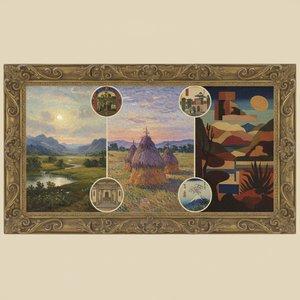 The Allure of Open Airs: Exploring Representations of Outdoors in Art History
 10 Iconic Impressionist Landscapes That Changed Art Forever
 Landscape painting
 Landscape Study
 Mastering the Outdoors: A Professional Buyer's Guide to Iconic Landscape and En Plein Air Artworks for Hospitality Design
 Layered Wood Wave Wall Art Panel


