The Dawn of Luminosity: Early Representations of Light Long before the advent of artificial illumination, light held a profound significance for humankind – a source of life, knowledge, and spiritual awakening. It’s unsurprising, then, that its repre...
Entering a gallery dedicated to the mastery of light requires more than just sight; it demands an awareness of how shadows define the very air we breathe. Before the eye settles on a specific subject, it first registers the tension between brilliance and obscurity. This is where the technical meets the visceral. In the early stages of Western painting, from the subtle gold tesserae of Byzantine mosaics to the nascent modeling in Giotto’s frescoes, light was a tool for divinity. It was used to evoke a sense of radiance that transcende the physical plane. As we move through these halls, we see this evolution—a transition from symbolic illumination to a scientific, almost tactile understanding of how photons interact with surface and skin.
The true shift occurred when artists stopped merely representing light and began sculpting with it. This movement toward naturalism changed the collector's relationship with the canvas. A painting was no longer just a window into a story; it became an environment where depth could be felt. When we look at the way light hits a textured surface, we are witnessing the birth of a new visual language, one that relies on the precise gradation of value to suggest a world that exists beyond the frame.
The Baroque Stage: Chiaroscuro and the Art of Drama
A Grand Spectacle of Baroque Majesty To stand before Sir Peter Paul Rubens' “The Landing at Marseilles, 3rd November 1600” is to be swept up in a whirlwind of historical drama and unparalleled artistic energy. Completed around 1625, this monumental c...
To stand before Peter Paul Rubens' The Landing at Marseilles, 3rd November 1600 is to witness the height of theatrical energy. Here, chiaroscuro is not a subtle whisper but a powerful narrative force. Completed around 1625, this monumental work uses stark contrasts between deep shadows and brilliant highlights to engineer a spectacle. Rubens does not simply document the return of Marie de Medici; he utilizes light to direct the eye through a bustling harbor filled with nobles and ordinary citizens alike. The technique of glazing—layering thin, translucent pigments—allows the skin tones and heavy silks to appear as if they possess an internal glow, pulling the viewer into the political triumph unfolding on the canvas.
This era embraced the dramatic potential of contrast to heighten emotional intensity. While Rubens used light to create a sense of movement and scale, others pushed these boundaries toward even more extreme ends. The interplay of light on water and the atmospheric haze of a Mediterranean port demonstrate how shadow can be used to define volume while simultaneously creating an atmosphere of heightened anticipation. In this period, light became the director of the scene, deciding which figures would emerge from the darkness to command our attention.
Sculpting Form: The Renaissance Precision of Shadow
Ugo da Carpi: A Pioneer of Chiaroscuro Woodcut Born: Approximately 1450-1480 in Carpi, Italy Died: Between 1523 and 1532 (aged approximately 73-122) Known for: Chiaroscuro woodcut technique, reproductive prints after Raphael and Parmigianino Early Li...
Before the drama of the Baroque, the High Renaissance sought a different kind of mastery: the perfection of form through subtle modulation. Leonardo da Vinci pioneered sfumato, a technique where edges are softened into a hazy, ethereal glow, allowing figures to emerge from the shadows with a lifelike, breathing quality. This was not about sudden shocks of light, but about the meticulous study of how light wraps around a three-dimensional object. In works like the Adoration of the Magi, we see this soft transition, where the boundary between subject and atmosphere becomes nearly imperceptible.
This precision extended to the development of chiaroscuro as a technical method for modeling volume. Artists like Raphael utilized light coming from specific angles to give weight to the human body, ensuring that every limb and fold of drapery possessed a sense of physical presence. Even in the more experimental works of Ugo da Carpi, we see the influence of this era through the development of the chiaroscuro woodcut. By working from a base tone toward light with white gouache, printmakers could replicate the sculptural depth found in much larger oil paintings, proving that the manipulation of value was a fundamental principle of composition across all mediums.
Atmospheric Depth: Aerial Perspective and Luminous Horizons
Discover Martin Johnson Heade (1819-1904): Luminist master of serene marsh scenes, vibrant hummingbird paintings & exquisite floral still lifes. Explore his rediscovered masterpieces!
Beyond the concentrated drama of figures, the focus shifts toward the infinite. Aerial perspective allows a painter to capture the mechanics of distance. By depicting far-off objects as paler, less detailed, and often tinged with a bluish hue, artists create an illusion of profound depth. The atmosphere acts as a veil, reducing contrast and saturation as the landscape recedes toward the horizon.
This technique finds its most serene expression in American Luminism. Artists such as Martin Johnson Heade and Fitz Henry Lane emphasized the horizontal plane, using calm, reflective water and soft, hazy skies to evoke quietude. Unlike the heavy shadows of the Baroque, Luminist light is often cool and clear, focusing on the clarity of the atmosphere. The goal was to minimize visible brushstrokes, creating a surface so smooth that the viewer encounters nothing but the sensation of a vast, tranquil world. This approach transforms the landscape into a study of light itself.
Shadows in Motion: From Tenebrism to Cinematic Noir
Low-key lighting is a style of lighting for photography, film or television. It is a necessary element in creating a chiaroscuro effect. Traditional photographic lighting (three-point lighting) uses a key light, a fill light and a back light for illu...
The evolution of light eventually reached a point of extreme tension known as tenebrism. If chiaroscuro is about modeling form, tenebrism is about the dominance of darkness. Artists like Caravaggio revolutionized the medium by using intense, focused light to pierce through deep, murky shadows, creating a spotlight effect that feels almost cinematic. This technique does not just illuminate; it isolates. It forces the viewer to confront the subject in a moment of profound psychological or spiritual significance.
This legacy of high-contrast lighting traveled far beyond the canvas, finding a second life in the 20th-century film noir genre. The use of low-key lighting—where a single key light creates sharp silhouettes and deep shadows—is used to evoke mystery, alienation, and moral ambiguity. Much like the works of Rembrandt, where an illuminated triangle under the eye adds a layer of character depth, cinematic lighting uses shadow to reveal the emotional landscape of a character. Whether in a 17th-century religious painting or a mid-century crime drama, the manipulation of light remains our most potent tool for storytelling.
Curating the Glow: Light as a Collector's Signature
Selecting artwork is an exercise in defining the atmosphere of a room. Light functions as a structural element in interior design; a large-scale Rubens reproduction can inject historical weight and movement into a space, while a delicate Luminist landscape introduces stillness. The choice between the tactile, impasto texture of an oil reproduction and the smooth finish of a fine art print depends entirely on the visual energy one intends to cultivate.
When commissioning custom portraits, the control of light remains paramount. Requesting the heavy shadows of Rembrandt-style lighting or the sun-drenched clarity reminiscent of Joaquín Sorolla’s Madrid allows for a personalized dialogue with art history. The ability to manipulate these tonal shifts ensures that a new acquisition integrates seamlessly with the existing collection. Ultimately, the careful management of shadow and highlight dictates how a piece interacts with its environment, turning a mere wall into a curated space.
Discover how the dramatic interplay of chiaroscuro and light can transform your home. Learn to use shadow, contrast, and masterful art reproductions to create a sophisticated, soulful interior with expert design insights from OriginalUniqueArt.com.
Explore the profound emotional depth of chiaroscuro. Discover how masters like Rembrandt and Caravaggio used light and shadow to create drama, spiritual intensity, and timeless beauty in art history.

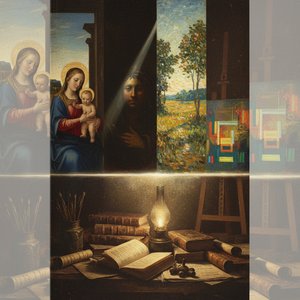 Illuminating Visions: A Historical & Artistic Exploration of Light in Painting
 The Landing at Marseilles, 3rd November 1600
 Ugo da Carpi
 Martin Johnson Heade
 Low-key lighting


