Timeless Elegance: Iconic Masterpieces That Define Sophistication and the Legacy of Classical Beauty
Explore the profound history of elegance through iconic masterpieces. From Neoclassical grandeur to Victorian grace, discover how timeless art defines sophistication and learn to curate your own museum-quality collection with our expert historical insights.
Introduction To step into a room adorned with elegance is to experience more than mere decoration; it is to enter a curated atmosphere of poise, restraint, and timeless grace. Elegance in art does not shout for attention through chaotic colors or jar...
To step into a room adorned with true elegance is to experience far more than mere decoration; it is to enter a curated atmosphere of poise, restraint, and timeless grace. In the grand lexicon of art history, elegance does not shout for attention through chaotic colors or jarring movements. Instead, it whispers through the deliberate placement of a shadow, the fluid sweep of a silk gown, or the quiet harmony of a balanced composition. It is an aesthetic that seeks to elevate the spirit, transforming a physical space into a sanctuary of sophistication. Historically, this pursuit has been a cornerstone of the world's most prestigious artistic movements, where the mastery of technique served to reflect the dignity and refinement of the human experience.
True elegance in art is found in the subtle luster of a pearl in a portrait or the tranquil stillness of a landscape. These works possess a universal ability to instill a sense of calm and luxury, providing a necessary counterpoint to the noise of contemporary life. Whether we are examining the refined symmetry of Neoclassicism or the soft, light-drenched atmospheres of later eras, the thread that binds these masterpieces is their reliance on fundamental principles of beauty and balance. For the discerning collector, these works serve as visual anchors of stability and class, offering a window into an era where art was the ultimate language of prestige and intellectual depth.
The Neoclassical Revival: Order, Reason, and the Grandeur of Antiquity
Introduction Imagine stepping back into a world yearning for order, reason, and timeless beauty—a world recovering from excess and seeking inspiration in the grandeur of antiquity. This is the essence of Neo-Classicism, an art movement that swept acr...
Imagine stepping back into a world yearning for order, reason, and timeless beauty—a world recovering from excess and seeking inspiration in the grandeur of antiquity. This is the profound essence of Neoclassicism, an art movement that swept across Europe during the 18th and early 19th centuries. More than just a stylistic shift, it was a cultural response born from Enlightenment ideals and fueled by the breathtaking archaeological discoveries at Pompeii and Herculaneum. The rediscovery of these Roman cities unlocked a deep fascination with classical art, architecture, and philosophy, prompting artists to reject the ornate flourishes of the Baroque and Rococo periods in favor of simplicity, symmetry, and clarity.
Artists of this era looked to ancient Greece and Rome not merely as sources of aesthetic inspiration, but as models for moral virtue and civic responsibility. The resulting artworks were masterful reinterpretations, infused with contemporary sensibilities yet deeply rooted in the past. They spoke of heroism, sacrifice, and the power of reason, often serving as powerful statements about political ideals and social reform. From marble sculptures radiating stoic dignity to canvases depicting scenes from classical mythology rendered with meticulous detail, Neoclassicism sought to capture a sense of permanence. This era reminds us that true sophistication is often found in the pursuit of perfection through disciplined form and the celebration of enduring human values.
Mastering Grace: The Delicate Nuances of Victorian Neo-Classicism
Admire 'A Classical Beauty,' a stunning Victorian Neo-Classical painting by John William Godward. Experience exquisite detail & timeless elegance. Hand-painted reproductions available.
As we move into the late 19th and early 20th centuries, the classical spirit underwent a romanticized transformation, particularly within the Victorian Neo-Classical movement. Artists such as John William Godward became masters of capturing an exquisite depiction of feminine grace and classical elegance. In works like Mischief or A Classical Beauty with a Pearl Fan, we encounter a beautifully rendered world of romanticized leisure. These paintings present serene, contemplative figures dressed in flowing, richly textured garments, seated gracefully amidst idyllic outdoor settings. The artist’s ability to capture the subtle interplay of light and shadow enhances the softness of skin and the intricate details of attire, creating a lifelike presence that resonates on an emotional level.
This period exemplifies a fascination with classical antiquity through a lens of aesthetic perfection and harmony. Through meticulous attention to detail, artists employed oil paints on canvas to achieve rich coloration and subtle gradations of tone. The textures—smooth marble, soft fabrics, and lush foliage—are rendered with exceptional realism, showcasing a skill that brings the ancient world into a tangible, tactile reality. It is an art of atmosphere, where the poised demeanor of the subject invites the viewer into a world of refined elegance and tranquil harmony, bridging the gap between historical inspiration and contemporary craftsmanship.
The Architecture of Beauty: Symmetry and Proportion in Classical Composition
A Palladian Masterpiece in South Yorkshire Standing as a silent sentinel of eighteenth-century ambition, the Doncaster Mansion House is far more than a mere municipal landmark; it is a profound architectural statement carved from ashlar stone. Design...
The foundation of all sophisticated art lies in its structural integrity, a principle clearly visible in both ancient sculpture and monumental architecture. The art of ancient Greece, spanning from the Mycenaebian period through the Hellenistic era, established a cornerstone for Western civilization. It introduced a pursuit of ideal beauty, rational order, and a deep connection with the divine. In sculpture, this was achieved through innovations like contrapposto—a pose where weight is shifted onto one leg to create an illusion of movement and anatomical accuracy. This mastery of form allowed artists to capture the human body in its most idealized state.
This architectural language of harmony and proportion extended into the very structures that housed these ideals. The Parthenon in Athens, dedicated to Athena, stands as a pinnacle of Classical ideals, utilizing a vocabulary of ornament and balance that would later be adopted by Roman architecture and continue to influence modern design. Even in the 18th century, we see this reflected in Palladian masterpieces like the Doncaster Mansion House, where a symmetrical façade and harmonious proportions command respect through their adherence to classical ideals. This commitment to balance and structure ensures that the artwork—or the space it inhabits—remains timeless, resisting the decay of passing trends.
Curating a Timeless Sanctuary: Integrating Masterpieces into Modern Interiors
A Timeless Dialogue: The Soul of Mougins Nestled within the sun-drenched, medieval heart of Provence, the Mougins Museum of Classic Art serves as a profound sanctuary where the echoes of antiquity meet the vibrant pulse of modernity. To step into thi...
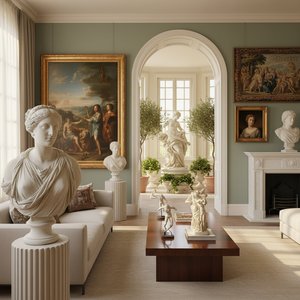
For the modern enthusiast, the challenge lies in integrating these historical echoes into a contemporary lifestyle. To curate a room with elegance is to orchestrate an encounter between the ancient and the avant-garde. Much like the Mougins Museum of Classic Art, which creates a dialogue between Roman antiquities and the bold strokes of Matisse or Picasso, a well-designed home can serve as a sanctuary where history meets modernity. The key is not to overwhelm, but to use historical motifs to breathe life into modern aesthetics, proving that true beauty is a continuous thread woven through the fabric of time.
Integrating these masterpieces requires an understanding of scale and placement. Whether it is a large-format mural recreating a historical ceiling or a multi-panel set spanning a wide staircase, the goal is to create a cohesive, impactful environment. For those looking to bring this level of sophistication into their own spaces, OriginalUniqueArt.com offers the ability to acquire museum-quality reproductions that honor these traditions. From hand-painted oils on 100% cotton canvas that capture every visible brushstroke, to custom "remixed" portraits that transform personal memories into the style of a Renaissance master, we provide the tools to turn any residence into a curated gallery of timeless elegance.
Explore 10 defining masterpieces of Romantic Realism! Discover Courbet, Millet & Daumier's powerful paintings—capturing emotion and social realities. Find museum-quality reproductions for your home at OriginalUniqueArt.com.
Explore the exquisite world of Rococo art – its history, masters, & defining elegance. Discover how this refined aesthetic shaped Europe and continues to inspire collectors today. Expert insights for discerning buyers.
Immerse yourself in a curated selection of timeless masterpieces that define pure elegance. From classical oil paintings to minimalist aesthetics, explore the stories behind these iconic works and find museum-quality reproductions for your decor. Discover all masterpieces on OriginalUniqueArt.com.
Discover how to infuse your modern home with timeless elegance. Our expert guide explores integrating classical masterpieces and custom oil reproductions into contemporary interiors for a sophisticated, soulful living space.

 10 Timeless Masterpieces That Define Pure Elegance
 Neo-Classicism's Greatest Hits: 10 Masterpieces for Your Home |
 a classical beauty with a peacock fan
 Doncaster Mansion House
 Mougins Museum of Classic Art


