The Primordial Mark: Tracing the Line from Prehistoric Caves to Classical Mastery
 The Power of the Line: An Art-Historical Exploration of Minimalist Elegance and Graphic Impact
The Primordial Mark: Tracing the Line from Cave Walls to Classical Mastery Before the advent of color, before the complexity of shadow and light, there existed only the line. It is the most fundamental gesture of human consciousness, a singular movem...
Before the first drop of pigment touched a canvas, before the complex interplay of shadow and light could define a face, there existed only the line. It is the most fundamental gesture of human consciousness, a singular, rhythmic movement that first etched our very existence onto the limestone walls of prehistoric caves. In these ancient, darkened chambers, we find the genesis of all visual storytelling—a raw, unadorned connection between thought and medium. These primitive marks were not merely decorations; they were the first attempts to capture the essence of life through a continuous path of motion.
As civilization progressed and the human hand gained greater discipline, this primal impulse evolved into the sophisticated precision of the Old Masters. During the Renaissance, the line became a tool of scientific rigor and divine grace. Artists utilized disegno—the concept of design and drawing—to construct anatomically perfect figures and mathematically balanced compositions. The line was no longer just a mark; it was a structural skeleton, providing the clarity and order necessary to convey the weight of human emotion and the grandeur of the divine. This evolution from the cave wall to the Renaissance altar demonstrates that while our tools have changed, our fundamental reliance on the line to direct the eye and define reality remains unshakable.
The Architecture of Movement: How Dynamic Lines Define the Futurist Vision
 Street Light
The Electric Pulse of Modernity: Exploring Balla's "Street Light" To stand before Giacomo Balla’s Street Light is not merely to observe a depiction of urban illumination; it is to step directly into the exhilarating, breathless rush of early twentiet...
As we moved into the dawn of the twentieth century, the stability of the old world began to dissolve into the frantic energy of a new, industrial age. The arrival of electricity, the automobile, and the relentless pulse of urban expansion demanded a new visual language—one that could capture not just what an object is, and its static form, but how it moves through space. This was the heartbeat of Italian Futurism, a movement that sought to shatter stagnant traditions in favor of speed, technology, and the raw power of progress.
In the works of masters like Giacomo Balla, we witness the transformation of light and motion into visible energy. In his seminal piece Street Light, the artist does not merely depict a lamp; he captures the electric pulse of modernity itself. Through techniques reminiscent of Divisionism, Balla breaks down luminosity into countless energetic strokes, creating radiating lines that burst outward from the source. Similarly, in Line of Speed, the canvas becomes a playground for kinetic energy, where bold colors and abstract forms simulate the dizzying rush of a world in motion. Even in architecture, figures like Antonio Sant’Elia utilized stark, precise linework to envision a "New City"—a landscape of soaring towers and external lifts that replaced heavy ornamentation with the kinetic vitality of industrial progress.
Sinuous Elegance: The Organic Flow of Art Nouveau and Natural Forms
 Art Nouveau
Art Nouveau ( AR(T) noo-VOH; French: [aʁ nuvo] ; lit. 'New Art') is an international style of art, architecture, and applied art, especially the decorative arts. It was often inspired by natural forms such as the sinuous curves of plants and flowers....
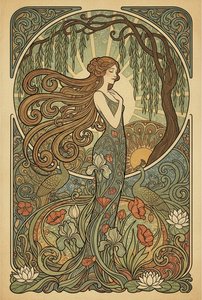
While the Futurists embraced the roar of the engine, another movement sought inspiration in the quiet, rhythmic pulse of the natural world. Art Nouveau emerged at the turn of the century as a sophisticated reaction against the rigid academicism of the nineteenth century. It was an international style that sought to unify fine art with the decorative arts, finding beauty in the sinuous curves of plants, flowers, and organic growth.
The hallmark of this era is the whiplash line—a dynamic, asymmetrical curve that suggests a sense of living movement. This aesthetic was not confined to canvas; it flowed into architecture, furniture, and jewelry, creating a cohesive environment of elegance. By utilizing modern materials like iron and glass to mimic organic forms, Art Nouveau designers created spaces that felt alive. The movement’s emphasis on fluidity and the rejection of harsh angles allowed for a sense of dynamism that was both graceful and revolutionary, proving that motion could be found in the gentle unfurling of a petal just as easily as in the flight of a machine.
Geometric Velocity: Deconstructing Motion in Cubo-Futurism and Modern Abstraction
 Cubo-Futurism: The Dynamic Fusion of Geometry and Speed in Modern Art
The Genesis of Motion: Deconstructing the Cubo-Futurist Synthesis Cubo-Futurism: The Sophisticated Intersection of Geometric Precision and Kinetic Energy in Modern Art The Genesis of Motion: Deconstructing the Cubo-Futurist Synthesis To understand th...
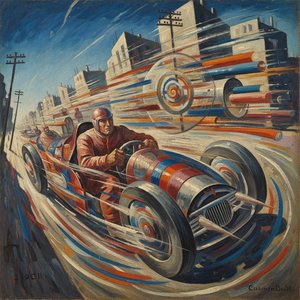
The search for motion reached a complex peak with the emergence of Cubo-Futurism, a sophisticated intersection where the structural rigor of French Analytical Cubism met the Italian obsession with speed. This movement represented a seismic shift in perception, deconstructing the singular viewpoint in favor of a multi-faceted, fragmented reality. It was a visual language designed to record an object's movement through space and time simultaneously.
By synthesizing geometric precision with kinetic energy, Cubo-Futurist artists were able to portray the very essence of modern life: the sensation of acceleration. The stillness of geometry was intentionally disrupted by the vibration of progress. This era taught us that motion could be achieved through the strategic arrangement of planes and edges, creating a sensory experience where the viewer’s eye is forced to dance across a fractured landscape. It was here that the line became truly multidimensional, serving as both a boundary for form and a vector for energy.
The Silent Language of Minimalism: Achieving Depth Through Line and Space
 Mastering Minimalist Elegance: An Expert Decorator’s Guide to Transforming Spaces with Modern Line Art
The Power of Simplicity: Why Modern Line Art is the Ultimate Design Essential Wall drawing #338: Two part drawing. The wall is divided vertically into two parts. Each part is divided horizontally and vertically into four equal parts. 1st part: Lines ...
In the wake of modern abstraction, the power of the line underwent another profound transformation through Minimalism. If the Futurists used lines to create noise and energy, the Minimalists used them to create silence and contemplation. This approach celebrates the essential, stripping away the superfluous to reveal the skeletal beauty of a concept. In the works of masters like Sol LeWitt, we see how a single, deliberate stroke or a geometric grid can define an entire atmosphere.
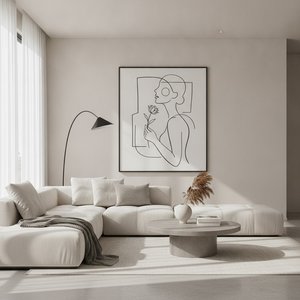
Minimalist line art acts as a visual palate cleanser, offering a sense of intellectual rigor and understated luxury. It does not demand attention through loud colors or complex narratives; instead, it invites the viewer into a meditative dialogue with space itself. By manipulating line weight and contour, artists can shape the very atmosphere of a room, providing a sophisticated anchor that transcends seasonal fads. In this way, the line remains our most potent tool for defining the relationship between the artwork, the viewer, and the void.
Bringing History Home: Preserving the Energy of Masterpieces through Hand-Painted Reproductions
To stand before a masterpiece is to experience a moment of profound connection with history. However, the true essence of these works—the tactile depth of the impasto, the subtle vibration of color, and the visible energy of the artist's brushstroke—is often lost in mass-produced prints or digital posters. At OriginalUniqueArt.com, we believe that the power of motion and the soul of art should be accessible to every collector.
Our studio specializes in creating museum-quality, hand-painted oil reproductions that honor the academic excellence of the original masters. Each piece is a labor of passion, meticulously crafted by artists holding degrees from prestigious Fine Arts academies. Unlike flat, computer-printed images, our 100% cotton canvas reproductions feature the physical texture and deeper tonal range that only real oil paint can provide. Whether you wish to transform your space with the electric energy of a Balla or seek a custom "period shift" to turn a personal memory into a Rembrandt-style masterpiece, our Project Coordinators guide you through a seamless process of creation.
We invite you to explore our collection and discover how the dynamic lines of history can breathe new life into your contemporary surroundings. From large-scale murals for grand halls to bespoke multi-panel sets for modern architecture, we bring the museum experience directly to your home. Experience the enduring power of the master's touch.