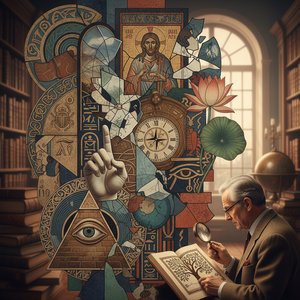
Cultural heritage is the tangible and intangible legacy of a group or society that is inherited from past generations. Not all legacies of past generations are "heritage". Rather, heritage is a product of selection by society. Cultural heritage inclu...
Heritage is rarely a random collection of old things; it is a deliberate selection made by societies to define who they are. We often think of heritage as the heavy, physical remnants of the past—the stone walls of a castle or the weight of an ancient bronze statue. This is what we call tangible culture. It provides a physical anchor for our shared memory. Yet, a group's identity is equally shaped by what we cannot touch: the songs, the oral histories, and the specific ways a community celebrates a harvest or mourns a loss. These intangible elements are the breath within the bones of history.
In the past, the preservation of these legacies was often an accidental byproduct of survival. A community kept its traditions because they were necessary for social cohesion. Today, we recognize that when a language fades or a ritual is forgotten, a piece of human experience vanishes forever. This realization has led to international efforts, such as those by UNESCO, to protect not just the monuments we can visit, and the archives we can read, but the very customs that define our humanity.
Visual Chronicles: How Painting Records Human Existence
The Enduring Legacy: How Paintings Preserve Cultural Memory From the ochre handprints pressed onto cave walls millennia ago to the vibrant canvases of contemporary artists, paintings have served as humanity’s most enduring visual chronicle. They are ...
Before the written word could formalize the complexities of human thought, our ancestors were already etching their existence into the earth. From the primal ochre handprints pressed onto cave walls millennia ago to the sophisticated oil landscapes of the nineteenth century, paintings have functioned as humanity’s most enduring visual chronicles. A canvas does more than depict a scene; it captures the atmosphere of an age. When we look at a landscape, we are seeing how a specific society perceived its relationship with nature, power, and divinity.
Consider the profound intimacy found in the frescoes unearthed from Pompeii. These works offer frozen glimpses into Roman daily life that written accounts often fail to convey. They provide a sensory connection to the past that remains palpable through every textured layer of pigment. This ability to transcend language barriers is why we still look to the Renaissance masters. When observing the Mona Lisa, one does not merely see a portrait; one encounters an attempt to capture the intellect and inner life of a subject. Through the meticulous application of color and form, artists document the rise and fall of empires and the shifting tides of religious devotion, ensuring that the pulse of history remains accessible to those who follow.
Architectural Anchors: The Built Environment as a Historical Vessel
A Tapestry of Time: Exploring England’s Heritage Through Its Historic Sites Step into a realm where centuries whisper from weathered stones and vibrant tapestries unfold across landscapes steeped in legend. English Heritage isn't merely a collection ...
The structures we inhabit act as the physical stage upon which history unfolds. Architecture is an immovable form of heritage, representing the technological and aesthetic ambitions of an era. A building is never just bricks and mortar; it is a repository of the social values that birtund its construction. From the imposing ramparts of Dover Castle to the industrial bones of a fish dock in Grimsby, these sites hold the weight of the stories they have witnessed.
This sense of stewardship has long been a matter of public interest. In the nineteenth century, France established the Commission des monuments historiques to inventory and protect its architectural treasures, recognizing that certain structures held value far beyond private ownership. Similarly, in the United Kingdom, organizations like English Heritage manage a portfolio that spans from prehistoric Stonehenge to Roman forts like Hadrian’s Wall. These sites are not static; they are active participants in our modern identity, providing a sense of continuity in an ever-changing landscape. By preserving the built environment, we ensure that the physical context of our ancestors remains a tangible part of our present.
The Art of Care: Evolution in the Science of Conservation
The conservation and restoration of cultural property focuses on protection and care of cultural property (tangible cultural heritage), including artworks, architecture, archaeology, and museum collections. Conservation activities include preventive ...
The act of keeping property in its original condition for as long as possible is a discipline that sits at the intersection of art and science. The history of conservation is a transition from simple mending to complex chemical analysis. In the sixteenth century, the restoration of the Sistine Chapel frescoes is often cited as an early European tradition of care. At that time, artists were typically called upon to repair damaged works. However, by the nineteenth century, the field began to intertwine with scientific inquiry.
As chemists like Friedrich Rathgen in Berlin and researchers at the British Museum began to study the environmental effects on pigments and materials, a professional framework emerged. Modern conservation ethics now prioritize minimal intervention and reversibility. This means that any treatment applied to an artwork should be documented and, if possible, undone by future generations using even better technology. Whether it is the Netherlands Institute of Cultural Heritage researching binding media or specialists using 3D scanning to analyze Graeco-Roman funerary masks, the goal remains the same: to protect the material integrity of our shared past through rigorous, evidence-based stewardship.
Encoded Meanings: Iconography as a Language of the Past
To truly understand an artwork, one must learn to read its symbols. This is the purpose of iconography, a discipline derived from the Greek words for "image" and "to write." It is the study of the identification and interpretation of the subject matter within a work. An image is rarely just a literal representation; it is often encoded with religious, political, or social meaning. Scholars like Erwin Panofsky developed methods to decode these visual languages, allowing us to move from simply seeing a figure to understanding its deeper significance.
This symbolic language was once a shared vocabulary across entire civilizations. In the 1593 publication of Cesare Ripa's Iconologia, readers could find guides to interpreting complex emblems. This tradition allowed artists to communicate profound truths through recognizable motifs. Even in more modern contexts, such as the way we recognize genres through recurring visual cues, the power of iconography remains. By studying these symbols, we bridge the gap between the artist's intent and our own contemporary understanding, turning a silent image into a readable text.
Living Legacies: Protecting Intangible Traditions and Rituals
The Enduring Legacy of the Troupe Korean Pongsan Mask Dance Drama Preservation Society The Troupe Korean Pongsan Mask Dance Drama Preservation Society represents more than just a collective of performers; it embodies a centuries-old tradition, a vibr...
While stones and canvases are fragile, they are not the only things at risk. The most delicate heritage is that which lives only within the human mind and body. The Troupe Korean Pongsan Mask Dance Drama Preservation Society is a remarkable example of this struggle. Originating from the Joseon Dynasty, this art form—a blend of ritual, satire, and storytelling—faced near extinction due to modernization and the devastation of the Korean War. Through the dedicated efforts of performers who relocated and rebuilt their traditions, the dance was saved and eventually recognized as a national treasure.
Protecting these living legacies requires more than just museum displays; it requires active community engagement. It involves supporting the artisans, dancers, and storytellers who embody these skills. When we protect an intangible tradition, we are not merely preserving a performance; we of are safeguarding a way of being. This effort is vital in an era of rapid globalization, ensuring that the diverse threads of human culture do not become a single, uniform fabric.
Digital Continuity: Preserving History through New Technologies
Experience the high-frequency Glitch Pop energy of Amélie Caron’s Chromatic Fragments in a Void of Infinite Digital Stardust and Geometric Chaos, a singular OriginalUniqueArt masterpiece inviting you to own digital transcendence.
As our lives increasingly move into the digital realm, the definition of heritage is expanding once again to include "digital heritage." This encompasses everything from digitized historical documents and databases to software and images that are "born digital." The challenge of the modern age is ensuring that these computer-based materials remain accessible long after the hardware used to create them has become obsolete.
New technologies are also providing unprecedented tools for the physical preservation of the past. High-resolution photogrammetry and 3D scanning now allow us to create perfect digital twins of ancient artifacts, such as Graeco-Roman masks, ensuring that even if the original is lost to time or disaster, its form remains. This intersection of technology and tradition allows us to build a more resilient archive for the future. At OriginalUniqueArt.com, we celebrate this continuity by offering high-quality reproductions that bring these historical narratives into the modern home, allowing the stories of the past to remain a visible part of our contemporary lives.
Discover how AI-driven alchemy transforms personal snapshots into breathtaking fine art. Explore the luxury of Glitch Pop aesthetics and bespoke hand-painted oil reproductions that turn digital memories into timeless, museum-quality masterpieces for your curated collection.
Explore how masterpiece artworks serve as eternal vessels of global heritage. Discover the profound connection between classical art history, cultural preservation, and the enduring legacy of the Old Masters in our deep dive into humanity's most significant visual treasures.
Unlock the hidden meanings within masterpieces! Explore art symbolism with OriginalUniqueArt.com's expert guide. Understand iconography, historical context & elevate your collecting knowledge. Discover insights for discerning collectors.
Explore how masterpiece paintings serve as the ultimate visual chronicle of human history. From ancient murals to modern expressions, discover the profound ways art encodes cultural memory, identity, and the enduring spirit of civilizations through every brushstroke.

 Cultural heritage
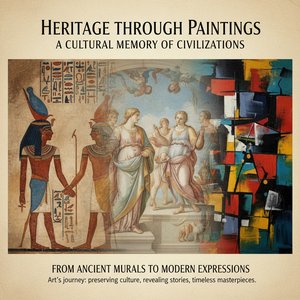 Heritage Through Paintings: A Cultural Memory of Civilizations – From Ancient Murals to Modern Expressions
 English Heritage
 Conservation and restoration of cultural property
 Troupe Korean Pongsan Mask Dance Drama Preservation Society
 Chromatic Fragments in a Void of Infinite Digital Stardust and Geometric Chaos