Breaking the Image: A Definitive Guide to Cubist Fragmentation and the Revolution of Modern Art
Explore the revolutionary world of Cubism. From Picasso's analytical deconstruction to Braque's geometric forms, master the history of fragmentation and modern art through this expert guide for students and collectors.
The Genesis of Fragmentation: Breaking the Single Perspective For centuries, the Western tradition of painting was anchored by a singular, unwavering truth: the fixed viewpoint. From the Renaissance masters to the Impressionists, art sought to captur...
For centuries, the Western tradition of painting was anchored by a singular, unwavering truth: the fixed viewpoint. From the Renaissance masters to the Impressionists, art sought to capture a moment through a window-like perspective, where depth and distance were meticulously orchestrated to mimic human vision. This established a sense of stability, a reliable way for the viewer to inhabit a space that felt continuous and predictable. However, at the dawn of the twentieth century, a seismic shift occurred that would forever shatter this illusion. It was not merely a change in aesthetic preference, but a fundamental revolution in how we perceive reality itself.
The birth of fragmentation marked the end of the passive observer and the beginning of an active, intellectual engagement with the canvas. As the world grew increasingly complex through technological advancement and shifting social structures, the old ways of seeing—the static, singular gaze—began to feel insufficient. The artists who would become the architects of Cubism realized that truth is rarely found in a single, frozen moment. Instead, they sought to move beyond the superficiality of what the eye sees to capture what the mind knows. This departure from the traditional window-like view challenged the very concept of a correct perspective, suggesting instead that reality is multifaceted, temporal, and inherently fragmented.
Analytical Cubism: The Rigorous Deconstruction of Form and Light
Deconstructing Perception: An Exploration of Braque’s *Still Life II* Georges Braque's Still Life II is not merely a depiction of objects; it’s an intellectual and visual dismantling of how we perceive reality. Created during the fervent years of Cub...
To understand the true radical nature of this movement, one must enter the disciplined realm of Analytical Cubism. This phase, primarily developed by Pablo Picasso and Georges Braque between 1909 and 1912, was characterized by a rigorous process of dissection. The term "analytical" is not incidental; it describes the meticulous way in which artists broke down their subjects into their constituent parts. They stripped away the distractions of vibrant color and sentiment to focus on the underlying architecture of form. By reducing complex organic shapes into cylinders, spheres, and cones, they created a visual vocabulary that prioritized structure over surface decoration.
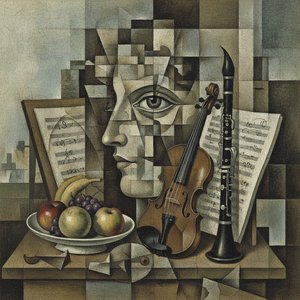
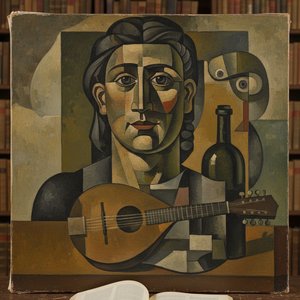
In works such as Picasso’s Portrait of Felipe IV or Braque’s Still Life II, we see this intellectual rigor in action. The artists utilized a muted palette—often dominated by browns, grays, and ochres—to ensure that color did not overwhelm the structural exploration. They replaced smooth curves with sharp edges and interlocking planes, creating a sense of spatial tension. This technique forces the viewer to participate in the creation of the image, as they must mentally piece together the fragmented geometry to recognize the subject. It is an exercise in perception where the canvas no longer mimics a mirror of nature but becomes an independent language of form and structure.
Beyond the Canvas: The Theoretical Foundations of Picasso and Braque
Jean Dominique Antony Metzinger: A Pioneer of Cubism Born: Nantes, France (1883) Died: 1956 Jean Dominique Antony Metzinger was a pivotal figure in the development of 20th-century art. He was not only a significant French painter but also a theorist,...
The movement was far more than a collection of stylistic experiments; it was supported by a profound theoretical framework that redefined the relationship between the artist, the subject, and the viewer. While Picasso and Braque provided the visual impetus, figures like Jean Dominique Antony Metzinger played a crucial role in shaping and popularizing the movement's intellectual depth. Metzinger, a painter, theorist, and critic, introduced groundbreaking ideas such as the "faceting of form." In his seminal work, Note sur la peinture (1910), he explored how an object could be understood through successive and subjective experiences within space and time, rather than from a single static angle.
This theoretical underpinning suggested that an artist could represent different viewpoints simultaneously within the same picture. This was a radical departure from the tradition of linear perspective. By bringing various views of a subject together, Cubism allowed for a greater representation of context and movement. It embraced the idea that our understanding of an object is a cumulative process—a collection of memories, angles, and perspectives gathered as we move around it. This intellectualized approach to art transformed the canvas from a site of mere representation into a site of cognitive reconstruction, where the subject is analyzed, broken up, and reassembled in an abstract form.
Geometric Echoes: The Global Expansion from Paris to Czech Cubism
Czech Cubism (referred to more generally as Cubo-Expressionism) was an avant-garde art movement of Czech proponents of Cubism, active mostly in Prague from 1912 to 1914. Prague was perhaps the most important center for Cubism outside Paris before the...
While the heart of Cubism beat most vibrantly in the studios of Paris, its revolutionary spirit quickly transcended French borders, finding unique expressions in other cultures. One of the most fascinating developments was Czech Cubism, a movement active primarily in Prague between 1912 and 1914. Often referred to as Cubo-Expressionism, this avant-garde group of artists, architects, and designers sought to extract the core components of Picasso and Braque’s work and apply them to their own cultural landscape.
The Czech proponents distinguished their work through a unique construction of sharp points, slicing planes, and crystalline shapes. Unlike the more analytical approach found in France, Czech Cubism often integrated these geometric principles into architecture and applied arts, creating a highly decorative yet structurally radical aesthetic. This movement demonstrated that the language of fragmentation was universal; it could be adapted to celebrate national identity and modern architectural innovation, proving that the deconstruction of the image was not just a Parisian phenomenon but a global shift in the consciousness of modernism.
The Legacy of Fragmentation: How Cubism Redefined Modern Visual Language
--- title: Cubism | Tate author: Clarrie Wallis url: https://www.tate.org.uk/art/art-terms/c/cubism hostname: tate.org.uk description: Tate glossary definition for cubism: A revolutionary new approach to representing reality in art invented by artist...
The impact of Cubism cannot be overstated; it remains one of the most influential styles of the twentieth century. By breaking the single perspective, it opened up almost infinite new possibilities for the treatment of visual reality. The movement served as the essential starting point for a multitude of later abstract styles, including Constructivism and Neo-Plasticism. The techniques of fragmentation, geometric simplification, and the rejection of traditional depth paved the way for the total abstraction that would dominate much of the twentieth-century art world.
Today, we see the echoes of Cubist deconstruction in everything from graphic design to modern architecture. The movement taught us that truth is not found in a single, unmoving glance, but in the complex interplay of multiple perspectives. It challenged us to look closer, to engage more deeply, and to find beauty in the fractured and the reconstructed. As we continue to navigate an increasingly fragmented modern world, the lessons of Cubism—the courage to break the image to find a deeper reality—remain as relevant as ever.
For those seeking to bring the profound depth of these historical movements into their own collections, OriginalUniqueArt.com offers unparalleled access to museum-quality reproductions. Whether you are drawn to the rigorous geometry of Analytical Cubism or the vibrant energy of the Old Masters, our master artists hand-paint each piece on 100% cotton canvas, ensuring that the visible brushstrokes and tonal richness of the original era are preserved for generations. From custom commissions that transform your personal photos into Cubist masterpieces to large-scale murals for architectural spaces, we invite you to experience the enduring power of art history.
Embark on a sophisticated journey through Analytical Cubist masterpieces. Our expert guide explores how Picasso and Braque deconstructed reality, bridging the legacy of Cézanne with a new era of geometric vision. A refined exploration for the true art enthusiast.
Explore the revolution of Cubism. From Picasso’s geometric deconstructions to modern AI-driven remixes, discover how breaking reality creates bold, high-impact art for contemporary spaces. Elevate your decor with hand-painted masterpieces and custom abstract transformations.
Explore the revolutionary world of Cubism with OriginalUniqueArt. Discover Picasso & Braque's groundbreaking techniques, its philosophical roots, and lasting impact on modern art. Expert insights for collectors.
Explore the life & work of Jean Metzinger, a pivotal Cubist painter and theorist. Discover his innovations in proto-Cubism, 'Du Cubisme,' and Crystal Cubism – a journey through modern art's evolution.

 Unlocking Analytical Cubism: A Collector's Guide to the Revolution of Fragmented Perspective
 Still Life II
 Jean Dominique Antony Metzinger