
The Post-Napoleonic Pivot: Finding Sanctuary in the Private Sphere
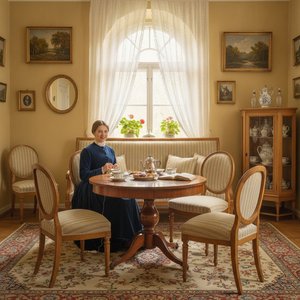 Biedermeier Style: The Art of Comfort, Elegance, and Middle-Class Sophistication in 19th-Century Europe
The Post-Napoleonic Pivot: Political Restraint and the Rise of the Private Sphere Biedermeier Style: The Elegant Art of Comfort, Simplicity, and Bourgeois Sophistication The Dawn of Biedermeier: Post-Napoleonic Europe and the Rise of the Middle Class...
To understand the soul of the Biedermeier era, one must first listen to the echoes of a continent recovering from the thunder of cannon fire. As the dust settled over the German Confederation in 1815, following the tumultuous conclusion of the Napoleonic Wars, a profound social transformation began to take root. The grand, sweeping gestures of imperial conquest and the intimidating, gilded opulence of the preceding Empire style suddenly felt heavy, perhaps even alien, to a populace seeking stability. In the wake of the Congress of Vienna, as the political landscape became increasingly restricted by conservative systems and the watchful eyes of figures like Klemens von Metternich, a peculiar phenomenon occurred: the gaze of the citizenry turned inward.
With public expression often met with censorship and surveillance, the home was reimagined not merely as a residence, but as a sacred sanctuary. This was a period of political restraint that paradoxically fostered an explosion of private creativity. The external world, characterized by shifting borders and rigid hierarchies, was replaced by the internal world of the domestic sphere—a private stage for emotional warmth, family intimacy, and quiet stability. It was within these walls that the true essence of Biedermeier began to breathe, turning away from the monumental and toward the meaningful.
The Soul of Biedermeier: From Satirical Origins to Bourgeois Elegance
 Biedermeier
The Biedermeier period was an era in the art and culture of the German Confederation between 1815 and 1848 during which the middle classes grew in number and artists began producing works appealing to their sensibilities. The period began with the en...
The very name Biedermeier carries a touch of historical irony, a whispered joke from the past that eventually became a celebrated aesthetic. Originally, the term did not emerge from an art academy, but from the pages of popular literature, specifically the Munich magazine Fliegende Blätter. It was a satirical nod to characters like Gottlieb Biedermaier—a fictional, somewhat mediocre poet who embodied the perceived complacency of the middle class. To the critics of the time, "Biedermeier" suggested a certain provincialism, a preoccupation with the small and the unchallenging.
Yet, what began as a caricature of bourgeois simplicity blossomed into a profound cultural movement. As the growing urban middle class gained economic stability through industrialization, they sought an art that reflected their own values: stability, family, and modest prosperity. They did not crave the intimidating grandeur of the aristocracy; instead, they found beauty in the familiar, the local, and the attainable. This shift democratized luxury, allowing the burgeoning bourgeoisie to surround themselves with objects and images that celebrated the joys of everyday existence. What was once mocked as "petty" became recognized as a sophisticated pursuit of harmony and emotional truth.
Aesthetic Principles: The Harmony of Geometric Purity and Functional Grace
The Dawn of Biedermeier: Post-Napoleonic Europe and the Rise of the Middle Class To understand the soul of the Biedermeier era, one must look to the shifting tides of 19th-century Europe following the tumultuous conclusion of the Napoleonic Wars. As ...
The aesthetic language of Biedermeier is a masterclass in the tension between restraint and refinement. It represents a deliberate rejection of the heavy, gilded ornamentation that had long defined European luxury. In its place, the movement embraced a philosophy of clarity, characterized by clean lines, harmonious proportions, and a remarkable geometric purity. There is a rhythmic simplicity to Biedermeier design that anticipates the functionalism of modernism; it celebrates the inherent beauty of the material itself rather than masking it under layers of gold leaf.
In furniture design, this manifested in the use of light-colored woods and polished veneers that allowed the natural grain to become the primary ornament. A Biedermeier chest of drawers or a gracefully curved chair relies on technical sophistication and structural integrity to command attention. This era mastered the art of functional elegance—the idea that an object is most beautiful when it serves its purpose with effortless grace. By stripping away the superfluous, Biedermeier designers created a sense of light and air, fostering environments that felt both orderly and inviting.
The Art of Living: Cultivating Intimacy through Domestic Design
 Biedermeier: Art, Society & Intimacy in Restoration Europe
The Rise of Biedermeier: Political Context & Social Shifts Wikipedia: Biedermeier The Biedermeier period was an era in the art and culture of the German Confederation between 1815 and 1848 during which the middle classes grew in number and artists be...
Beyond the physical objects, Biedermeier was an art of living. It was a movement centered on the cultivation of domestic culture, where the rituals of daily life—the exchange of epistolary correspondence, the gathering around a well-appointed table, the quiet afternoon stroll—were elevated to the status of high art. The interior of a Biedermeier home was designed to facilitate intimacy. Every element, from the placement of a comfortable armchair to the delicate arrangement of a small writing desk, was intended to foster a sense of emotional warmth and connection.
This period saw a blossoming of decorative arts that catered specifically to the needs of the private sphere. The rise of the urban middle class created a new kind of audience—one that valued the tactile and the personal. This era celebrated the attainable beauty found in the small details: the soft glow of candlelight on polished wood, the delicate patterns of textiles, and the quiet presence of cherished family portraits. It was an era where the home became a curated collection of memories and comforts, a place where the soul could find refuge from the turbulent world outside.
Timeless Resonance: Bringing Biedermeier Sophistication to the Modern Home
Though the Biedermeier period reached its conclusion with the revolutions of 1848, its influence remains remarkably contemporary. In our modern era, where we often find ourselves seeking "quiet luxury" and authenticity amidst a sea of digital noise, the principles of Biedermier design offer a soothing blueprint. The movement’s emphasis on material integrity, thoughtful composition, and the rejection of excess resonates deeply with the contemporary desire for sustainable and meaningful interiors.
Integrating elements of this style into a modern home does not require a museum-like reconstruction of the 19th century. Rather, it is about adopting its spirit: seeking out pieces that offer functional clarity, embracing light and natural textures, and prioritizing the creation of spaces that promote emotional well-being. Whether through a single antique Biedermeier accent piece or a modern design inspired by its geometric purity, we can all find inspiration in this historic pursuit of home harmony. It serves as a timeless reminder that true elegance is found not in how much we display, but in the thoughtful way we inhabit our most private sanctuaries.
At OriginalUniqueArt.com, we share this profound love for the emotional depth and historical resonance of the masters. While our hearts beat most vibrantly for the light-drenched landscapes of Monet and the textured souls of Van Gogh, we recognize that all great art movements are threads in the same magnificent tapestry of human expression. We invite you to explore our curated collection of hand-painted oil reproductions, where every brushstroke is a tribute to the enduring power of beauty and the timeless art of living well.


