The Genesis of Art Nouveau: A Rebellion Against Industrial Rigidity
 10 Iconic Masterpieces That Defined the Art Nouveau Movement
Introduction Imagine stepping into the heart of the Belle Époque , a period where the rigid, mechanical geometry of the industrial age began to surrender to the rhythmic, undulating pulse of the natural world. Art Nouveau emerged not merely as a deco...
To understand the soul of Art Nouveau, one must first envision the soot-stained landscape of the late 19th century. As the Industrial Revolution accelerated, the world became increasingly defined by mechanical precision, mass production, and a certain rigid, geometric monotony. This era of academicism and historicism sought to replicate the past through stiff, predictable forms, leaving little room for the spontaneous vitality of the human spirit. Art Nouveau emerged not merely as a new aesthetic preference, and certainly not just a decorative trend, but as a profound cultural rebellion. It was a movement that sought to erase the boundary between fine art and the functional beauty of everyday life, breathing life back into an age of iron and steam.
Emerging at the turn of the 20th century, this "New Art" found its heartbeat in the Belle Époque, a period of unparalleled elegance and optimism. Artists and designers looked toward the organic world to find a visual language capable of expressing movement and dynamism. By rejecting the formal vocabulary of 19th-century European academic art, they embraced asymmetry and the use of modern materials—such as iron, glass, and ceramics—to create unusual, flowing forms that seemed to grow rather than be constructed. This was a period where the boundaries between structure and ornament dissolved into a seamless dance of light and form, marking a pivotal shift in how humanity perceived its relationship with the built environment.
The Language of Nature: Whiplash Curves and Organic Symbolism
 10 Iconic Art Nouveau Masterpieces That Changed Art Forever
Introduction To step into the world of Art Nouveau is to surrender to the rhythmic pulse of nature itself. It is an era where the rigid lines of the industrial age dissolved into a breathtaking dance of whiplash curves, organic silhouettes, and the i...
At the very core of the Art Nouveau aesthetic lies an unyielding passion for organic grace. The movement’s most recognizable hallmark is the whiplash line—a sinuous, undulating curve that mimics the rhythmic pulse of nature itself. Imagine walking through a twilight garden where every vine, petal, and insect possesses a life of its own; this was the inspiration behind the movement's characteristic dynamism. These lines were not merely decorative flourishes but were deeply symbolic, representing the interconnectedness of all living things and the fluid energy of the natural world.
This fascination with nature extended far beyond simple floral motifs. The movement drew strength from the delicate wings of dragonflies, the twisting stems of lilies, and the flowing tresses of the feminine form. In the hands of master designers, these biological inspirations were stylized into a sophisticated visual shorthand. Through the use of asymmetrical compositions and a sense of perpetual motion, Art Nouveau artists achieved a Gesamtkunstwerk—a total work of art—where every element, from a grand architectural facade to a small piece of jewelry, whispered the same story of organic harmony and spiritual uplift.
Alphonse Mucha and the Mastery of Decorative Storytelling
 Alphonse Mucha: A Comprehensive Exploration of Art Nouveau's Master of Decorative Symbolism
The Genesis of a Style: Mucha's Early Life and Influences Wikipedia: Alphonse Mucha Alfons Maria Mucha (Czech: [ˈalfons ˈmuxa] ; 24 July 1860 – 14 July 1939), known internationally as Alphonse Mucha, was a Czech painter, illustrator, and graphic arti...
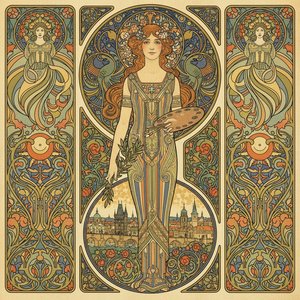
No name is more synonymous with the sinuous elegance of Art Nouveau than Alphonse Mucha. Born in the modest Moravian town of Ivančice, Mucha’s journey from a student at the Academy of Fine Arts in Prague to the heights of Parisian fame is a testament to his singular vision. While his early training was rooted in traditional academic styles, it was his move to Paris in 1887 that allowed him to forge a path that would eventually define an era. Mucha possessed a rare ability to blend decorative elegance with profound symbolism, turning even the most commercial commissions into works of high art.
His breakthrough came through a legendary collaboration with the celebrated actress Sarah Bernhardt. The poster for Gismonda (1894) became an instant sensation, introducing "le style Mucha" to the masses. His work is characterized by idealized female figures, often draped in flowing, ethereal robes and surrounded by lush, botanical elements. Whether through his evocative portraits like Study for Painting or his vibrant lithographs such as Flower Litho, Mucha utilized a rich palette of reds, golds, and deep blues to create an atmosphere of refined luxury. His mastery lay in his ability to use the poster as a canvas for visual poetry, where every line served a narrative purpose, capturing the very essence of the Belle Époque’s romantic spirit.
Architectural Elegance: From Brussels' Ironwork to Paris' Métro
 Art Nouveau in Brussels
The Art Nouveau movement of architecture and design first appeared in Brussels, Belgium, in the early 1890s, in the architecture and interior design of houses designed by Paul Hankar, Henry van de Velde, and especially Victor Horta, whose Hôtel Tasse...
While Mucha mastered the graphic arts, architects were busy reshaping the urban landscape. The movement first found its architectural footing in Brussels during the early 1890s, led by visionaries such as Victor Horta. His Hôtel Tassel stands as a monumental achievement, showcasing how modern materials like iron and glass could be manipulated to create interiors that felt alive with organic growth. These structures rejected the heavy, historical revivals of the past in favor of light-filled, open spaces where the architecture itself seemed to breathe.
This architectural revolution soon swept through Paris, reaching its zenith during the 1900 Paris International Exposition. The streets of the city were transformed by the iconic Métro entrances designed by Hector Guimard. These structures, with their sinuous, plant-like ironwork, acted as portals between the industrial city and the enchanted world of Art Nouveau. This era also saw the rise of magnificent private residences, such as the Casa Lis in Salamanca, where the boundaries between structure and ornament were completely erased through the use of mesmerizing stained glass and intricate detailing, proving that the movement's elegance was as much about the spaces we inhabit as the objects we hold.
The Total Work of Art: Integrating Fine Art into Everyday Life
 Art Nouveau
Art Nouveau ( AR(T) noo-VOH; French: [aʁ nuvo] ; lit. 'New Art') is an international style of art, architecture, and applied art, especially the decorative arts. It was often inspired by natural forms such as the sinuous curves of plants and flowers....
One of the most radical objectives of Art Nouveau was to break down the traditional distinction between the "fine arts"—painting and sculpture—and the "applied arts." The movement sought a total aesthetic takeover, where the beauty found in a museum could be found in a chair, a lamp, or a piece of glassware. This philosophy demanded that every aspect of the domestic environment be treated with the same reverence as a canvas. It was an era of exquisite craftsmanship, where the decorative arts—including textiles, ceramics, and metalwork—were elevated to the status of high art.
This integration created a cohesive lifestyle of unparalleled sophistication. For the collector, this meant that a room could be curated as a single, unified masterpiece. The use of modern materials like glass and iron allowed for new forms of light manipulation, turning everyday objects into ethereal sculptures. This pursuit of beauty in the mundane was a direct response to the perceived ugliness of mass-produced industrial goods, aiming instead to surround the individual with an environment that was both aesthetically pleasing and spiritually uplifting.
Preserving the Belle Époque: Collecting Art Nouveau Masterpieces
 Museo Art Nouveau y Art Déco - Casa Lis
A Jewel of Modernism: The Enchanted World of Casa Lis Nestled within the ancient, sun-drenched city walls of Salamanca, Spain, the Museo Art Nouveau y Art Déco – Casa Lis stands as a breathtaking testament to an era of unparalleled elegance. To appro...
Today, the legacy of Art Nouveau remains a profound source of inspiration for art enthusiasts and collectors alike. To possess a piece of this era is to hold a fragment of a time when humanity dared to dream of a world harmonized with nature. While original architectural marvels and museum-grade artifacts are rare, the spirit of the movement lives on through high-quality reproductions that capture the tactile depth and vibrant energy of the originals.
For those seeking to bring this historical elegance into a modern space, there is immense value in selecting works that honor the original techniques. At OriginalUniqueArt.com, we specialize in creating museum-quality oil reproductions that respect the soul of the movement. Unlike flat prints, our hand-painted oils on cotton canvas feature visible brushstrokes and a deep tonal range that mirrors the texture of Mucha’s lithographs or the architectural grandeur of the Belle Époque. Whether you are drawn to the flowing lines of a classic poster or wish to commission a custom piece that "remixes" history, we provide a bridge to this golden age, ensuring that the elegance of Art Nouveau continues to grace the walls of contemporary homes for generations to come.