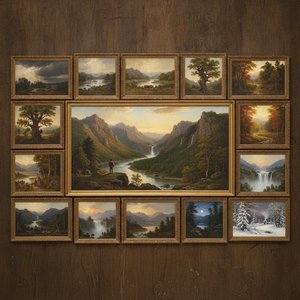
Wild Frontiers: The Sublime Majesty of the American West through Hudson River School Masterpieces
Explore the sublime beauty of the American West through the lens of Hudson River School masters. Discover the history, artistry, and legacy of iconic landscapes by Bierstadt and Cole, and find museum-quality, hand-painted oil reproductions for your collection.
Introduction To step into the world of the Hudson River School is to witness a profound romance between the human spirit and the untamed American wilderness. Imagine standing on the edge of a precipice in the mid-19th century, where the air is thick ...
To step into the world of the Hudson River School is to witness a profound romance between the human spirit and the untamed majesty of the American wilderness. Emerging in the 1820s, this was not merely a collection of painters, but a collective attempt to capture the very soul of a burgeoning nation through the lens of the sublime. At its heart, the movement sought something far deeper than mere scenery; these visionary artists looked toward the rugged landscapes of the Hudson River Valley and beyond, seeking the divine within the earth. In an era where the Industrial Revolution began to reshape the world with iron and steam, these masters turned their brushes toward the untouched, finding a spiritual sanctuary in the grandeur of nature.
The aesthetic vision was heavily influenced by Romanticism, an intellectual movement that emphasized emotion, intuition, and the awe- perhaps even terrifying—power of the natural world. Through meticulous detail and an almost religious devotion to light, artists like Thomas Cole transformed landscapes into epic narratives of discovery and national identity. The air in these paintings feels thick with the scent of pine, and the golden light of a setting sun pierces through ancient canopies to reveal a landscape that feels both primordial and sacred. For the modern viewer, these works serve as enduring reminders of our connection to the earth, offering a poignant stillness that contrasts sharply with our contemporary era of digital abstraction and urban density.
Manifest Destiny on Canvas: Art as an Allegory of American Expansion
American Progress is an 1872 painting by John Gast, a Prussian-born painter, printer, and lithographer who lived and worked during the 1870s in Brooklyn, New York. American Progress, an allegory of manifest destiny, was widely disseminated in chromol...
As the United States pushed westward, art became a powerful tool for articulating the concept of Manifest Destiny—the belief that the nation was destined to expand across the continent. This period of massive migration and settlement was captured with both grandeur and gravity. Perhaps no work embodies this complex historical narrative more vividly than John Gast’s 1872 masterpiece, American Progress. In this allegorical painting, we see Columbia, the female personification of the United States, moving from the settled East toward the sparsely populated West. She carries a schoolbook and lays telegraph wires, symbolizing the arrival of civilization, while the darkness of the untamed frontier retreats before her advancing light.
However, this expansion was not without its shadows. The movement’s canvases often depicted the tension between progress and the vanishing wilderness. In Gast's work, as the light moves West, we see the displacement of indigenous peoples and the retreat of the American bison into the dark, looming clouds of the distant mountains. These paintings were more than just landscapes; they were declarations of national identity that documented a period of rapid expansion and evolving cultural consciousness. They provided a visual language for a nation defining itself, capturing the movement of settlers via stagecoach, horseback, and steam train as they traversed a landscape that felt both infinite and destined for transformation.
Masters of Light and Landscape: From Thomas Cole to Albert Bierstadt
A Pastoral Masterpiece Immerse yourself in the tranquil beauty of this captivating landscape painting by Albert Bierstadt. Created in 1855, this artwork invites viewers into a serene rural scene where nature's splendor takes center stage. The composi...
The lineage of the Hudson River School is a tapestry of mentorship and technical evolution. The movement’s foundation was laid by Thomas Cole, whose masterful oil paintings established the template for romanticizing American nature and history. His influence was profound, shaping the way subsequent generations perceived the landscape as a site of spiritual encounter. Following in his footsteps, artists like Henry Ary brought an acute eye for detail and a mastery of human dignity to their work, a skill honed during their early years in portraiture. Ary’s transition from the precision of the human face to the atmospheric perspective of the Catskill region allowed light to dance across his vistas, capturing the fleeting essence of mist and shadow with remarkable sensitivity.
As the movement progressed into its second generation, the scope of the subject matter expanded significantly. While early works focused on the Hudson River Valley, later artists turned their gaze toward the far reaches of the continent. Albert Bierstadt stands as a titan of this era, particularly known for his ability to render the breathtaking scale of the Rocky Mountains. In works such as Rustic Mill, Bierstadt demonstrates a masterful technique that exemplifies the school's hallmark: meticulous attention to detail paired with a romantic portrayal of nature. His use of a rich, earthy palette—deep greens, warm browns, and soft blues—creates a harmonious blend that is both soothing and visually striking, inviting the viewer to lose themselves in the tranquil beauty of a pastoral scene.
The Romantic Wilderness: Capturing the Untamed Beauty of the American West
The painting River Landscape in Summer by William Mason Brown is a beautiful representation of a serene landscape, created in 1856. This oil on canvas piece is currently located at the Chrysler Museum of Art in the United States. The painting feature...
The true magic of these masterpieces lies in their ability to evoke the sublime—that specific emotional state where awe meets a sense of overwhelming scale. To view a landscape by Jesse Talbot or William Mason Brown is to experience the vastness of a world that felt, at the time, truly infinite. In Brown’s River Landscape in Summer, we see the serenity of a flowing river and the strength of ancient trees, providing a sense of shade and tranquility that masks the immense, untamed mountains looming in the background. These artists did not just document the appearance of the wilderness; they sought to capture its very soul.
This pursuit of the sublime required an extraordinary command of light and texture. The layering of oil paints allowed for a luminous quality, where sunlight could appear to dapple through ancient trees or rise from a pristine river in a misty haze. This technique is what makes a high-quality reproduction so vital for the modern collector; the visible brushstrokes and deeper tonal range found in a hand-painted oil on cotton canvas allow the viewer to feel the physical presence of the artist's hand. When we look at these works, we are not just looking at scenery; we are participating in a visual experience of the American frontier, where every sunbeam and every shadow tells a story of discovery and reverence.
Preserving the Frontier: The Enduring Legacy of 19th-Century American Landscapes
The frontier myth or myth of the West is one of the influential myths in American culture. The frontier is the concept of a place that exists at the edge of a civilization, particularly during a period of expansion. The American frontier occurred thr...
Today, the legacy of the Hudson River School continues to resonate within our cultural consciousness. In an increasingly urbanized world, these paintings offer a powerful reminder of the natural world’s enduring beauty and its inherent fragility. They serve as a historical archive of a landscape that has since been irrevocally changed by industrialization and settlement, preserving a vision of an unspoiled Eden that continues to inspire conservation efforts and a sense of national pride.
For those who wish to bring this piece of history into their own homes, OriginalUniqueArt.com offers the opportunity to own museum-quality reproductions that honor the academic excellence of these masters. Our artists, holding degrees from prestigious Fine Arts academies, specialize in recreating the tactile depth and emotional weight of these original works. Unlike mere prints, our handmade oil reproductions feature the physical texture and impasto brushstrokes that define the Hudson River School style. Whether you are a history lover seeking to connect with the past or an interior designer looking to add architectural grandeur through large-format canvas wraps, we provide a bridge to this golden era of American art, ensuring that the majesty of the wild frontier remains a living part of our modern world.
Delve into the breathtaking world of the Hudson River School. Our expert guide explores how 19th-century masters captured the sublime majesty of the American wilderness through Romanticism and unparalleled landscape artistry. A must-read for fine art enthusiasts.
Explore the profound beauty of American Romanticism. Discover how the Hudson River School captured the sublime wilderness through masterworks of light, emotion, and national identity. Learn about iconic artists like Thomas Cole and Kensett in this expert art-history guide.
Journey through the breathtaking landscapes of the Hudson River School. From Thomas Cole to Albert Bierstadt, explore 10 iconic masterpieces that defined American Romanticism. Find museum-quality art reproductions and decor inspiration at OriginalUniqueArt.com. Explore the full collection online.

 American Progress
 Rustic Mill
 River Landscape in Summer
 Frontier myth