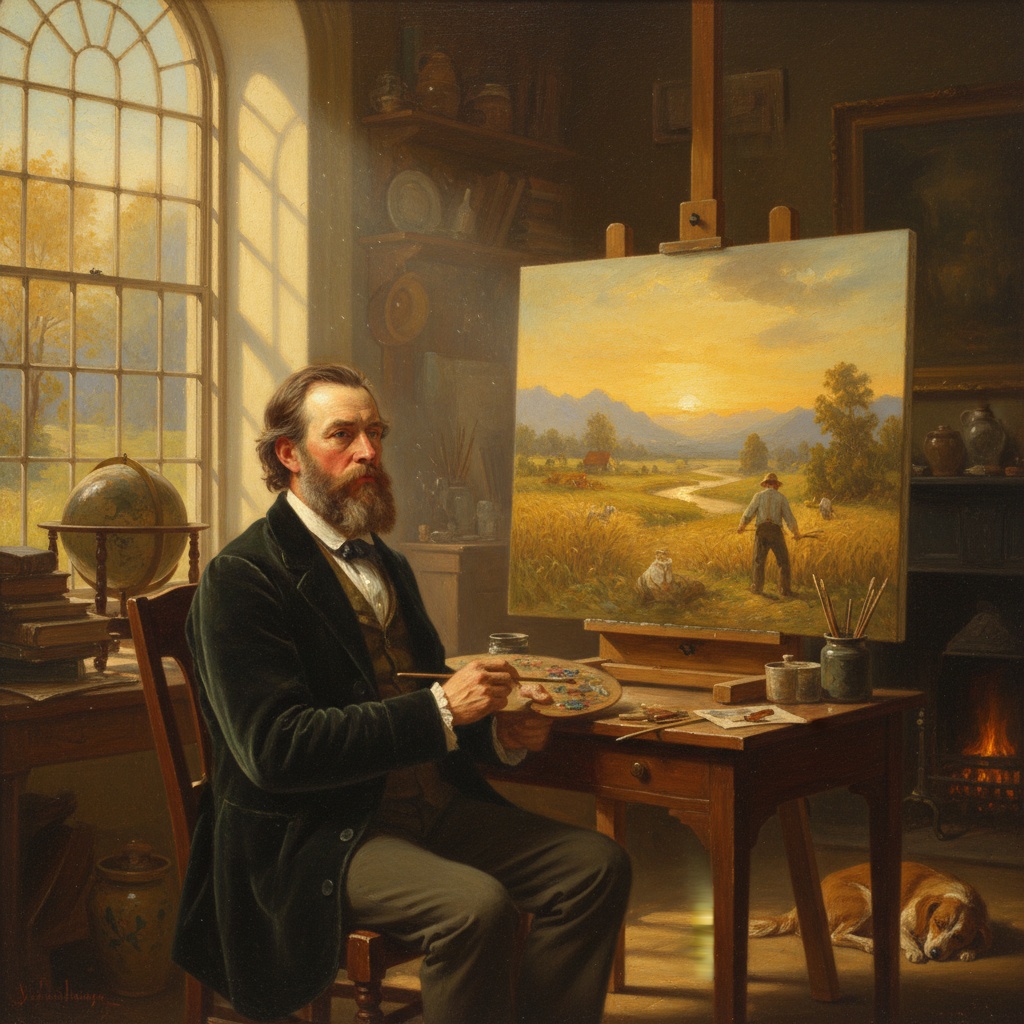
Early Life and Artistic Foundations: A Canadian Beginning
William Henry Hope, born in Montreal in 1835, emerged from a family steeped in artistic sensibility – his mother, Avis Townes, was a light opera singer who later turned her talents to cleaning, demonstrating a practical resilience that perhaps subtly informed her son’s grounded approach to art. While not formally trained within the rigid structures of academic institutions initially, Hope embarked on a formative journey across Europe during the 1880s, seeking inspiration and honing his skills in Paris, the Netherlands, and Italy. This period was crucial; it wasn't merely about acquiring technique but absorbing the atmosphere, studying the Old Masters firsthand, and developing an independent artistic voice that would later distinguish him within the Canadian art landscape. His early exposure to the Fontainebleau forest, a haven for plein air painters, instilled in him a deep appreciation for natural light and its transformative power – a hallmark of his mature style.
The Surrey Landscapes: Capturing Light and Atmosphere
 Autumn, Croham Hurst, Croydon, Surrey, North Side
Explore William Henry Hope’s ‘Autumn, Croham Hurst’. A stunning Impressionistic landscape painting of vibrant autumnal colors & textures. Discover this 1894 masterpiece!
Upon returning to Montreal, Hope quickly established himself as a prominent figure, becoming deeply connected with the Royal Canadian Academy of Arts. However, it was his depictions of the Surrey countryside, particularly around Croydon, that truly defined his artistic identity. Paintings like “Croham Hurst, Croydon” (1890) and “Autumn, Croham Hurst” (1894), reveal a masterful command of Impressionistic techniques, yet Hope’s work transcends simple imitation. He wasn't merely recording what he *saw*, but conveying the very *feeling* of a place – the crispness of autumn air, the gentle warmth of sunlight filtering through trees, the subtle shifts in color as the day progressed. “Addington Hills, Croydon” (1896) exemplifies this; it’s not just a landscape, but an evocation of tranquility and the beauty found in everyday scenes. These weren't grand vistas designed to inspire awe, but intimate portrayals of the English countryside that resonated with a growing sense of national identity and appreciation for local landscapes.
Hope's Genre Scenes: Everyday Life with Quiet Dignity
Genre painting (or petit genre) is the painting of genre art, which depicts aspects of everyday life by portraying ordinary people engaged in common activities. One common definition of a genre scene is that it shows figures to whom no identity can b...
While celebrated for his landscapes, Hope also produced a significant body of genre paintings. These works offer glimpses into the lives of ordinary people – scenes of domestic interiors, harbors bustling with activity, and quiet moments of contemplation. Unlike some genre painters who leaned towards sentimentality or caricature, Hope approached his subjects with a remarkable degree of dignity and realism. He wasn’t interested in moralizing or offering social commentary; instead, he focused on capturing the inherent beauty and complexity of everyday existence. His attention to detail – the texture of fabrics, the play of light on surfaces, the subtle expressions on faces – elevates these scenes beyond mere documentation. They are quiet observations, imbued with a sense of empathy and respect for his subjects.
Realism, Luminism, and the Influence of European Masters
Hope’s artistic style is often described as realist, but this label doesn't fully capture its nuance. He possessed a keen eye for accuracy and detail, meticulously rendering form and texture. However, he wasn’t simply replicating reality; he was interpreting it through a distinctly personal lens. The influence of Luminism – an American art movement characterized by the dramatic use of light and atmosphere – is readily apparent in his landscapes. He shared with Luminist painters a fascination with capturing the ephemeral qualities of light, creating scenes that feel both tangible and ethereal. Furthermore, the subtle color harmonies and atmospheric perspective evident in his work suggest a deep understanding of European masters like Corot and Constable, whose influence he absorbed during his formative years abroad. He synthesized these influences into a uniquely Canadian vision, one that celebrated the beauty of the natural world and the dignity of everyday life.
Legacy and Recognition: William Henry Hope in Art History
William Henry Hope’s contribution to Canadian art is often understated, yet profoundly significant. As a champion of realism at a time when more stylized approaches were prevalent, he paved the way for future generations of artists who sought to capture the authentic beauty of their surroundings. His election to the Royal Canadian Academy of Arts solidified his position within the artistic establishment, and his work continues to be admired for its technical skill, atmospheric depth, and quiet dignity. The founding of the Pen and Pencil Club of Montreal in 1890 further demonstrates his commitment to fostering a vibrant art community. While he may not have achieved the widespread fame of some of his contemporaries, Hope’s legacy endures through his evocative paintings, which offer a compelling glimpse into a bygone era and a testament to the power of observation and artistic sensitivity.
Collecting William Henry Hope: A Guide for Enthusiasts
For collectors seeking to acquire works by William Henry Hope, several avenues exist. Auction houses frequently feature his landscapes and genre scenes, offering opportunities to bid on original paintings. Online art marketplaces also provide access to a wider range of pieces, though careful due diligence is essential to ensure authenticity. Prices vary considerably depending on size, subject matter, and condition, ranging from modest investments for smaller watercolors to more substantial sums for larger oil paintings. Look for works that showcase his signature mastery of light and atmosphere – the Surrey landscapes are particularly sought after. Beyond the aesthetic appeal, acquiring a painting by Hope is an investment in Canadian art history, a chance to own a piece of a legacy built on realism, sensitivity, and a profound appreciation for the beauty of everyday life. OriginalUniqueArt.com offers high-quality reproductions of his most celebrated works, allowing enthusiasts to experience the artistry of William Henry Hope firsthand.