Early Life & Artistic Foundations: From Dutch Roots to Canadian Shores
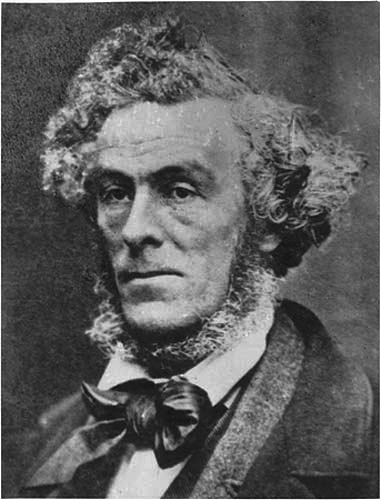 Wikipedia: Cornelius Krieghoff
Cornelius David Krieghoff (June 19, 1815 – March 5, 1872) was a Dutch-born Canadian-American painter of the 19th century. He is best known for his paintings of Canadian genre scenes involving landscapes and outdoor life, which were as sought after in...
Cornelius David Krieghoff’s story is one of fascinating transatlantic movement, a journey that shaped his artistic vision and ultimately cemented his place as the quintessential painter of 19th-century Canada. Born in Amsterdam in 1815, his early life was steeped in the traditions of European art, though not necessarily through formal academic channels. His father, Johann Ernst Krieghoff, a wallpaper manufacturer, instilled a sense of craftsmanship and an appreciation for design, but it was the family’s relocation to Germany that first exposed young Cornelius to more structured artistic training at the Academy of Fine Arts around 1830. This foundation, however, proved merely a prelude to the experiences that would truly define his style. A move to New York in 1836 saw him briefly enlist in the U.S. Army, an unusual path for an aspiring artist but one that provided valuable opportunities for sketching and observation – particularly during his service in the Second Seminole War. It was a period of honing skills, capturing fleeting moments, and developing a keen eye for detail, qualities that would become hallmarks of his mature work.
The pivotal moment arrived with his sojourn to Paris in 1844, where he diligently copied masterpieces at the Louvre under the tutelage of Michel Martin Drolling. This immersion in the classical tradition provided technical refinement and a deeper understanding of composition and form. Yet, even amidst the grandeur of European art, Krieghoff’s artistic spirit yearned for something more – a unique subject matter that resonated with his own experiences. That opportunity presented itself upon his arrival in Montreal around 1846, where he discovered not only a burgeoning artistic community but also a landscape and culture ripe for depiction.
The Rise of a Genre Painter: Depicting Everyday Life in Quebec
 Cornelius David Krieghoff
Cornelius David Krieghoff (1815-1872) was a Canadian painter renowned for evocative 19th-century genre scenes & landscapes of Quebec life, capturing winter beauty & frontier culture with remarkable detail.
Montreal proved to be the catalyst for Krieghoff’s distinctive style. He quickly became known as a genre painter, focusing not on historical or mythological scenes but on the everyday lives of Canadians – particularly those inhabiting the province of Quebec. This was a deliberate choice, a departure from the prevailing artistic trends and a bold embrace of his adopted homeland. He co-founded the Montreal Society of Artists in 1847, establishing himself within a network of like-minded creatives. However, it was his connection with the Mohawk community at Kahnawake that profoundly influenced his work. He befriended them, meticulously sketching their lives and customs, offering a glimpse into a world often overlooked by mainstream society.
In 1853, Krieghoff relocated to Quebec City, a move that would define the most prolific period of his career. He painted with an almost obsessive energy, capturing scenes of bustling marketplaces, lively taverns, and the rugged beauty of the surrounding countryside. His paintings weren’t merely representations; they were vibrant narratives, filled with character and authenticity. He wasn't simply *recording* life in Quebec; he was celebrating it – its hardships, its joys, and its unique spirit.
Krieghoff's Signature Style: Realism, Detail, and the Charm of Winter Scenes
What sets Krieghoff apart is his masterful blend of realism and charm. His paintings are characterized by meticulous detail – from the texture of clothing to the expressions on faces – yet they never feel overly precise or academic. There’s a warmth and vitality in his brushstrokes, a sense of immediacy that draws the viewer into the scene. He possessed an exceptional ability to capture light and atmosphere, particularly in his iconic winter landscapes. Paintings like “Running the Toll” exist in multiple variants, demonstrating not just his popularity but also his fascination with capturing subtle shifts in mood and weather.
His use of color is equally noteworthy – a palette that reflects the harsh beauty of the Canadian climate: crisp whites, deep blues, and earthy browns. He wasn’t afraid to depict the challenges of winter life – the biting cold, the arduous labor – but he always infused his scenes with a sense of resilience and community. The figures in his paintings are often bundled in thick coats, their faces ruddy from the cold, yet they exude a quiet dignity and determination. This ability to find beauty in adversity is perhaps the most enduring quality of Krieghoff’s work.
Indigenous Representation in Krieghoff’s Work: A Complex Legacy
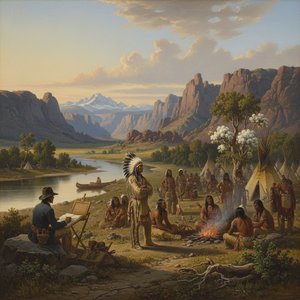
 A Caughnawage Indian Encampment
Explore Cornelius Krieghoff’s ‘A Caughnawage Indian Encampment.’ This 1848 oil painting offers a glimpse into Native American life, showcasing rich detail & historical significance. Own a piece of Canadian art history.
Krieghoff's depictions of Indigenous people, particularly the Mohawk community, are central to his oeuvre. Paintings like “A Caughnawage Woman” (1855) and “A Caughnawage Indian Encampment” (1848) offer valuable glimpses into their lives during this period. However, it’s crucial to approach these works with a critical eye. While Krieghoff clearly developed genuine relationships with the people he painted, his representations were inevitably filtered through the lens of his own cultural perspective.
Scholars debate the extent to which his paintings romanticized or idealized Indigenous life. It’s important to remember that these works were created during a period of significant social and political upheaval, marked by assimilation policies and displacement. While Krieghoff's intention may have been to celebrate their culture, it’s essential to acknowledge the power dynamics at play and the potential for misrepresentation. Nevertheless, his paintings remain important historical documents, offering a rare visual record of Indigenous life in 19th-century Canada.
Beyond the Brushstrokes: Historical Context & Lasting Influence
Krieghoff’s success wasn't merely artistic; it was also deeply rooted in the social and political context of his time. Canada was undergoing a period of nation-building, and there was a growing desire for art that reflected its unique identity. Krieghoff’s paintings filled this void, offering images that resonated with a burgeoning sense of national pride. His work appealed to both Canadian and European audiences, contributing to the development of a distinctly Canadian artistic style.
Despite periods of financial hardship and fluctuating popularity, Krieghoff remained remarkably prolific throughout his career. He spent time traveling between Canada and Europe, continuing to paint scenes that captured his imagination. He died in Chicago in 1872, leaving behind a vast portfolio of work that continues to captivate audiences today. His influence can be seen in the generations of Canadian artists who followed him, particularly those who sought to depict the beauty and diversity of their homeland.
Collecting Krieghoff Today: Value, Authenticity, and Appreciation
Today, Cornelius Krieghoff’s paintings are highly sought after by collectors and institutions alike. His works can be found in major museums across Canada and beyond, including the National Gallery of Canada, the Art Gallery of Ontario, and the McCord Museum. The value of his paintings varies depending on size, subject matter, and condition, ranging from several thousand to hundreds of thousands of dollars.
When collecting Krieghoff’s work, authenticity is paramount. It's crucial to consult with reputable art dealers and appraisers to ensure the provenance of a painting. Look for hallmarks of his style – meticulous detail, vibrant color palettes, and a sense of warmth and vitality. Beyond their monetary value, Krieghoff’s paintings offer a unique window into 19th-century Canada, capturing a moment in time with remarkable skill and sensitivity. OriginalUniqueArt.com offers high-quality reproductions of his most iconic works, allowing art enthusiasts to experience the beauty and charm of Krieghoff's vision firsthand. Explore our collection today and discover the enduring legacy of this beloved Canadian artist. For personalized guidance or a free artwork appraisal, visit our consultation page.