The Lens of Naturalism: Where Botanical Precision Meets Artistic Grace
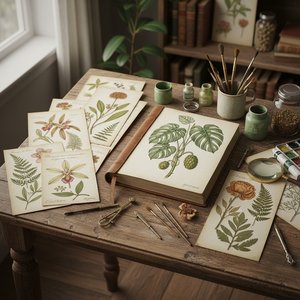
To gaze upon a masterfully executed botanical study is to witness a profound dialogue between the inquisitive mind and the observant eye. There exists a rare, delicate equilibrium where the rigorous demands of scientific classification meet the ethereal grace of fine art. This intersection is not merely about documentation; it is an act of devotion. When we look at the exquisite works found in Jane Loudon’s The Ladies' Flower-garden Of Ornamental Annuals, we are not simply viewing a catalog of flora, but experiencing an 18th-century symphony of watercolor and light. Each petal and stamen is rendered with such meticulous care that the boundary between biological fact and aesthetic beauty begins to dissolve.
In this realm, naturalism serves as the bridge. The artist does not merely replicate a specimen; they interpret its very essence. This requires a profound understanding of form, color, and the subtle way light interacts with organic surfaces. For the classic art enthusiast, this genre offers a sanctuary of order amidst the chaos of the natural world. It is a celebration of the minute—the tiny veins on a leaf, the soft fuzz of a stem, the translucent quality of a dewdrop—all captured through a lens that values both the truth of the specimen and the poetry of the brushstroke.
The Alchemist's Brush: Capturing Biological Wonders through Watercolor and Oil
The medium chosen by the scientific artist is never accidental; it is an essential component of the discovery itself. Watercolor, with its inherent translucency and fluid movement, has long been the preferred companion for those documenting the ephemeral beauty of wildflowers. Consider the delicate studies of Mary Morris Vaux Walcott, such as her 1925 depiction of the Bogbean (*Menyanthes trifoliata*). Through the careful layering of pigment, she achieves a sense of moisture and vitality that feels almost breathable. The medium allows for a soft diffusion of color, mimicking the way sunlight filters through organic matter, creating a sense of depth that is both structural and atmospheric.
Conversely, the use of oil paint introduces a different dimension of scientific inquiry—one of texture and permanence. Where watercolor captures the fleeting moment, oil can immortalize the tactile reality of a specimen. The heavy application of pigment, or impasto, allows an artist to recreate the rugged bark of a tree or the waxy surface of a succulent. This technique provides a three-dimensional quality that invites the viewer to reach out and touch the canvas. In these works, the chemistry of the paint—the interplay of linseed oils and mineral pigments—becomes an extension of the biological subject matter, turning the act of painting into a form of alchemical transformation.
From Specimen to Masterpiece: The Evolution of Scientific Illustration in Art History
The history of scientific art is a chronicle of human progress, tracing our journey from mere observation to deep, analytical understanding. In the 18th and 19th centuries, artists like Claude Aubriet played a pivotal role in this evolution. His detailed depictions of birds, plants, and landscapes were not only aesthetically pleasing but served as vital records for an era of great exploration. These illustrators were often part of larger scientific expeditions, acting as the visual chroniclers of new worlds. Their work provided the visual evidence upon which botanical and zoological theories were built, making them essential contributors to the scientific canon.
As we moved into the 19th century, artists such as Frederick E. Cohen further refined this tradition, blending American naturalism with a sophisticated sense of composition. The evolution of the genre reflects a shift from purely functional illustration toward a more evocative form of fine art. While the primary goal remained accuracy, the secondary goal became the evocation of wonder. This transition allowed scientific art to move from the pages of academic journals into the hallowed halls of galleries and private collections, where it could be appreciated for its ability to inspire awe as much as its ability to inform.
The Tactile Truth: Preserving the Intricacy of Nature through Texture and Light
At the heart of every great scientific artwork lies a commitment to the "tactile truth." This is the pursuit of capturing not just what a subject looks like, but how it feels. To achieve this, the artist must master the manipulation of light and shadow, using chiaroscuro to define volume and create a sense of physical presence. When an artist successfully renders the subtle shadows beneath a petal or the glint of light on a moist leaf, they are providing the viewer with a sensory experience that transcends sight.
This preservation of intricacy is what gives scientific art its enduring power. It demands a high level of technical proficiency—a mastery of lightfastness in pigments and the structural integrity of the canvas. The true magic happens when the artist uses texture to guide the eye, creating a rhythmic movement across the composition that mimics the organic growth patterns found in nature. This marriage of light and texture ensures that the artwork remains a "living" entity, capable of revealing new details upon every subsequent viewing, much like a specimen under a microscope.
The Eternal Archive: Honoring the Legacy of Scientific Discovery in Modern Collections
Today, the legacy of scientific art continues to resonate within modern interior design and private collections. We find ourselves in an era where we can revisit these historical wonders through high-fidelity reproductions that honor the original artist's intent. Whether it is a large-scale mural inspired by 18th-century botanical studies or a meticulously crafted oil reproduction of a 19th-century naturalism piece, these works bring a sense of intellectual depth and timeless elegance to any space.
Collecting such art is an act of preserving human curiosity. It allows us to maintain a connection to the great era of discovery, keeping the spirit of exploration alive in our homes. By surrounding ourselves with the precision of the past, we find a sense of continuity and peace. These artworks serve as a reminder that the pursuit of knowledge and the pursuit of beauty are, and have always been, one and the same. In every carefully rendered leaf and every expertly applied brushstroke, we find a profound respect for the wonders of the natural world that continues to inspire generations.
For those seeking to bring this extraordinary history into their own lives, OriginalUniqueArt.com offers an unparalleled gateway to the masters of the past. From bespoke oil reproductions that capture the tactile depth of historical botanical studies to museum-quality Giclée prints that preserve every delicate detail, we specialize in making art history accessible and enduring. Whether you are looking to commission a custom piece inspired by classical naturalism or seeking to transform a personal memory into a masterpiece, our dedicated artists and curators are here to guide your journey through the beauty of discovery.