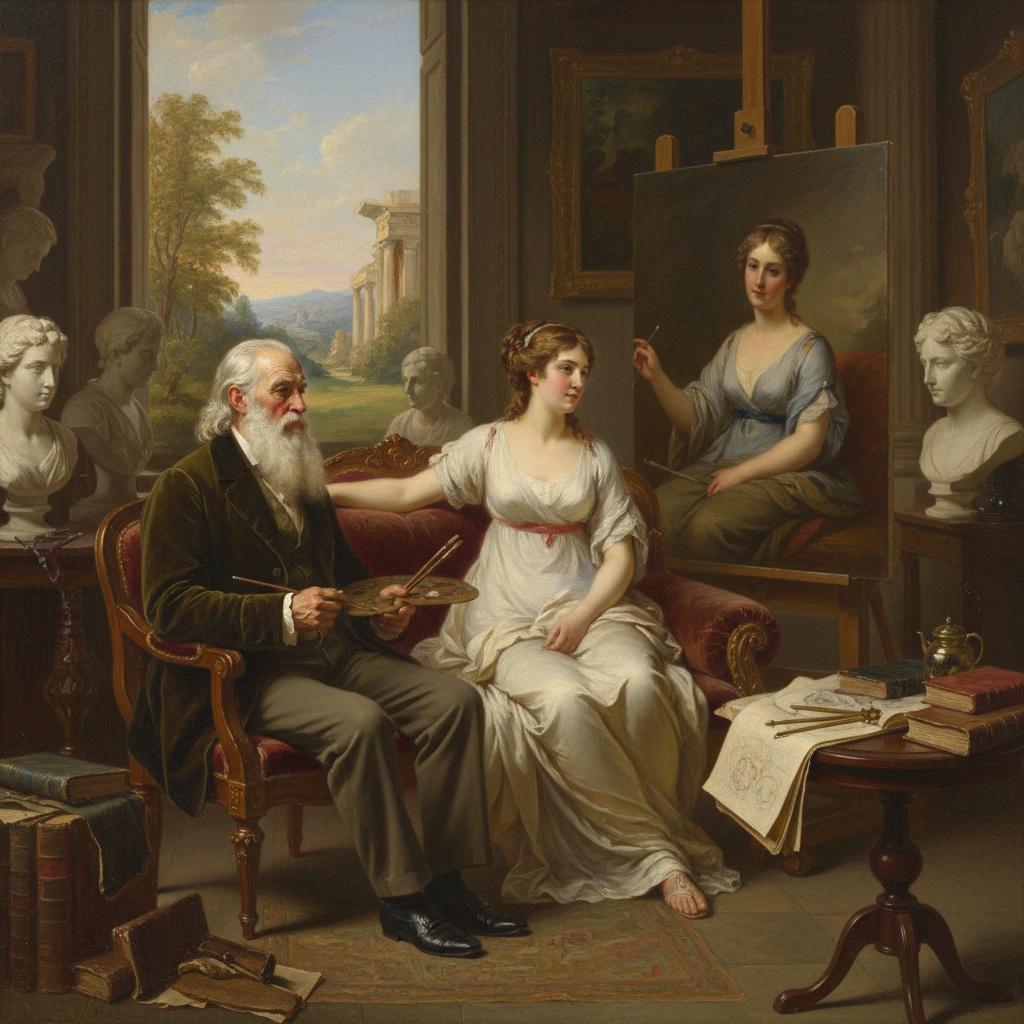
The Foundations of Precision: Defining Academic Realism and Its Historical Roots
To understand the profound allure of Academic Realism, one must first journey back to the hallowed halls of the great European academies, where art was not merely an expression of feeling, but a rigorous discipline of observation. This movement, which reached its zenith in the nineteenth century, was rooted in the belief that beauty is found through the meticulous study of nature and the perfection of classical ideals. Unlike the spontaneous, often fragmented visions of later modernism, Academic Realism sought to bridge the gap between the seen world and a perfected, idealized reality. It was an era where the artist’s hand served as a conduit for truth, capturing the subtle textures of skin, the weight of heavy drapery, and the atmospheric depth of a landscape with unparalleled fidelity.
The historical lineage of this style is deeply intertwined with the Renaissance masters, drawing inspiration from the anatomical precision of Michelangelo and the balanced compositions of Raphael. By adhering to strict pedagogical standards, artists trained in the academic tradition learned to master the fundamental elements of composition, perspective, and anatomy before ever attempting a brushstroke of personal expression. This disciplined approach created a visual language that felt both authoritative and eternal. When we gaze upon works like Sir Edward Poynter’s Andromeda, we are not merely seeing a mythological figure; we are witnessing the culmination of centuries of technical refinement, where classical beauty is rendered with a clarity that feels almost tangible.
Ultimately, the foundation of Academic Realism lies in its reverence for tradition and its commitment to excellence. It provided a standard of quality that defined the aesthetic values of an entire era, establishing a benchmark for what it means to truly "master" reality. This period of art history reminds us that true creativity often flourishes within the boundaries of profound technical competence.
The Mastery of Form: Technical Virtuosity and the Pursuit of Anatomical Truth
At the heart of the Academic tradition lies an almost scientific devotion to form. For the academic painter, the human body was the ultimate subject—a complex architecture of bone, muscle, and sinew that demanded absolute accuracy. This pursuit of anatomical truth required years of dedicated study, often involving the careful observation of live models to understand how light interacts with the subtle contours of the physique. There is a certain gravity in these works; when an artist captures the way a shoulder rests or the tension in a hand, they imbue the subject with a sense of physical presence that transcends the flat surface of the canvas.
This technical virtuosity extends far beyond mere anatomy; it encompasses the ability to render texture and weight with such precision that the viewer can almost feel the coolness of marble or the softness of silk. Consider the delicate interplay of light on a subject's skin, or the heavy, tactile quality of fabric in a portrait. Artists like Friedrich Gustav Schlick demonstrated this through their detailed depictions of historical figures, where every fold of clothing and every strand of hair contributed to a sense of lived reality. This level of detail was never intended as mere decoration; rather, it served to ground the subject in a believable, physical world, making the mythological or the historical feel immediate and present.
The mastery of form is, therefore, an act of profound respect for the natural world. By capturing the intricate details of life with such unwavering accuracy, academic artists elevated the mundane to the monumental. This dedication to anatomical and textural truth remains one of the most captivating elements of the style, inviting the viewer into a space where reality is both observed and perfected.
Light, Shadow, and Soul: The Role of Chiaroscuro in Creating Depth and Emotion
If anatomy provides the structure of Academic Realism, then light and shadow provide its soul. The technique of chiaroscuro—the dramatic contrast between light and dark—is perhaps the most evocative tool in the academic painter's repertoire. It is through the careful manipulation of luminance that an artist can sculpt figures out of the darkness, creating a three-dimensional illusion that breathes life into the composition. Light does not merely illuminate; it directs the eye, highlights the emotional focal points, and establishes the atmospheric mood of the entire piece.
In many masterworks, light acts as a narrative force. A soft, ethereal glow might descend upon a melancholic muse, as seen in Sir Edward Poynter’s Music: Heavenly Maid, evoking a sense of serenity and divine presence. Conversely, sharp, directional light can create tension and drama, pulling the viewer's attention to a specific gesture or expression. This interplay of shadow is essential for creating depth; without the receding darkness, the brightly lit subjects would appear flat and disconnected from their environment. The shadows hold the secrets of the painting, providing the necessary contrast that allows the highlights to sing with vitality.
Beyond mere technicality, this use of light serves an emotional purpose. It allows the artist to imbue a scene with mystery, intimacy, or grandeur. By controlling the ebb and flow of light across the canvas, the academic painter guides the viewer's emotional journey, ensuring that the painting is not just seen, but felt. The mastery of shadow is what transforms a mere depiction of a person into a profound exploration of human emotion.
From Academy to Gallery: The Enduring Legacy of Classical Techniques in Modern Art
While the formal era of the great academies may have passed, the techniques they perfected continue to resonate within the contemporary art world. The principles of Academic Realism—precision, anatomical accuracy, and the masterful use of light—remain the bedrock of classical training. Even as modern art explores abstraction and conceptualism, the allure of the "real" persists. We see this legacy in the continued demand for portraiture that captures the true essence of a subject and in the enduring popularity of landscapes that honor the majesty of the natural world.
The influence of these classical methods can be found in the way modern collectors approach art, seeking pieces that possess a certain "living" quality—a tactile depth that digital mediums often struggle to replicate. The tradition of meticulous layering and the use of fine pigments to create texture is a direct descendant of the academic method. Furthermore, the concept of "remixing" history—applying classical techniques to modern subjects—proves that these old-world skills are remarkably adaptable. Whether it is a contemporary portrait rendered with the dramatic chiaroscuro of the seventeenth century or a landscape painted with the light-drenched softness of the Romantic era, the DNA of academic excellence remains unmistakable.
The legacy of Academic Realism is not found in a stagnant adherence to the past, but in the continuous application of its rigorous standards to new visions. It provides a timeless toolkit for any artist or enthusiast who believes that true beauty is achieved through the harmonious marriage of technical skill and emotional depth.
Preserving the Master's Touch: How Academic Excellence Lives on Through Fine Reproductions
In an age of mass production, the preservation of the master's touch requires a dedicated commitment to craftsmanship. The true spirit of Academic Realism lies in the visible brushstroke, the subtle impasto, and the complex layers of oil paint that create a sense of three-dimensional texture. This is why high-quality reproductions are so vital; they allow the beauty of the Old Masters to enter modern homes, not as flat images, but as breathing, tactile works of art. At OriginalUniqueArt.com, we honor this tradition by employing artists who hold degrees from prestigious Fine Arts academies, ensuring that every handmade oil reproduction maintains the rigorous standards of the original masters.
Our process is a tribute to the slow, deliberate artistry of the past. Each painting is a labor of passion, involving multiple layers of paint applied over several weeks to build the necessary depth and character. We utilize premium pigments and heavy-duty cotton canvases to ensure that the light interacts with the surface just as it would in a museum setting. Whether it is a Giclée print using 12-color pigment-based inks for longevity or a custom commission where a personal photograph is transformed into a Renaissance-style masterpiece, our goal is to preserve the "soul" of the artwork.
By bringing these meticulously crafted pieces into contemporary spaces, we ensure that the legacy of Academic Realism remains a living part of our cultural fabric. We invite you to explore our vast library of 465,000 paintings and discover how the timeless beauty of classical art can transform your environment. From custom portrait commissions to large-scale architectural murals, OriginalUniqueArt.com is dedicated to making the grandeur of art history accessible to all, ensuring that the brilliance of the masters continues to inspire generations to come.