The Architect of Form: Defining the Cubist Revolution
To understand the seismic shift that occurred in the early twentieth century, one must look beyond the mere surface of the canvas and into the structural reconfiguration of reality itself. Georges Braque did not simply paint objects; he interrogated them. Before the advent of Cubism, the Western tradition had long been tethered to the illusion of depth, a window into a world governed by single-point perspective and the soft light of Impressionism. However, Braque, alongside his contemporary Pablo Picasso, sought to dismantle this deceptive tranquility. He approached the canvas not as a mirror, but as a laboratory where form could be dissected and reassembled.
The revolution was rooted in a profound rejection of the ephemeral. While the Fauves embraced a wild, emotive use of color, Braque turned inward toward the architectural integrity of the subject. His early explorations were deeply influenced by the structural lessons of Paul Cézanne, particularly the notion that nature should be treated through the cylinder, the sphere, and the cone. By stripping away the distractions of atmospheric light, Braque focused on the essential geometry of existence, creating a visual language that demanded a new way of seeing—one that acknowledged the complexity of multidimensional space.
For the discerning collector, this period represents more than just a stylistic change; it marks the birth of modern autonomy in art. The subject matter became secondary to the structural logic of the composition. In this era, Braque began to redefine the boundaries between the object and the void, proving that the true essence of an item lies not in its outward appearance, quite literally, but in the way its various facets interact within a flattened, yet intellectually deep, pictorial plane.
Analytic Cubism: Deconstructing Space and Perspective
As the movement matured into what we now recognize as Analytic Cubism, Braque’s work underwent an intense period of fragmentation. This phase is characterized by a rigorous, almost clinical deconstruction of the subject. In masterpieces such as Bottle and Fishes, one observes the dissolution of traditional boundaries. The artist utilized a muted palette—dominated by earthy ochres, greys, and deep browns—to ensure that color did not overwhelm the structural investigation. This restraint allowed the viewer to focus entirely on the overlapping planes and the rhythmic interplay of light and shadow.
In this stage, the concept of "viewpoint" was radically transformed. Rather than presenting a single, static moment in time, Braque presented a composite reality. He invited the eye to move around the object, capturing multiple perspectives simultaneously. This technique effectively collapsed the distance between the viewer and the subject, creating a dense, interlocking web of shapes that seem to vibrate with intellectual energy. The space within the painting is no longer an empty container but a tangible substance, as much a part of the composition as the objects themselves.
This period of intense analysis reached its zenith in works like Pedestal Table, where the distinction between foreground and background becomes intentionally blurred. For the connoisseur, analyzing these works requires a patient, meditative approach. One must learn to navigate the labyrinth of facets, finding the subtle clues—a curve of a rim, the edge of a glass—that anchor the abstraction to the physical world. It is a profound exercise in perception, rewarding those who seek depth beneath the surface of fragmentation.
The Symbiosis of Braque and Picasso: A Collaborative Masterpiece
It is impossible to discuss the trajectory of Georges Braque without acknowledging the unparalleled creative dialogue he shared with Pablo Picasso. Their relationship during the height of Cubism was less a traditional friendship and more a profound intellectual partnership, often described by contemporaries as two mountain climbers roped together. They worked in such close proximity, sharing techniques and even canvases, that distinguishing their individual hands during the Analytic phase can be an almost impossible task for all but the most trained eye.
'This synergy was instrumental in pushing the boundaries of what art could achieve. While Picasso brought a certain raw, sculptural intensity to the movement, Braque provided a sense of rhythmic harmony and spatial discipline. A poignant testament to this era can be found in works like Picasso’s Portrait of Georges Braque, which utilizes the very fragmented forms and muted tones that the duo perfected. Their collaboration was a closed loop of innovation, where every breakthrough by one was immediately absorbed and expanded upon by the other.
This period of shared discovery fundamentally altered the course of art history. The tension between their individual styles—the visceral and the structural—created a fertile ground for experimentation that eventually led to the development of Synthetic Cubism. For collectors of modern art, understanding this symbiotic relationship is essential; it allows one to appreciate the movement not as a solo endeavor, but as a collective intellectual revolution that redefined the very DNA of twentieth-century aesthetics.
Materiality and Texture: The Evolution Toward Synthetic Cubism
As the analytical rigor of the early years began to yield to new possibilities, Braque pioneered the transition into Synthetic Cubism. If the first phase was about taking things apart, this second phase was about putting them back together using a new vocabulary of materials. This era saw the introduction of papier collé—the use of pasted paper and mixed media—which brought a literal sense of texture and "objectness" to the canvas. Braque began to incorporate elements of the real world, such as wood grain patterns or newspaper fragments, directly into his compositions.
This shift introduced a playful yet sophisticated tension between representation and reality. By using textures that mimicked physical substances, Braque challenged the viewer to question what was painted and what was truly present. The palette began to brighten slightly, though it never lost its characteristic earthiness, and the compositions became flatter, more decorative, and more layered. This was no longer a dissection of space, but an assembly of signs and symbols that pointed toward reality without attempting to mimic it.
The introduction of these tactile elements transformed the painting into a physical object in its own right. The interplay of smooth paper against heavy oil paint created a sensory experience that moved beyond the visual. For the modern collector, this evolution represents a pivotal moment where art moved toward the concept of the "assemblage," paving the way for much of the mixed-media and installation art that would follow in the decades to come.
Curating the Avant-Garde: Integrating Cubist Aesthetics into Modern Collections
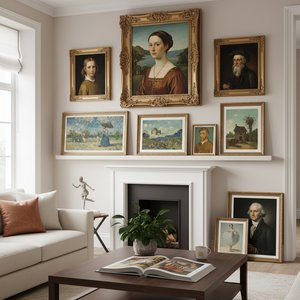
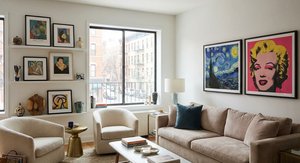
Integrating the revolutionary spirit of Georges Braque into a contemporary collection requires an appreciation for both historical weight and modern elegance. Cubism, with its emphasis on structure, geometry, and muted sophistication, possesses a timeless quality that complements a wide range of interior aesthetics—from the minimalist to the classically grand. The strength of a Cubist piece lies in its ability to act as an intellectual anchor within a room, providing a focal point that invites contemplation rather than mere observation.
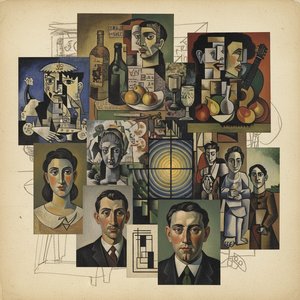
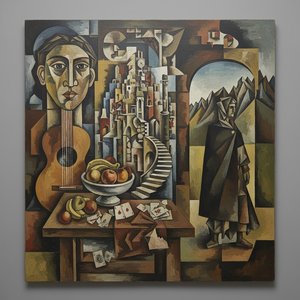
When selecting reproductions or original works for a curated space, one should consider the architectural dialogue between the art and the environment. A large-scale, multi-panel Cubist arrangement can transform a wide wall or a grand staircase into a dynamic gallery experience, where the flow of brushstrokes across panels creates a sense of movement and continuity. The interplay of light on the textured surfaces of a high-quality oil reproduction can add a layer of depth and "soul" to a room that flat prints simply cannot achieve.
Ultimately, collecting Cubism is an investment in the history of human perception. Whether through the acquisition of a meticulously hand-painted tribute to Braque’s mastery or the exploration of custom commissions that reimagine personal imagery through a Cubist lens, the goal is to surround oneself with works that challenge and inspire. By embracing the fragmented beauty of this movement, a collector does not merely decorate a space; they curate an enduring dialogue with the avant-garde.
At OriginalUniqueArt.com, we are dedicated to preserving this legacy of human creativity. Our master artists specialize in creating authentic, hand-painted oil reproductions that capture the profound textures and structural complexities of masters like Braque. From bespoke commissions that transform your personal memories into Cubist masterpieces to large-scale architectural murals, we provide the expertise and craftsmanship required to bring the revolutionary spirit of art history into the modern home.