The Essence of Luminism: Defining the Radiance of Light
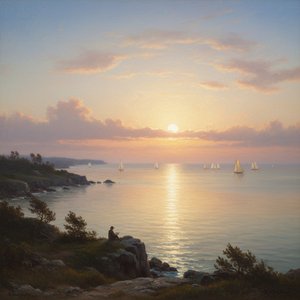
To encounter a true Luminist masterpiece is to experience a moment of profound stillness, where the boundary between the physical world and the divine seems to dissolve into a golden haze. Unlike the more turbulent expressions of European Romanticism, Luminism emerged as a uniquely American meditation on the sanctity of nature. It is an art movement defined not by dramatic action, but by the quiet, pervasive presence of light. This style seeks to capture the very breath of the atmosphere, rendering the air itself as a tangible, glowing medium that envelops the landscape.
At its core, Luminism is an exploration of clarity and transcendence. The artists of this movement were obsessed with the way sunlight filters through mist, reflects upon tranquil waters, or dissolves into the soft hues of twilight. There is a spiritual weight to these works; they do not merely depict a scene, but rather invite the viewer into a state of contemplative grace. By focusing on the subtle gradations of luminosity, these painters achieved a sense of infinite depth, making the canvas feel less like a flat surface and certainly more like a window into an eternal, sun-drenched afternoon.
The Hudson River School Legacy: Foundations of American Romanticism
The roots of this luminous tradition are deeply embedded in the fertile soil of the Hudson River School, a movement that sought to define the American identity through its untamed and majestic wilderness. As the young nation expanded, artists looked toward the vast, unexplored territories of the continent as a source of both national pride and spiritual revelation. This era was characterized by a profound reverence for the sublime—the idea that nature, in all its grandeur and mystery, could evoke a sense of awe and even terror within the human soul.
While the Hudson River School provided the thematic foundation of epic landscapes and historical narratives, Luminism emerged as a refined evolution of this aesthetic. Where earlier works might focus on the ruggedness of mountains or the drama of storms, the Luminist influence brought a newfound softness and serenity to the genre. It transformed the wild, often chaotic depictions of nature into organized, peaceful compositions where light serves as the ultimate unifying force. This transition marked a pivotal moment in art history, shifting the focus from the external struggle of man against nature to an internal, quiet communion with the divine elements of the earth.
Techniques of Transcendence: Atmospheric Depth and Hidden Brushwork
The technical mastery required to achieve such ethereal effects is nothing short of extraordinary. One of the most striking characteristics of Luminist painting is the almost invisible brushstroke. Unlike the thick, textured impasto of later Impressionism, Luminists often employed a smooth, glass-like finish. This meticulous application of oil paint was intended to eliminate any trace of the artist's hand, allowing the viewer to focus entirely on the illusion of light and atmosphere. The surface becomes a seamless mirror of the sky, creating a sense of pure, unmediated reality.
Achieving this level of transparency requires a sophisticated understanding of glazing—the process of applying multiple, thin, translucent layers of pigment over one another. Each layer acts as a filter, catching and refracting light as it passes through to the base colors below. This technique builds an incredible sense of luminosity from within the painting itself. Furthermore, the careful management of tonal values—the subtle shifts between shadow and highlight—creates a palpable sense of atmospheric depth. Through these disciplined methods, artists were able to render the weight of moisture in the air and the shimmering heat of a summer day with breathtaking precision.
Masters of the Glow: From Thomas Cole to Ralph Blakelock
The lineage of Luminism is populated by visionaries who each contributed a unique facet to the movement's luminous vocabulary. We must begin with Thomas Cole, the foundational figure of the Hudson River School. While his works often possess a dramatic, almost theatrical intensity, his ability to imbue landscapes with historical and symbolic significance laid the groundwork for all who followed. His compositions frequently serve as allegories for the rise and fall of civilizations, yet they are always anchored by a masterful command of natural light.
As the movement progressed, we see the emergence of artists like Ralph Albert Blakelock, whose work drifted toward the more emotive and mysterious realms of Tonalism. His paintings, such as the hauntingly beautiful Sunburst, utilize muted browns and deep, atmospheric shadows to evoke a sense of twilight serenity. In contrast, contemporary practitioners like Frank Hayward continue to explore these themes through a modern lens, using texture and light to capture the solitude of the natural world. Even in the maritime scenes of artists like Eric Hudson, one can detect the lingering spirit of this era—a dedication to capturing the heavy seas and the shifting light of the coast with an eye for historical truth and atmospheric depth.
Luminism in Modern Interiors: Curating Ethereal Landscapes for the Home
In the contemporary era, the allure of Luminist landscapes remains undiminished. For the discerning collector, these works offer more than mere decoration; they provide a sanctuary of calm within the modern home. The expansive horizons and tranquil light characteristic of this style possess a unique ability to expand the perceived boundaries of a room, bringing the restorative power of the outdoors inside. Integrating such pieces into an interior design scheme requires a thoughtful approach to color and scale.
When curating a collection, consider how the luminous palette of a painting interacts with your existing environment. A large-scale landscape featuring soft golds and blues can serve as a breathtaking focal point in a minimalist living space, while smaller, more intimate works can add layers of depth to a study or library. Whether through a high-quality Giclée print or a meticulously handcrafted oil reproduction, the presence of a luminous work invites a slower pace of life, encouraging residents and guests alike to pause, breathe, and lose themselves in the eternal glow of the American landscape.