The Genesis of Fragmentation: Understanding the Cubist Revolution
At the dawn of the twentieth century, the art world stood on the precipice of a seismic shift, moving away from the romanticized perceptions of nature toward a more cerebral, structured reality. The birth of Cubism was not merely a change in aesthetic preference but a radical intellectual rebellion against the traditional constraints of perspective that had governed Western art since the Renaissance. This movement sought to dismantle the single-point perspective, replacing it with a multifaceted view of the world where objects were no longer viewed from a fixed position, but through a series of overlapping, simultaneous viewpoints.
This revolution was driven by an urge to capture the true essence of form—not as it appears to the eye in a fleeting moment of light, but as it exists in the mind's comprehension. By breaking down subjects into their fundamental geometric components, artists began to explore the relationship between space and volume in ways previously unimagined. It was a period of profound discovery, where the canvas ceased to be a window into a fictional scene and instead became a complex plane of intersecting lines and planes, inviting the viewer to reconstruct the subject through an active, intellectual engagement with the fragmented imagery.
Analytical Cubism: Deconstructing Form and Perspective
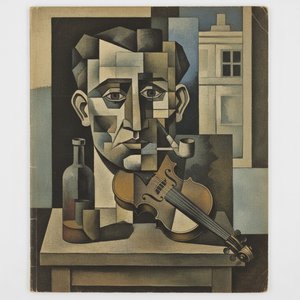
The first phase of this movement, known as Analytical Cubism, represents perhaps the most rigorous period of deconstruction in art history. During this era, masters such as Pablo Picasso and Georges Braque worked in close, almost symbiotic collaboration to strip away the superficiality of color and subject matter. In works like Picasso’s Man with a Guitar or Braque’s Untitled (3111), the focus shifted toward a monochromatic palette of muted earth tones—ochres, greys, and browns—to ensure that the viewer's attention remained fixed on the structural integrity of the composition rather than being distracted by emotive hues.
In this stage, the subject is meticulously dissected. A vase, a bottle, or a human figure is fractured into a myriad of small, overlapping facets. This technique creates a sense of rhythmic complexity, where the boundaries between the object and its surrounding atmosphere become blurred. The brilliance of Analytical Cubism lies in its ability to present multiple sides of an object at once; one might see the profile of a face and the frontal view of an eye simultaneously. It is a sophisticated dance of geometry that challenges the observer to find order within what initially appears to be chaos, rewarding those who look closely with a deeper understanding of structural depth.
Synthetic Cubism: The Art of Reassembling Reality
As the movement evolved, it transitioned from the analytical deconstruction of forms into the more additive and decorative phase known as Synthetic Cubism. If the former was about taking things apart, the latter was about putting them back together in a new, vibrant language. This period introduced the revolutionary concept of collage, where artists began to incorporate real-world elements—newspaper clippings, sheet music, or wallpaper—directly onto the canvas. This integration of "low" materials into "high" art bridged the gap between reality and representation, creating a tactile, layered experience that redefined the boundaries of the medium.
Synthetic Cubism brought a renewed sense of color and texture to the movement. The compositions became flatter and more legible, utilizing larger, more distinct shapes to build up images. This era allowed for a playful exploration of symbols and signs; a simple curve could represent a musical note, while a textured patch might suggest the grain of wood. It was an era of synthesis, where the artist acted as a composer, arranging disparate elements into a cohesive, rhythmic whole that celebrated the construction of meaning through the layering of textures and shapes.
Geometric Abstraction and the Evolution of Modern Expression
The legacy of Cubism extends far beyond its initial period, acting as the foundational DNA for much of the geometric abstraction that followed. The movement’s emphasis on the mathematical properties of shape and the reduction of form paved the way for artists like Helen Gerardia, whose work utilized hard-edge painting and a mastery of negative space to explore the tension between color and geometry. This lineage demonstrates how the Cubist impulse to find order in fragmentation eventually led to entirely non-representational art, where the subject is no longer an object from the physical world, but the interaction of pure form itself.
This evolution represents a continuous dialogue with the concept of reality. As artists moved further into abstraction, they continued to use the geometric vocabulary established by Picasso and Braque to evoke emotion and movement. The precision of the line and the weight of the plane became tools for expressing the spiritual and the psychological. Through this progression, Cubism transformed from a specific stylistic period into a universal language of modernism, influencing everything from graphic design to architecture and ensuring that the "shattering" of reality would forever change how we perceive the structure of our universe.
The Collector's Perspective: Integrating Cubist Masterpieces into Contemporary Interiors
For the discerning collector, acquiring a piece influenced by Cubism is an investment in intellectual depth. These works possess a unique ability to anchor a room, providing a sophisticated focal point that commands attention through their structural complexity. Because Cubist-inspired art relies on a balance of geometry and rhythm, it integrates seamlessly into modern, minimalist, or even maximalist interiors. A large-scale, multi-panel Cubist reproduction can transform a wide wall into a dynamic architectural feature, creating a sense of movement and layered perspective that flat, traditional landscapes often lack.
When curating such pieces, one must consider the interplay of texture and light. The tactile nature of oil reproductions—with their visible, impasto brushstrokes—complements the geometric rigor of the subject matter, adding a "living" quality to the abstraction. Whether through a carefully selected Giclée print or a bespoke, hand-painted oil masterpiece, bringing Cubist expression into a home allows for a continuous engagement with one of art history's most profound revolutions. It is an invitation to view one's surroundings not just as a collection of objects, but as a beautifully complex arrangement of form, space, and light.
At OriginalUniqueArt.com, we specialize in preserving this profound legacy. From meticulously handcrafted oil reproductions that capture the very soul of the masters to custom commissions that allow you to reimagine your own world through a Cubist lens, our mission is to make the extraordinary accessible. Whether you are seeking a museum-quality print or a bespoke masterpiece, our commitment to academic excellence and artisanal quality ensures that every piece we create serves as a timeless testament to the power of artistic expression.