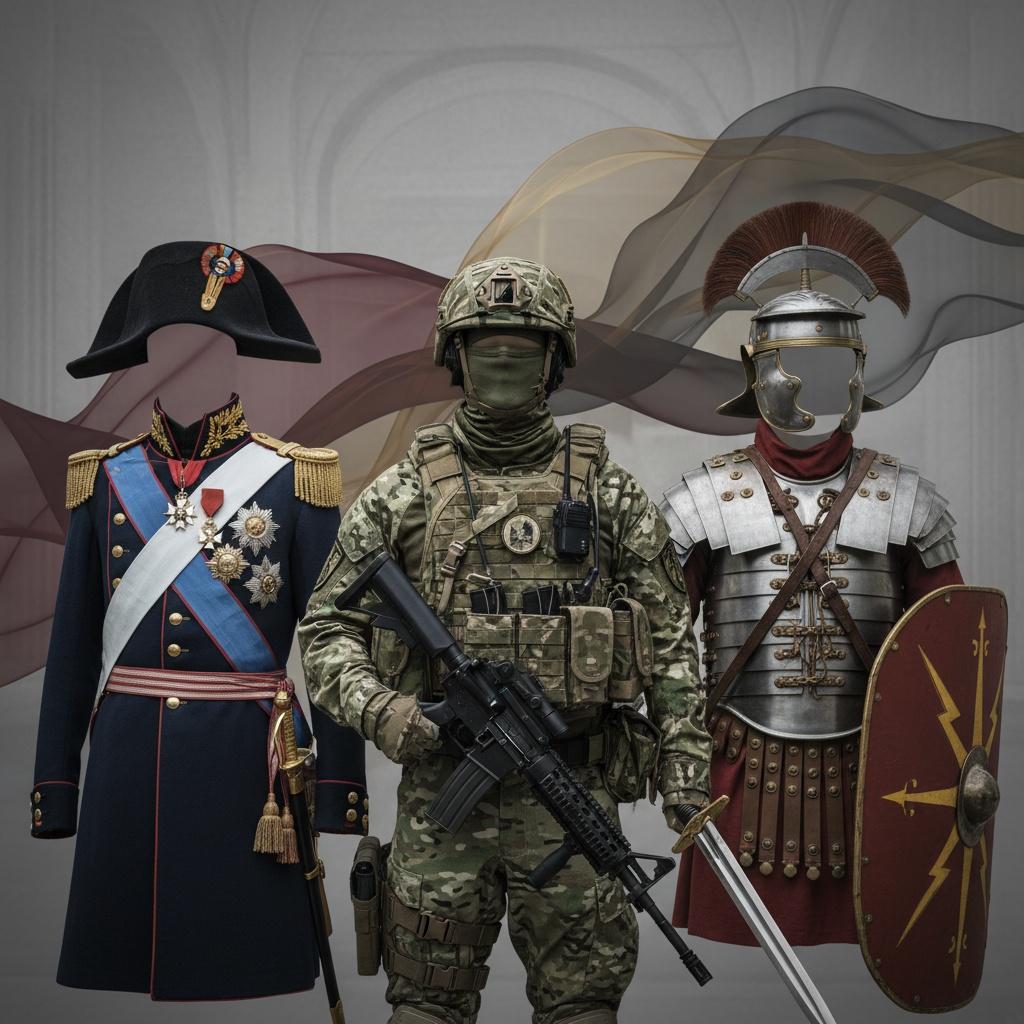
The Threads of Command: Uniforms as Visual Language of Authority
To gaze upon a historical military portrait is to read a silent, yet thunderous, lexicon of power. A uniform is never merely a garment; it is a carefully constructed architecture of identity designed to communicate rank, duty, and allegiance before a single word is spoken. In the realm of fine art, the artist serves as a translator of this visual language. When we examine works such as Josep Cusachs i’s Military Administration, we see how the meticulous application of lithographic hatching and stark black-and-white contrasts can evoke the rigid discipline of 19 th-century military life. The fabric itself becomes a medium for storytelling, where every braid, button, and epaulette acts as a punctuation mark in a narrative of command.
The weight of authority is often felt through the perceived heaviness of the attire depicted. Artists utilize texture to convey the stiffness of heavy wool or the luster of polished brass, ensuring that the viewer understands the gravity of the subject's position. This visual vocabulary transcends simple documentation; it creates an atmosphere of permanence and institutional strength. By focusing on the structural elements of the uniform, the artist anchors the individual within a larger historical continuum, transforming a personal likeness into a symbol of statehood and martial order.
Beyond the Rank: Symbolism and Secret Narratives in Military Portraiture
Beneath the surface of regalia lies a complex web of symbolism that invites the discerning eye to look deeper. While the outward appearance denotes rank, the subtle inclusion of certain motifs can hint at personal triumphs, ancestral lineages, or even spiritual allegories. Consider the captivating Victorian era works like Frank Dicksee’s The Symbol; though it leans into the realm of mystery and royalty, it exemplifies how art uses rich colors and symbolic objects to shroud a subject in layers of meaning. In military portraiture, a specific medal or a particular sash can represent a pivotal moment on a distant battlefield, turning a static image into a window onto a lived history.
These narratives are often whispered through the interplay of light and shadow. A master painter might use chiaroscuro to highlight a single decoration, drawing the viewer's attention to a mark of valor, while leaving the rest of the figure in a contemplative gloom. This technique creates a sense of psychological depth, suggesting that the man within the uniform possesses a complex inner life shaped by the very conflicts his attire represents. The art becomes an exploration of the tension between the public persona—the decorated officer—and the private individual, caught in the solemnity of their duty.
From Daguerreotype to Oil: The Evolution of Documenting Martial Identity
The methodology of capturing military identity has undergone a profound metamorphosis alongside technological advancement. In the mid-1emb19th century, the advent of photography provided a new, raw form of historical documentation. Roger Fenton’s 1856 daguerreotype of Major General Lockyer and Two of His Staff offers a unique, unvarnished glimpse into Victorian authority. The photographic medium brought a clinical precision to military portraiture, capturing the exact textures of formal attire with a realism that was previously unattainable. This era of documentation provided a foundational truth, a frozen moment of historical reality that grounded the romanticized traditions of earlier eras.
Yet, even as photography rose to prominence, the tradition of oil painting continued to offer something the camera could not: the ability to interpret and embellish. While a daguerreotype records what was, an oil painting captures how it felt. The transition from the silvered surfaces of early photography to the layered, tactile world of oil on canvas allowed artists to infuse portraits with emotion, atmosphere, and a sense of timelessness. This evolution represents a dialogue between the objective eye of the lens and the subjective soul of the brush, both essential in our understanding of martial history.
The Texture of Valor: Capturing Materiality and Detail in Historical Regalia
To truly appreciate the majesty of military art, one must attend to the tactile nuances of the medium. The true mastery of a historical painter lies in their ability to replicate the physical world—the crispness of a starched collar, the intricate embroidery of a sleeve, or the cold sheen of a saber. Artists like Christa Hook have gained renown for this exact level of detail, producing works where the military equipment and the textures of the uniforms are rendered with such realism that they seem almost tangible to the touch.
This focus on materiality serves a higher purpose than mere technical display; it honors the craftsmanship of the era. The heavy application of paint, or impasto, can mimic the raised texture of gold thread, while thin, translucent glazes can replicate the soft sheen of silk sashes. When an artist successfully captures these details, they bridge the gap between the viewer and the past, allowing us to feel the weight of the history being presented. It is in these minute details—the way light catches a single thread of gold—that the true spirit of valor is preserved.
Legacy in Layers: How Modern Collectors Preserve the Spirit of Military Art
For the modern historian and art enthusiast, the preservation of these works is an act of cultural stewardship. Collecting military art is not merely about acquiring beautiful objects; it is about maintaining a connection to the eras that shaped our contemporary world. Whether through the acquisition of museum-quality prints or the commissioning of bespoke oil reproductions, there is a profound desire to keep these narratives alive in our personal spaces. The layering of history—both in the physical layers of paint on a canvas and in the temporal layers of memory—ensures that the stories of command and courage do not fade into obscurity.
In an age of digital fleetingness, the permanence of a well-executed painting offers a sanctuary for historical reflection. As we look upon these works, we are reminded that identity is something constructed, defended, and ultimately, immortalized through art. By valuing the craftsmanship and the symbolic depth of these pieces, we ensure that the visual language of authority continues to speak to future generations, long after the uniforms themselves have become relics of a bygone age.
OriginalUniqueArt.com stands at the intersection of this historical reverence and modern accessibility. As a global leader in art reproduction and custom commissions, we specialize in bringing the profound textures of the Old Masters into the contemporary home. From meticulously handcrafted oil reproductions that capture every tactile brushstroke to high-fidelity Giclée prints designed for longevity, our mission is to preserve human creativity. Whether you seek to transform a personal memory into a historical masterpiece or wish to adorn your space with the grandeur of military portraiture, our academy-trained artists and dedicated project coordinators ensure that every piece meets the highest standards of academic excellence.