Early Life and Artistic Formation: Seeds of a Symbolist Style
 Wikipedia: Victor Borisov-Musatov
Victor Elpidiforovich Borisov-Musatov (Russian: Ви́ктор Эльпидифо́рович Бори́сов-Муса́тов; April 14 [O.S. April 2] 1870 – November 8 [O.S. October 26] 1905) was a Russian painter, prominent for his unique Post-Impressionistic style that mixed Symboli...
Viktor Borisov-Musatov, born in Saratov in 1870, emerged from a provincial background that belied the ethereal beauty he would come to embody in his paintings. His early life was marked by a physical ailment – a spinal curvature developed after a fall – which perhaps contributed to a heightened sensitivity and inward focus. While not directly causative, this experience fostered a contemplative nature, steering him away from the robust realism prevalent in much of Russian art at the time. Encouraged by his family, he initially pursued formal artistic training in Moscow before relocating to St. Petersburg in 1891. However, illness repeatedly interrupted his studies, leading to periods of self-directed exploration and a growing dissatisfaction with the academic constraints of traditional instruction.
This early period was crucial in shaping Musatov’s aesthetic trajectory. He wasn't immediately drawn to the grand historical narratives favored by artists like Repin or Surikov; instead, he gravitated towards subtle moods, delicate color palettes, and a nascent interest in decorative elements. His initial works, though not yet fully formed, hinted at an exceptional gift for perceiving the world through a distinctly poetic lens – a sensitivity that would blossom during his pivotal years studying in Paris.
The Evocative Landscapes: Atmosphere and Emotional Resonance
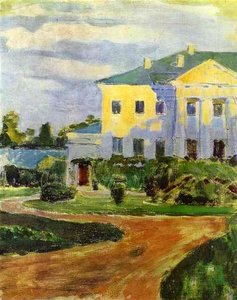 Manor House at Zubrilovka
Admire "Manor House at Zubrilovka" by Viktor Borisov-Musatov. A stunning Symbolist painting of a European manor house, rich in color & detail. Explore its tranquil beauty!
Musatov’s time in Paris (1895-1898) proved transformative. Immersed in the European art scene, he absorbed influences from Impressionism and Symbolism, but crucially, he didn't simply replicate these styles. He synthesized them into something uniquely his own. He began to develop a signature approach characterized by hazy atmospheres, muted tones, and a deliberate blurring of forms. His landscapes weren’t depictions of specific locations so much as evocations of emotional states – memories, dreams, and a longing for an idealized past.
Paintings like Manor House at Zubrilovka exemplify this quality. The scene isn't sharply defined; it feels suspended in time, bathed in a soft, melancholic light. The manor house itself is less a concrete structure and more a symbol of aristocratic elegance and fading grandeur. This wasn’t merely aesthetic preference; Musatov sought to capture what he termed the “melody of ancient sadness,” an elegiac remembrance of times long past – not necessarily historically accurate, but imbued with a romanticized beauty. He aimed to create paintings that resonated on an emotional level, inviting viewers into a world of quiet contemplation and wistful nostalgia.
Recurring Motifs and Symbolic Language in Borisov-Musatov’s Paintings
 The God's Dream
Explore 'The God’s Dream' by Viktor Borisov-Musatov (1905). A Romantic watercolor depicting a serene landscape & symbolic figures. Discover Russian Symbolism & Post-Impressionism.
Certain motifs recur throughout Musatov's oeuvre, lending his work a cohesive symbolic language. Women often feature prominently – not as active participants in narratives, but as embodiments of grace, melancholy, and the ephemeral nature of beauty. They are frequently depicted in gardens or interiors, surrounded by flowers and decorative objects that further enhance the sense of refined elegance and subtle longing.
Water is another significant element, appearing as ponds, pools, or flowing streams. This wasn’t accidental; Musatov associated water with fluidity, reflection, and the passage of time – a visual metaphor for the elusive nature of memory and emotion. In The God's Dream, the serene landscape and symbolic figures are interwoven with watery reflections, creating an atmosphere of dreamlike tranquility. The use of these recurring motifs wasn’t arbitrary; they were carefully chosen to convey specific emotional nuances and contribute to the overall sense of poetic resonance.
Borisov-Musatov's Unique Technique: Blending Impressionism and Decorative Art
Musatov’s technique was as distinctive as his subject matter. While influenced by Impressionism, he rejected its emphasis on capturing fleeting moments of light and instead focused on creating a more harmonious and stylized composition. He employed a delicate layering of paint, often using thin glazes to achieve subtle tonal variations and luminous effects. This approach resulted in paintings that possessed a remarkable sense of depth and atmosphere.
He also consciously incorporated elements of decorative art, drawing inspiration from Japanese prints and Russian folk traditions. This is evident in the flattened perspective, simplified forms, and emphasis on pattern and ornamentation found in works like Portrait of Nadezhda Staniukovich. The young woman’s red flower hat isn't merely a fashion accessory; it’s an integral part of the composition, contributing to the overall decorative harmony. Musatov wasn’t simply painting portraits or landscapes; he was creating visual poems – carefully constructed arrangements of color, form, and symbol.
Legacy and Influence: The Creator of Russian Symbolism Style
 Wikipedia: Russian symbolism
Russian symbolism was an intellectual, literary and artistic movement predominant at the end of the 19th and beginning of the 20th century. It arose separately from West European symbolism, and emphasized defamiliarization and the mysticism of Sophio...
Viktor Borisov-Musatov's career was tragically cut short by his untimely death in 1905 at the age of just thirty-five. However, his impact on Russian art was profound. Together with Mikhail Vrubel, he is widely considered a founder of Russian Symbolism, paving the way for a new generation of artists who sought to explore the inner world of emotion and spirituality.
His influence extended beyond painting, impacting literature, music, and theater. He rejected the didactic realism that had dominated much of 19th-century Russian art, instead embracing a more subjective and poetic approach. Musatov’s legacy lies not only in his beautiful paintings but also in his ability to create a uniquely evocative atmosphere – a world of dreams, memories, and subtle longing that continues to captivate viewers today. His work serves as a poignant reminder of the power of art to transcend mere representation and tap into the deepest recesses of the human soul.
Explore the beauty and depth of Viktor Borisov-Musatov’s paintings at OriginalUniqueArt.com, where museum-quality reproductions bring his masterpieces to life.