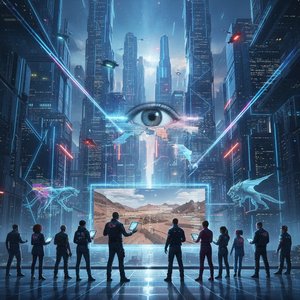
The Dawn of AI Art: From Algorithmic Beginnings to Neural Style Transfer
The term artificial intelligence visual art, or AI art refers to visual artwork generated or enhanced through the implementation of artificial intelligence (AI) programs, most commonly using text-to-image models (T2I or TTI). The process of automated...
For centuries, the creation of art has been inextricably linked with human skill, emotion, and intention. Yet, even before the digital age, whispers of automated artistry circulated – tales of mechanical marvels capable of rudimentary creative acts. These early imaginings, dating back to ancient automata designed by figures like Daedalus and Hero of Alexandria, represent a nascent desire to replicate the artistic process itself. However, it wasn’t until the mid-20th century, with the birth of artificial intelligence, that this ambition began to take tangible form. The 1950s witnessed the first tentative steps in algorithmic art, where computers generated images based on pre-defined rules and mathematical equations. These works, while often abstract and lacking the nuance of human creation, signaled a profound shift – the possibility of a machine participating in the artistic realm.
A pivotal moment arrived with Harold Cohen’s AARON system in the late 1960s. Unlike earlier programs that simply executed instructions, AARON aimed to *codify* the very act of drawing. Cohen sought to translate the complex decision-making process of an artist into a set of symbolic rules, allowing the computer to generate original images with a degree of autonomy. Though initially crude by today’s standards, AARON represented a groundbreaking attempt to understand and replicate artistic cognition. The system was exhibited in 1972 at the Los Angeles County Museum of Art, sparking debate about the nature of creativity and the role of technology in artmaking. These early experiments laid the conceptual groundwork for the sophisticated techniques that would emerge decades later, culminating in the revolutionary development of neural style transfer.
The recent explosion in AI art is largely attributable to advancements in deep learning, specifically Convolutional Neural Networks (CNNs). Neural Style Transfer (NST), first formally presented by Gatys et al. in 2015, allows algorithms to manipulate images, adopting the visual characteristics of another – effectively transferring the ‘style’ of a Van Gogh painting onto a photograph. This isn't merely applying a filter; it involves analyzing the content and style representations within neural networks trained on vast datasets of artwork. The CNNs deconstruct an image into layers representing different features—content (objects, scenes) and style (brushstrokes, colors, textures). By recombining these layers from two distinct images, NST creates a hybrid that embodies both.
Understanding Aesthetics: The Philosophical Foundations of Visual Appeal
Aesthetics is the branch of philosophy that studies beauty, taste, and related phenomena. In a broad sense, it includes the philosophy of art, which examines the nature of art, artistic creativity, the meanings of artworks, and audience appreciation....
Before delving deeper into the technical intricacies of AI art, it’s crucial to consider the philosophical underpinnings of aesthetics – the branch of philosophy concerned with beauty, taste, and the nature of artistic experience. For centuries, thinkers have grappled with questions about what makes an artwork appealing, whether aesthetic qualities are inherent to the object itself or subjective perceptions within the viewer's mind. The debate between objectivity and subjectivity remains central to aesthetic discourse.
Philosophers often discuss ‘aesthetic properties’ – features of an object that shape its appeal, such as balance, harmony, contrast, and complexity. These qualities can evoke a range of emotional responses, from joy and tranquility to awe and contemplation. The concept of 'disinterested pleasure,' articulated by Immanuel Kant, suggests that genuine aesthetic appreciation stems from detached observation rather than practical utility or personal gain. However, AI-generated art challenges this notion; the process is inherently driven by a specific goal – transforming an image to resemble another style. Yet, the resulting artwork can still evoke profound emotional responses and inspire subjective interpretations.
Furthermore, understanding the historical context of an artwork is essential for appreciating its aesthetic value. The Renaissance masters, for example, drew inspiration from classical sculpture and architecture, incorporating these influences into their own works. Similarly, Impressionist painters sought to capture the fleeting effects of light and color, drawing inspiration from Japanese woodblock prints. When employing NST, it’s important to consider how the chosen style interacts with the content image. A photograph of a modern cityscape rendered in the style of a Renaissance master might create an intriguing juxtaposition or a jarring incongruity depending on the viewer’s perspective.
A Historical Dialogue: How AI Art Connects with Artistic Traditions
Throughout art history, movements have emerged in reaction to or continuation of preceding ones. Impressionism built upon the foundations of Realism, while Cubism challenged traditional perspectives. Artists often borrow elements from diverse sources, creating hybrid styles that reflect their unique vision. AI-driven style transfer can be viewed as a modern extension of this tradition, offering new tools for artistic exploration and reinterpretation.
Karl Sims’ work in artificial life since the 1980s demonstrated early examples of AI generating visually compelling artwork. He received awards at Prix Ars Electronica for his videos using artificial evolution, showcasing how algorithms could create novel forms based on iterative processes. More recently, projects like Electric Sheep showcased the potential for automated aesthetic evolution, allowing users to contribute computing power to generate an infinite animation of fractal flames. These initiatives paved the way for the widespread adoption of NST and other AI art techniques.
The act of imitation itself has long been a cornerstone of artistic training. Students traditionally learn by copying the works of masters, absorbing their techniques and developing their own skills through emulation. AI-driven style transfer can be seen as a digital form of this practice, allowing users to explore different styles and experiment with various approaches without requiring years of formal training. It’s a powerful tool for understanding artistic principles and appreciating the nuances of different aesthetic traditions.
Limitations and Considerations: Navigating the Boundaries of AI Creativity
While NST offers remarkable possibilities, it’s essential to acknowledge its limitations. The algorithms are not inherently ‘creative’ in the human sense; they rely on pre-existing data and defined parameters. They excel at pattern recognition and replication but lack the conscious intent, emotional depth, and conceptual understanding that characterize human artistry.
The quality of the output depends heavily on the input images. A high-resolution photograph with clear details will yield a more compelling result than a blurry or poorly lit image. Similarly, the chosen style image should possess distinct characteristics that are readily transferable. Experimentation is key; different combinations of content and style can produce vastly different outcomes. Furthermore, ethical considerations arise regarding copyright and authorship. If an algorithm replicates the style of a specific artist, questions emerge about ownership and originality.
The ongoing debate surrounding AI art highlights the need for clear guidelines and responsible practices. While algorithms can generate visually stunning images, they cannot replicate the unique perspective and emotional resonance that comes from human experience. It’s important to view AI-generated art as a tool – a powerful medium for exploration and expression, but not a replacement for genuine artistic creativity.
Personalizing Your Vision: Practical Applications of Style Transfer for Photo Enhancement
The practical applications of AI-driven style transfer extend beyond artistic exploration. It offers exciting possibilities for personalized photo enhancement, creating unique gifts, and transforming everyday images into captivating works of art. One common application is turning personal photographs into paintings reminiscent of beloved classic styles.
Imagine transforming a family portrait into a Van Gogh masterpiece or recreating a cherished landscape in the style of Monet. This allows individuals to personalize their visual narratives and create unique heirlooms that capture precious memories in a new light. AI-driven style transfer can also be used for commercial purposes, such as creating marketing materials with distinctive aesthetics. Businesses can generate eye-catching visuals that align with their brand identity and resonate with target audiences.
The ability to rapidly iterate through different styles offers a significant advantage in fast-paced creative environments. Furthermore, the technology has potential applications in education and art therapy. Students can explore artistic techniques by experimenting with NST, while individuals undergoing therapy can express emotions and process experiences through visual creation. At OriginalUniqueArt.com, we believe in democratizing access to art, empowering everyone to transform their vision into reality.
The Future Canvas: Emerging Trends in AI-Driven Artistic Expression
The future of AI art is brimming with potential—advancements in generative models, neural network architectures, and VR/AR integration promise to unlock new levels of creativity. Current NST algorithms primarily focus on transferring style from existing images. However, emerging technologies like Generative Adversarial Networks (GANs) allow AI to create entirely novel artwork based on learned patterns.
GANs consist of two competing networks—a generator that creates images and a discriminator that evaluates their authenticity. These advancements will enable users to specify more complex artistic parameters, such as mood, emotion, or subject matter. Imagine requesting an image that evokes ‘nostalgia’ in the style of Impressionism or creating a surreal landscape with elements of Cubism and Abstract Expressionism.
The integration of AI art tools into virtual reality (VR) and augmented reality (AR) environments will further expand creative possibilities. Users can interactively manipulate images, experiment with different styles, and create immersive artistic experiences that blur the lines between the physical and digital worlds. At OriginalUniqueArt.com, we are committed to staying at the forefront of these innovations, offering our customers access to cutting-edge tools and techniques for exploring the boundless potential of AI art.