The Rise of AI Style Transfer: From Novelty to Artistic Tool
Neural style transfer (NST) software algorithms are able to manipulate digital images, or videos, in order to adopt the appearance or visual style of another image. NST algorithms are characterized by their use of deep neural networks for the sake of...
For centuries, the pursuit of artistic expression has been inextricably linked with human skill, intuition, and a profound understanding of materials. The very act of creation – whether wielding a brush, sculpting clay, or composing music – was considered uniquely human. Yet, in recent years, a new force has entered the arena: artificial intelligence. What began as a technological curiosity—the ability to manipulate images using algorithms—has rapidly evolved into a powerful tool for artistic transformation, capable of reimagining personal photographs in the manner of iconic masters. This isn’t simply about applying filters; it represents a fundamental shift in how we perceive and create art.
The initial fascination with AI-generated imagery often centered around novelty—the sheer spectacle of transforming a snapshot into something resembling a Van Gogh painting. However, as the technology matured, its potential became increasingly apparent. Neural style transfer (NST), at its core, is about disentangling content from style. Algorithms analyze the statistical patterns within two distinct images – one providing the ‘content’ (typically a photograph) and the other dictating the ‘style’ (e.g., Monet's 'Impression, soleil levant'). The algorithm then reconstructs the content image using the textures, colors, and brushwork characteristic of the chosen style. This process, involving complex convolutional neural networks that break down images into layers of abstraction, allows for a level of stylistic replication previously unimaginable.
The early results were often imperfect—sometimes beautiful, sometimes jarring. But advancements in machine learning have focused on customization and control, allowing users to fine-tune parameters and specify which image layers are affected. This has moved the technology beyond simple imitation towards genuine artistic expression, empowering individuals to explore their creative vision with unprecedented freedom.
Deconstructing Master Styles: How Algorithms ‘Learn’ Monet, Van Gogh & Picasso
Impressionism was a 19th-century art movement characterized by visible brush strokes, open composition, emphasis on accurate depiction of light in its changing qualities (often accentuating the effects of the passage of time), ordinary subject matter...
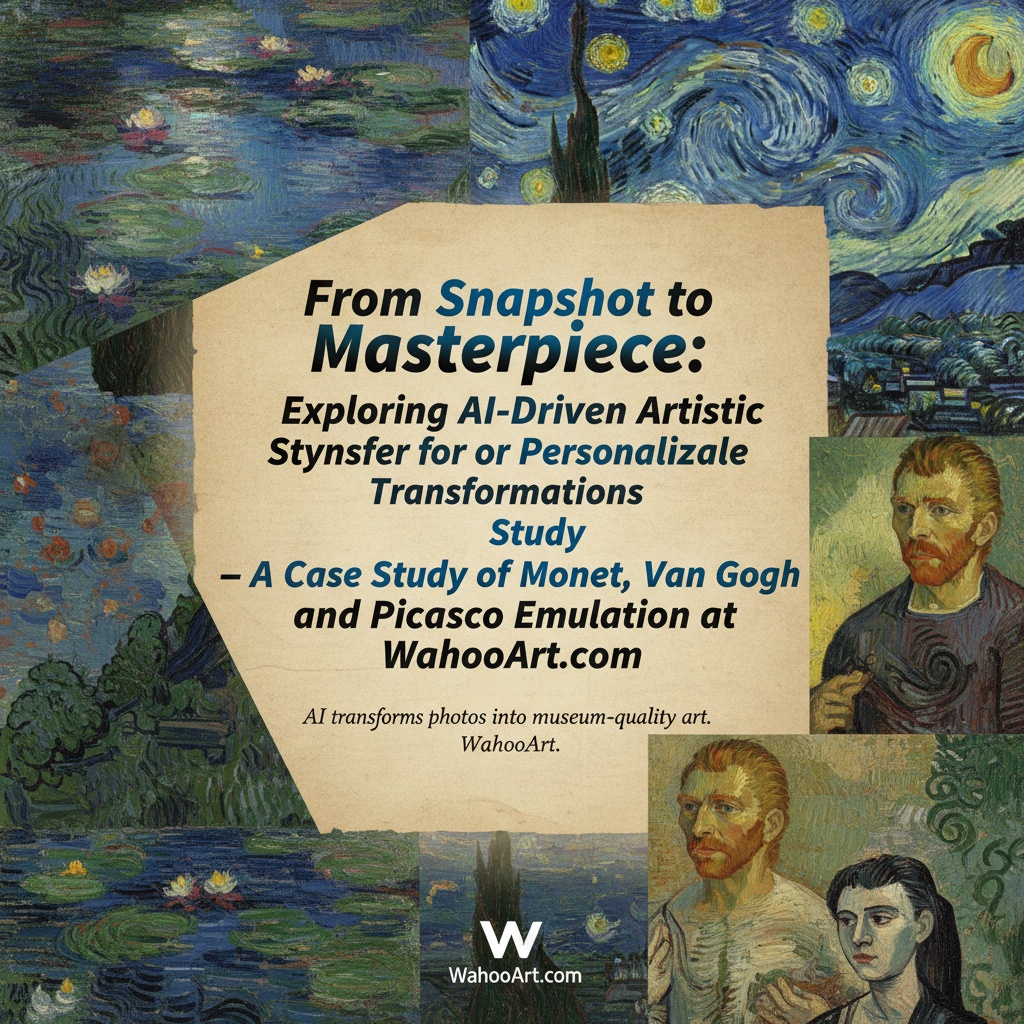
To truly appreciate the power of AI style transfer, it's essential to understand how algorithms “learn” the nuances of a particular artistic style. It isn’t about copying pixels; it’s about identifying and replicating underlying patterns. Consider Claude Monet’s Impressionism – a movement defined by visible brushstrokes, open composition, and an emphasis on capturing fleeting moments of light. An algorithm tasked with emulating this style must analyze not only the colors but also the spatial relationships between brushstrokes, the overall composition, and even the subtle variations in texture.
Similarly, replicating Vincent van Gogh’s distinctive aesthetic requires more than simply applying swirling brushstrokes. His work is imbued with a palpable sense of emotion and psychological depth. Algorithms must accurately reproduce his thick impasto technique, the dynamic movement of his brushstrokes, and the bold contrast between colors. This necessitates analyzing not only the visual elements but also the underlying emotional intent – a challenge that pushes the boundaries of current AI capabilities.
Pablo Picasso’s Cubism presents an entirely different set of challenges. It isn’t about replicating textures or colors; it’s about deconstructing and reassembling forms, presenting multiple perspectives simultaneously. Algorithms must accurately identify the key elements within an image and then reconstruct them using geometric shapes, distorted perspectives, and fragmented planes. This requires a sophisticated understanding of spatial relationships and compositional principles.
Beyond the Filter: Achieving Authentic Emulation – Texture, Color, and Composition
Successfully emulating these master styles demands more than just replicating visual elements; it requires capturing the *feeling* of the original artwork. For Monet, this means accurately reproducing his dappled sunlight, soft pastel color palettes, and broken brushstrokes. The algorithm must understand how light interacts with surfaces, creating a sense of atmosphere and movement. Achieving this necessitates careful attention to texture generation and color blending.
Van Gogh’s style requires replicating the energy and intensity of his brushwork. Algorithms often incorporate techniques to simulate the ‘energy’ of Van Gogh's style—introducing subtle distortions and exaggerations that capture the artist's unique vision. The success of this emulation hinges on preserving the content image while infusing it with a similar level of emotional intensity.
With Picasso, the challenge lies in maintaining visual coherence while embracing the inherent abstraction of Cubism. Algorithms must accurately identify the key elements within an image and then reconstruct them using geometric shapes, distorted perspectives, and fragmented planes. This requires a sophisticated understanding of spatial relationships and compositional principles, ensuring that the final result is both visually striking and intellectually engaging.
Personalizing Your Vision: Customization Options and Control in AI Art Creation
The true power of AI style transfer lies in its ability to personalize artistic expression. While simple apps offer pre-defined style options, the most compelling applications allow for nuanced adjustments. This includes controlling the ‘style weight’ – determining how strongly the target style is applied – as well as specifying which layers of the image should be affected. More advanced tools enable users to combine multiple styles, creating entirely unique aesthetic blends.
Recent developments have focused on improving the coherence and realism of generated images, addressing issues such as visual artifacts or distortions. The ability to refine prompts—providing detailed instructions about desired colors, textures, and compositions—is also crucial. Instead of simply requesting “a painting in the style of Klimt,” you might specify “a portrait in the style of Klimt, with gold leaf accents and a dark background.” This level of control empowers users to move beyond generic transformations and create truly personalized artworks.
The Photographer’s Role: Optimizing Images for Stunning Style Transfers
While AI algorithms are remarkably sophisticated, the quality of the source photograph remains paramount. Low-resolution images will inevitably result in pixelation and loss of detail when enlarged. A high-resolution file allows the algorithm to capture subtle nuances and textures, ensuring a lifelike representation.
Composition also plays a crucial role – the photograph should complement the original artwork’s layout and focal points. Consider the rule of thirds, leading lines, and negative space to create visual balance and draw the viewer's eye. Color harmony is equally important; the colors in the photograph must blend seamlessly with the existing palette of the target style. Professional algorithms employ sophisticated color grading techniques to create a natural transition between the two images, subtly adjusting tones and values to achieve visual unity.
AI as Artistic Partner: Collaboration, Creativity, and the Future of Image Transformation
Ultimately, AI art isn't about replacing artists; it’s about augmenting their capabilities. The process is inherently collaborative, requiring human input at every stage. The initial prompt—the seed of the creative vision—is crucial. Artists can use AI to generate variations on existing themes, explore different stylistic approaches, or create entirely new compositions.
Furthermore, AI can assist with tedious tasks such as color correction and texture generation, freeing up artists to focus on more conceptual aspects of their work. The result is a synergistic partnership between human creativity and artificial intelligence – a collaboration that promises to unlock new possibilities in the world of art. At OriginalUniqueArt, we believe this technology democratizes artistic expression, allowing anyone to transform their cherished memories into stunning works of art, inspired by the masters and tailored to their unique vision.