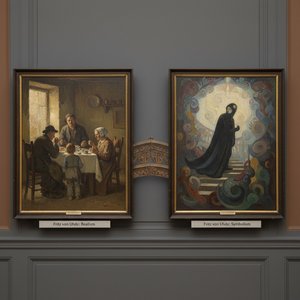
Introduction
German impressionist painters captured the fleeting essence of light and atmosphere through a unique lens that bridged the gap between traditional academic rigor and the radical spontaneity of the French movement. Emerging during a period of profound industrial and social transformation in the late 19th and early 20th centuries, these artists moved their easels out of the controlled environment of the studio and into the open air. They sought to translate the sensory experience of a single, passing moment—the shimmer of sunlight on a river, the hazy quality of a morning mist, or the vibrant energy of a bustling urban street—onto the canvas with rapid, visible brushstrokes.
This movement was not merely a stylistic choice but a cultural response to a changing world. While they drew inspiration from the light-drenched palettes of their French counterparts, German impressionists often infused their work with a distinct sense of psychological depth and a profound connection to the local landscape and social realities. Their ability to balance the ephemeral effects of light with a structured, emotive composition allowed them to navigate the transition from realism to modernism, making their work a vital link in the evolution of European art history.
Today, these masters remain essential for understanding the roots of modern visual perception. Their works continue to resonate because they prioritize the subjective experience of sight, inviting viewers to feel the temperature and movement of a scene rather than just observe it. By exploring the lives and techniques of ten pivotal figures—including Max Liebermann, Max Slevogt, and Fritz von Uhde—we gain a deeper appreciation for the light, color, and soul that define this transformative era of German art.
Max Liebermann
 Free hour at Amsterdam orphanage - Max Liebermann
Max Liebermann (1847–1935) stands as a central figure among German impressionist painters, having successfully adapted the fleeting light and spontaneous brushwork of the French movement to a distinctly German sensibility. After moving beyond his initial studies in law and philosophy, his artistic vision was forged through travels in Weimar, Paris, and the Netherlands. He was deeply moved by the boldness of Édouard Manet, a connection that helped him transition from a naturalistic depiction of everyday life toward a more impressionistic approach to light and color.
His work is characterized by an exquisite sensitivity to atmosphere, whether he was capturing the luminous, sun-drenched garden scenes at Wannsee or crafting insightful portraits of both the working class and the bourgeoisie. In his representative work, Free hour at Amsterdam orphanage (1876), we see the early stages of this evolution. The piece utilizes loose, visible brushstrokes and natural lighting to transform a communal courtyard into a scene of movement and life. By focusing on the essence of a moment rather than rigid detail, Liebermann bridged the gap between realism and the impressionist desire to translate the very experience of light onto the canvas.
Walter Sickert
 Portrait of the artist's first wife, née Ellen Cobden - Walter Sickert
The Portrait of the artist's first wife, née Ellen Cobden serves as a profound example of the artist's ability to navigate light and shadow. In this 1893 work, Sickert utilizes a soft, directional light to strike the subject's face and neck, leaving the rest of the composition to dissolve into a dark, indistinct background. The palette is defined by deep earth tones—umber, sienna, and charcoal—which create a striking chiaroscuro effect against the pale flesh tones of the sitter.
Born in Munich in 1860, Walter Sickert belongs to this group of German impressionist painters due to his German origins and his early stylistic development. Though he became a central figure in British art, his roots in Germany and his training under James Abbott McNeill Whistler at the Slade School deeply informed his approach to tonal studies. His work often captures the gritty, theatrical reality of urban life, moving away from the bright, outdoor focus of traditional Impressionism toward a more psychological, Post-Impressionist exploration of interior scenes and the shadows of the city. Through a heavy impasto and a preference for painting alla prima, he transformed the fleeting atmosphere of modern life into enduring, dramatic compositions.
Fritz von Uhde
 Austrian officer on horse back - Fritz von Uhde
Fritz von Uhde stands as a pivotal figure among German impressionist painters, primarily due to his courageous departure from the rigid, studio-bound traditions of the Dresden Academy. By embracing plein-air painting, he brought a revolutionary sense of natural light to both humble peasant life and profound religious scenes. His work serves as a vital bridge between the grounded observations of Realism and the atmospheric spontaneity of the Impressionist movement.
A fascinating period of his life involved a detour from formal art studies to serve as a Lieutenant and horsemanship instructor in the army. This military service, which occurred after his dissatisfaction with conservative academic structures, sharpened his keen observational skills. We see an early manifestation of his ability to capture character and movement in Austrian officer on horse back. In this 1874 oil on canvas, Uhde utilizes expressive brushwork and a sophisticated play of light to define the contours of the rider and horse, prioritizing atmospheric depth over sharp, photographic outlines.
By focusing on how light interacts with its subject in a natural setting, Uhde helped define the visual language of German Impressionism, moving away from the artificiality of the studio to capture the fleeting essence of a moment.
Max Slevogt
 Frau Voll mit Tochter - Max Slevogt
Max Slevogt (1868–1932) represents a vital evolution within the German Impressionist movement, marking a decisive departure from the heavy, dark tonalism of the Munich Academy toward a more luminous, sensory engagement with the world. His artistic soul underwent a profound transformation following a pivotal visit to Paris in 1889, where the influence of the French avant-garde encouraged him to abandon rigid studio compositions in favor of the spontaneous, atmospheric vitality of plein air painting.
In his 1895 work, Frau Voll mit Tochter, we witness this transition in real-time. While the piece retains a certain somber, dramatic weight, it moves away from strict academicism toward a more immediate, tactile reality. The painting captures a fleeting, quiet moment of domesticity, utilizing loose, energetic brushwork and a textured impasto that emphasizes the physical presence of the subjects over photographic precision. Slevogt’s ability to balance these heavy, emotional shadows with sudden bursts of color—such as the striking blue of a garment—showcases the very essence of the Impressionist impulse: capturing the ephemeral dance of light and the psychological depth of a single, unadorned moment.
Lothar Von Seebach
 Forêt en hiver - Lothar Von Seebach
Lothar von Seebach (1853–1930) was a vital figure in the Alsatian art scene, known for his profound connection to the spirit of Strasbourg. After studying at the Karlsruhe Academy of Fine Arts under Ferdinand Keller, Seebach chose a life of artistic independence over academic prestige, famously declining professorships to remain immersed in his craft. His work is a quintessential example of the German impressionist movement, as he moved away from rigid academicism to capture the immediate, fleeting sensations of light and atmosphere. Rather than focusing on polished studio finishes, he embraced a loose, expressive brushwork that prioritized the emotional essence of a scene.
In his representative work, Forêt en hiver, we see this mastery of light and texture. The painting captures a quietude in the Alsatian woods, where the air feels heavy and still. He utilizes a delicate balance of warm ochre tones from the fallen leaves against the cool, muted grays of a misty, overcast sky. Through broken brushstrokes and atmospheric perspective, Seebach transforms a simple winter landscape into a tranquil, tactile experience of the season's dormancy.
Friedrich Kallmorgen
 Old Woman with Bundle of Flax - Friedrich Kallmorgen
Friedrich Kallmorgen stands as a vital figure among German impressionist painters due to his profound ability to capture the fleeting atmosphere of both maritime environments and rural life. His approach to light and movement, often developed through direct observation in the Lüneburg Heath and the Harz Mountains, aligns him with the impressionist desire to document the immediate sensory experience of a scene. Trained at the Kunstakademie Düsseldorf and the Academy of Fine Arts in Karlsruhe under masters like Eugen Dücker and Hans Fredrik Gude, Kallmorgen moved beyond academic rigidity to embrace the shifting nuances of the natural world.
His mastery of light and texture is exemplified in his 1894 work, Old Woman with Bundle of Flax. In this evocative piece, Kallmorgen utilizes a somber, earthy palette to depict a solitary figure within a dimly lit, rustic interior. The composition focuses on the tactile qualities of the subject—the white headscarf, the dark apron, and the voluminous, textured bundle of flax—creating an intimate study of manual labor. By prioritizing the interplay of light and shadow over sharp outlines, Kallmorgen demonstrates the core tenets of the impressionist movement through a distinctly German lens.
Gotthardt Kuehl
 The blue room - Gotthardt Kuehl
A visitor encountering a work by Gotthardt Kuehl (1850–1915) immediately senses a sophisticated dialogue between academic precision and the fleeting effects of light. His paintings are characterized by a masterful handling of atmosphere, where forms are not defined by rigid outlines but by the rhythmic application of broken color and textured brushwork. This approach allowed him to capture the subtle nuances of light as it interacts with domestic interiors and the landscapes of Dresden.
Kuehl stands as a pivotal figure among German impressionist painters, largely due to his transformative years in Paris between 1878 and 1889. It was there that he absorbed the revolutionary techniques of the French Impressionists, blending these modern sensibilities with the rigorous training he received at the Dresden and Munich Academies. This synthesis enabled him to move beyond traditional realism toward a more atmospheric, light-drenched style.
In his 1900 masterpiece, The blue room, we see this mastery on full display. The composition is a quiet meditation on light and shadow, where sunbeams spill across a wooden floor to meet the deep, saturated blues of a draped table. Rather than using black for shadows, Kuehl employs layered, cool tones, turning a simple domestic corner into a profound study of stillness and color harmony.
Walter Ufer
 Callers - Walter Ufer
Born in Hückeswagen, Germany, in 1876, Walter Ufer represents a fascinating bridge between European academic rigor and the vibrant, light-drenched spirit of Impressionism. His journey began with a technical foundation in lithography and printmaking, which instilled in him a profound understanding of tonal depth. This precision was further refined through intensive studies at the prestigious academies of Hamburg and Dresden, as well as in Munich. It was this sophisticated German training that allowed him to eventually master the ephemeral qualities of light and shadow when he transitioned into the Impressionist style.
Ufer’s legacy is most deeply felt through his role in the influential "Taos Ten" in New Mexico. He utilized the Impressionist approach—focusing on the immediate, atmospheric effects of sunlight—to capture the dignity of Native American life. In his 1926 work, Callers, we see this mastery on full display. The painting depicts a quiet, social moment of individuals on horseback, using a nuanced palette to translate the warmth and rhythm of Taos Pueblo into a cohesive, evocative scene. His ability to synthesize European formal techniques with the rugged, sun-soaked landscapes of the American West marks him as a vital figure in the evolution of the movement.
Karl Heffner
 Chamonix And Mont Blanc - Karl Heffner
Karl Heffner (1849–1925) stands as a vital figure among German impressionist painters due to his ability to translate the fleeting, atmospheric qualities of nature into emotive visual experiences. While his training in Munich under masters like Adolf Heinrich Lier provided him with a rigorous foundation in composition, Heffner moved beyond mere academic realism to embrace the core tenets of Impressionism: the pursuit of light and the immediate, transient moment. His restless spirit led him from the moody, melancholic moors of England to the luminous warmth of Italy, always seeking to capture how light interacts with the physical world.
In his representative work, Chamonix And Mont Blanc, Heffner demonstrates this mastery of atmospheric realism. The painting captures a specific, transient moment in the high Alps, where the massive, snow-capped summits command the sky under a diffused, soft light. Rather than focusing on sharp, static edges, he employs visible, layered brushstrokes that suggest the tactile reality of earth and ice. By utilizing atmospheric perspective to pale the distant peaks and balancing the permanence of stone against the ephemeral light of the glaciers, Heffner exemplifies the Impressionist desire to paint the sensation of a landscape rather than just its form.
Paul Baum
 Vorfruhlingsweg Nach Niedergrunstedt - Paul Baum
Paul Baum (1859–1932) stands as a serene master within the German impressionist movement, known for his ability to capture the fleeting, tranquil essence of the natural world. His artistic evolution was deeply shaped by his travels and his engagement with the light-drenched techniques of masters like Monet and Pissarro. A significant turning point in his career occurred in 1895 when he was awarded the Villa Romana prize, a residency in Rome that infused his work with a luminous palette and a sophisticated sense of atmospheric perspective.
His time spent in Tuscany further refined his ability to translate the warmth and light of the Italian countryside into evocative, sensory experiences. In his representative work, Vorfruhlingsweg Nach Niedergrunstedt, we see the hallmark of his impressionist approach. Rather than relying on rigid outlines, Baum uses soft brushstrokes and subtle tonal gradations to define a damp, muddy dirt road winding through a rural landscape. Through the interplay of light on the wet earth and the diffused sky, he captures a specific, ephemeral moment in time, emphasizing the tactile textures of a changing season.
Conclusion
The legacy of these German impressionist painters lies in their ability to capture the fleeting nuances of light and the shifting atmosphere of the landscape, moving away from rigid academicism toward a more visceral, sensory experience. From the social realism of Max Liebermann to the luminous, outdoor studies of Fritz von Uhde and Max Slevogt, each artist contributed a unique perspective to the movement, whether through capturing the quietude of the German countryside or the vibrant energy of modern life. Their collective work transformed how light was perceived on canvas, turning momentary impressions into enduring visual poetry.
At OriginalUniqueArt.com, we invite you to bring this era of light and color into your own living space. Through our full collection, you can explore a wide array of masterpieces from this influential period. Our skilled artists specialize in creating museum-quality, hand-painted oil reproductions that preserve the authentic brushstrokes and textural depth of these original works, allowing you to live with the beauty of German Impressionism every day.