The Birth of the 'Wild Beasts': Origins of the Fauvist Revolution
At the dawn of the twentieth century, a seismic shift occurred within the hallowed halls of the Parisian art scene, a tremor that would forever alter the trajectory of modern expression. The term Fauvism, much like the movement itself, arrived with a startling, unbridled energy that caught the establishment by surprise. It was during the 1905 Salon d'Automne that the critic Louis Vauxcelles, upon witnessing the jarring juxtaposition of vibrant, non-naturalistic hues against more traditional forms, famously recoiled, describing the artists as Les Fauves—the Wild Beasts. This was not merely a critique of technique, but an instinctive reaction to a perceived loss of control, a visceral response to artists who seemed to have abandoned the constraints of reality in favor of a more primal, unmediated sensory experience.
This revolution did not emerge from a vacuum; it was the culmination of years of experimentation with light and color by the Impressionists and Post-Impressionists. However, where the Impressionists sought to capture the fleeting nuances of atmosphere, the Fauves sought to capture the enduring intensity of emotion. They stripped away the academic requirement for mimetic accuracy, choosing instead to use the canvas as a stage for psychological truth. The movement was characterized by a rejection of three-dimensional perspective and the subtle modeling of form, replaced by a flattened pictorial space that emphasized the raw power of the medium itself.
As these artists gathered in the sun-drenched landscapes of Southern France, particularly in coastal enclaves like Collioure, the seeds of this rebellion took deep root. The landscape was no longer just a subject to be observed, but a catalyst for a new visual language. This period marked the transition from art as a window into the world to art as an explosion of the artist's internal landscape, setting the stage for a century of radical aesthetic inquiry.
Chromatic Rebellion: The Liberation of Color from Form
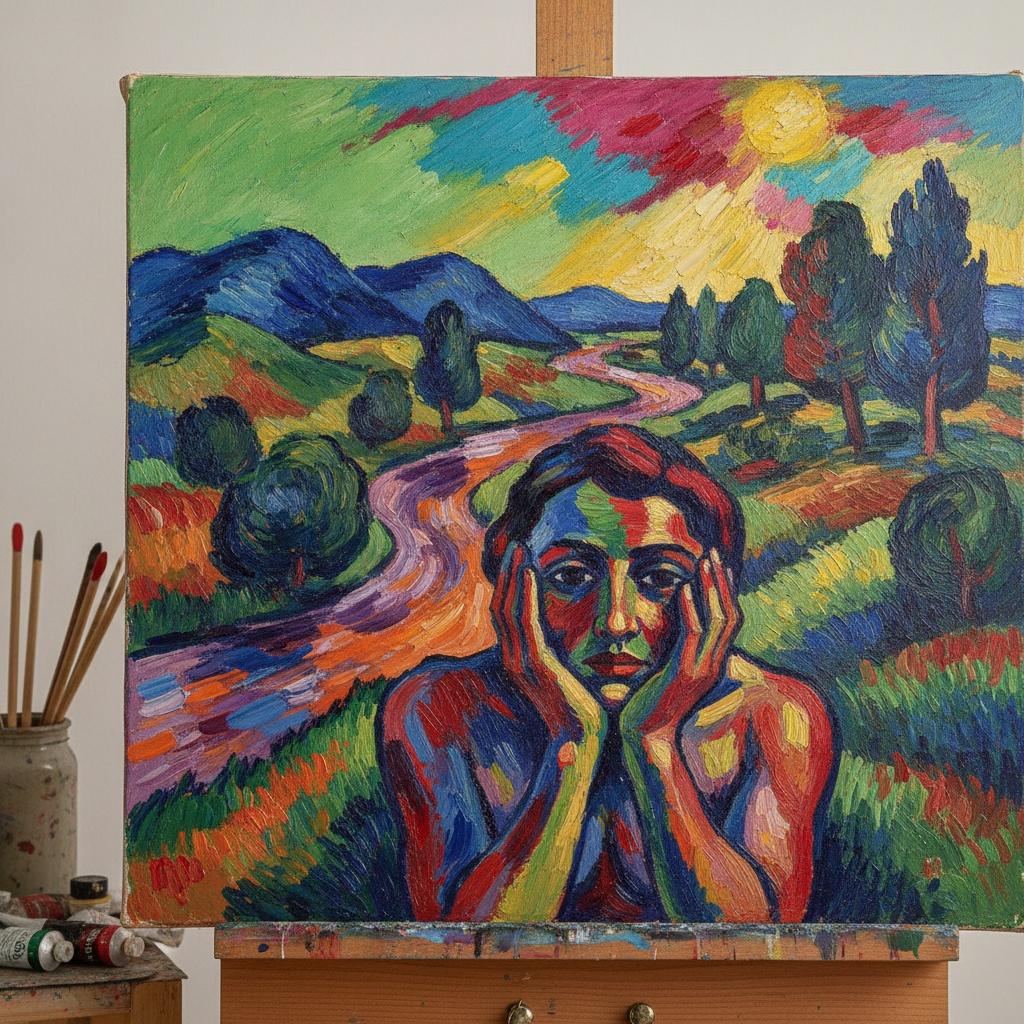
To understand Fauvism is to witness the moment color was finally granted its independence. For centuries, color had been subservient to line and form; it existed to describe the texture of a petal, the shadow of a fold, or the depth of a valley. The Fauves, however, enacted a chromatic rebellion, severing the umbilical cord between color and its descriptive duty. In their hands, a sky could be a searing vermilion, and a tree trunk could pulse with an electric cobalt. This was not a lack of skill, but a deliberate, sophisticated choice to use arbitrary color as a tool for emotional resonance.
< p>This liberation allowed for a new kind of structural integrity within the painting. Without the traditional reliance on chiaroscuro—the gradual transition from light to dark—to create volume, the artists relied on the juxtaposition of complementary colors to generate movement and depth. The vibration created by placing a bright orange next to a deep blue creates a visual tension that mimics the pulse of life itself. This technique transformed the canvas into a rhythmic arrangement of pigments, where the eye is led not by the logic of anatomy or architecture, but by the sheer magnetism of hue.This approach demanded a profound courage from both the artist and the viewer. To look upon a Fauvist work is to accept that the "truth" of a scene lies not in its literal appearance, but in its energetic essence. By decoupling color from form, the movement paved the way for future abstractions, proving that pigment alone possesses the capacity to communicate complex human sentiments without the need for recognizable iconography.
Masters of Intensity: Analyzing Matisse and Derain
At the heart of this tempestuous movement stood two titans whose individual styles, while sharing a common vocabulary of intensity, offered distinct perspectives on the Fauvist ideal. Henri Matisse, often regarded as the movement's intellectual anchor, approached color with a sense of poetic grace and structural balance. In works such as Le Thé dans le jardin, one observes how Matisse could utilize a bold palette to create a sense of serene, everyday life, yet infuse it with an underlying vitality that transcends mere decoration. His mastery lay in his ability to organize intense color into harmonious compositions that felt both radical and profoundly balanced.
In contrast, André Derain brought a more rugged, almost architectural energy to the movement. His depictions of the French coast, particularly his celebrated works centered around Collioure, serve as quintessential examples of Fauvist vigor. In masterpieces like Collioure, the Village and the Ocean, Derain utilized thick, painterly strokes and a mosaic-like application of color to capture the shimmering heat and salt-sprayed atmosphere of the Mediterranean. His work often feels more tactile than Matisse's, with brushstrokes that seem to physically wrestle with the light, creating a sense of dynamic movement that mirrors the ebb and flow of the sea.
While Matisse sought a certain equilibrium and decorative elegance, Derain pushed the boundaries of texture and spontaneous execution. Together, they defined the dual nature of Fauvism: it was at once a highly controlled exploration of compositional harmony and an untamed outburst of painterly instinct. Their collective influence ensured that the movement would not be remembered merely as a fleeting moment of chaos, but as a sophisticated reimagining of what a painting could achieve.
Beyond the Canvas: The Emotional Resonance of Fauvist Landscapes
The landscapes of the Fauvists are far more than mere topographical studies; they are emotional topographies. When we look at The Fishermen of Collioure, we are not simply seeing a maritime scene; we are experiencing the rhythmic labor and the sun-drenched vitality of the coastal life through a lens of heightened reality. The landscape becomes a vessel for the artist's temperament. The use of saturated greens, fiery yellows, and deep indigos serves to amplify the sensory experience of the viewer, evoking the heat of the sun, the coolness of the shade, and the saltiness of the breeze.
This emotional resonance is achieved through a deliberate simplification of the natural world. By stripping away the distracting details of fine texture and minute detail, the Fauvists allowed the fundamental elements of nature—light, color, and shape—to speak more clearly. This reductionism creates a sense of universality; the landscape ceases to be a specific, localized place and becomes an archetypal expression of nature's power. The viewer is invited to feel the landscape rather than merely observe it.
Furthermore, the interaction between the land and the sea in these works often mirrors the internal conflict of the movement itself—the tension between the stability of form and the fluidity of color. The ruggedness of the painted earth provides a foundation for the more volatile, expressive applications of paint used to depict the water and sky, creating a visual metaphor for the very essence of the Fauvist struggle: finding order within the beautiful chaos of raw emotion.
Fauvism’s Legacy: From Radical Experimentation to Modern Expression
Though the movement itself was relatively short-lived, its impact on the trajectory of twentieth-century art is immeasurable. The Fauvist rebellion broke the final shackles of representational tradition, providing the essential groundwork for Expressionism, Cubism, and eventually, the total abstraction of the mid-century. The permission to use color as an independent emotional agent became a cornerstone of modern artistic practice, influencing generations of artists who sought to explore the psychological depths of their subjects.
The legacy of the "Wild Beasts" lives on in every artwork that prioritates subjective experience over objective reality. We see their influence in the emotive brushwork of the German Expressionists and in the vibrant, color-driven compositions of later modernists. They taught us that art does not need to mirror the world to be true; it only needs to be honest in its expression of feeling.
For the contemporary collector and enthusiast, the works of this era remain as vital and provocative as they were in 1905. To encounter a Fauvist masterpiece is to be reminded of the transformative power of color and the enduring human desire to capture the uncontainable essence of life. As we continue to navigate an increasingly complex visual world, the raw, unfiltered energy of the Fauves serves as a profound testament to the enduring strength of human creativity.
At OriginalUniqueArt.com, we are dedicated to preserving this legacy of human creativity. Our mission is to make fine art accessible to everyone, offering exquisite, hand-painted oil reproductions that capture the true soul and texture of historical masterpieces. Whether you seek the vibrant energy of a Derain or the poetic balance of a Matisse, our master artists specialize in recreating the visible brushstrokes and deep tonal ranges that define these iconic movements. From custom portrait commissions to large-scale architectural murals, we bring the majesty of art history into your personal space with unparalleled craftsmanship and a commitment to excellence.