The Essence of Abstraction: Defining the Color Field Movement
To encounter a Color Field painting is to step away from the frantic narrative of the physical world and enter a realm of pure, unadulterated presence. Emerging in the mid-20th century as a profound evolution of Abstract Expressionism, this movement sought to strip away the anecdotal and the figurative, leaving behind only the essential dialogue between pigment and canvas. Unlike the gestural intensity of action painting, which celebrates the visible struggle of the artist’s hand, Color Field painting invites a more meditative stillness. It is an art of expansion, where the boundaries of the frame seem to dissolve into an infinite horizon of hue.
This movement was never merely about the application of paint; it was a philosophical inquiry into the nature of perception itself. By reducing the subject matter to large, flat areas of color, artists challenged the viewer to move beyond looking at a painting and instead begin living within it. The canvas ceases to be a window into another scene and becomes an environment—a chromatic landscape that breathes with its own internal logic. For the discerning collector, this shift represents a transition from collecting objects of representation to acquiring vessels of atmosphere.
Chromatic Resonance: The Emotional Architecture of Pure Color
Color possesses a unique, primal ability to bypass the intellect and speak directly to the human psyche. In the hands of the Color Field masters, color is not used to describe light or shadow, but to construct an emotional architecture. When we observe deep, pulsating reds or somber, receding blues, we are experiencing a physiological response that predates language. This resonance is the heartbeat of the movement, where the vibration of one hue against another creates a tension that can evoke everything from profound tranquility to existential dread.
The power of this technique lies in its ability to manipulate the viewer's sense of space and time. A carefully balanced field of color can create an illusion of immense depth, pulling the eye into a bottomless void, or it can flatten the plane, demanding an immediate, visceral confrontation with the surface. This is the true alchemy of the movement: using the simplest of elements—pigment and light—to orchestrative complex psychological states. It is a sophisticated form of visual music, where each shade acts as a note in a silent, yet deafening, symphony of emotion.
Masters of the Infinite: From Rothko’s Depth to Morris Louis’ Fluidity
The history of this movement is best understood through the divergent yet complementary legacies of its titans. Mark Rothko remains perhaps the most iconic figure, his works characterized by soft-edged, luminous rectangles that seem to hover prec de la mort, suspended in a state of eternal twilight. To stand before a Rothko is to encounter a spiritual threshold; his use of layered, translucent glazes creates a sense of breathing light that invites deep introspection and often, a profound sense of the sublime.
In stark contrast, the work of Morris Louis offers a different kind of transcendence through movement and flow. His "Veil" paintings, such as the celebrated High or the structurally rhythmic Number 1-82, utilize the technique of staining, where thinned acrylic paint is poured onto unprimed canvas. This allows the pigment to soak into the fibers, creating a seamless integration of color and substrate. Where Rothko offers a heavy, contemplative presence, Louis provides a fluid, organic elegance, with lines that bleed and bloom like ink in water. Together, these masters represent the dual poles of the movement: the weight of human emotion and the weightless beauty of pure form.
The Tactile Sublime: Texture and Light in Abstract Expressionism
While the term "field" might suggest a lack of texture, the reality is far more nuanced. The true mastery of Color Field painting lies in the subtle interplay between the flatness of the color and the physical reality of the medium. In the works of artists like Sigrid Burton, we see a contemporary evolution known as chromatic expressionism, where atmospheric color fields are infused with allusions to nature, blending the influence of Kandinsky with the ethereal qualities of the Light and Space movement. Here, the texture is not found in thick impasto, but in the way light interacts with the varying densities of paint.
The tactile experience of these works is often discovered in the minute details: the way a stain settles into the weave of a cotton canvas, or the slight, intentional variations in pigment saturation. This creates a "tactile sublime"—a sensation where the eye perceives depth and texture that the hand cannot touch, yet the soul feels intimately. It is this delicate balance between the ethereal and the material that gives these paintings their enduring power, making them much more than mere decorations; they are living, breathing entities of light and substance.
Curating Atmosphere: Integrating Color Field Works into Modern Interiors
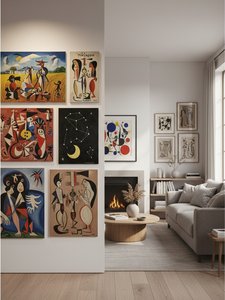
For the modern collector and interior designer, Color Field paintings offer an unparalleled opportunity to define the architectural soul of a space. Because these works function as environments rather than mere images, they possess a unique ability to anchor a room. A large-scale, multi-panel installation can transform a wide hallway or a grand staircase into a cohesive, modern gallery, with colors flowing seamlessly across multiple canvases to create a sense of rhythmic continuity.
Integrating such powerful works requires a sophisticated approach to color and light. A vibrant, high-contrast piece can serve as a bold focal point in a minimalist setting, while more muted, atmospheric works can provide a subtle, unifying undertone to a complex interior palette. Whether through the use of custom-sized murals or meticulously framed reproductions, the goal is to allow the painting to dictate the mood of the architecture, turning a physical structure into a curated sanctuary of aesthetic reflection.
OriginalUniqueArt: Preserving the Legacy of Abstract Mastery
At OriginalUniqueArt.com, we believe that the profound emotional impact of fine art should be accessible to the global community of collectors. Our mission is to preserve the legacy of masters like Rothko and Louis by providing museum-quality, hand-painted reproductions that capture the true essence of their work. Each piece is a labor of passion, meticulously crafted by artists trained in prestigious academies, ensuring that the visible brushstrokes, tonal depth, and textural nuances of the original movement are honored.
We specialize in transforming the ephemeral beauty of Color Field painting into lasting physical treasures. From bespoke commissions that allow you to "remix" art history to large-format architectural murals that redefine your space, our service is designed for the discerning individual who values authenticity and craftsmanship. Through our rigorous six-step process—from digital mockup to final varnish—we ensure that every work we deliver is not just a reproduction, but a new masterpiece for your collection.