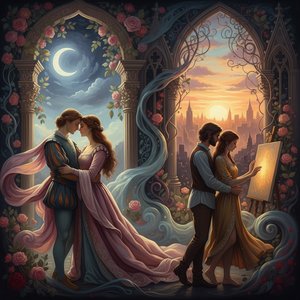
Introduction: The Dawn of Feeling – Romanticism's Rejection of Enlightenment Reason
Romanticism (also known as the Romantic movement or Romantic era) was an artistic and intellectual movement that originated in Europe towards the end of the 18th century. The purpose of the movement was to advocate for the importance of subjectivity...
The late eighteenth century witnessed a seismic shift in artistic and intellectual thought, a turning away from the cool rationality of the Enlightenment towards a celebration of emotion, intuition, and the power of the individual. This was the birth of Romanticism, an attitude as much as it was a style – a profound re-evaluation of what constituted beauty, truth, and the human experience. For decades prior, art had largely adhered to principles of order, balance, and classical form. The French Revolution, with its tumultuous upheaval and subsequent Napoleonic era, served as a catalyst for change, exposing the fragility of reason and prompting artists to look inward, seeking solace and meaning in subjective experience rather than objective reality. It wasn’t merely a stylistic rebellion; it was a fundamental re-orientation of values, prioritizing feeling over fact, imagination over imitation, and the untamed wilderness of nature over the manicured gardens of societal convention.
Nature as Spiritual Mirror: Experiencing the Sublime in Landscape Painting
 The Cemetery Gate (The Churchyard)
Central to Romanticism’s ethos was a profound reverence for nature. But this wasn't simply an appreciation for picturesque scenery; it was a quest to encounter something *beyond* the tangible world, a connection to the infinite and the divine. The concept of the “sublime” – that awe-inspiring mixture of terror and beauty – became paramount. Artists sought out landscapes capable of evoking these powerful emotions: towering mountains, stormy seas, vast forests shrouded in mist. Caspar David Friedrich’s work exemplifies this perfectly. His paintings aren't depictions *of* nature so much as meditations *on* it. Riesengebirge (Memories of the Riesengebirge), for example, isn’t merely a landscape; it’s an exploration of mortality and spirituality, rendered in muted colors and meticulous detail that draws the viewer into a contemplative state. The figures within his scenes are often small, dwarfed by the immensity of their surroundings, emphasizing humanity's insignificance in the face of nature’s grandeur. This wasn’t about dominance over the natural world but rather a humbling recognition of its power.
The Individual Unleashed: Emotion, Passion, and the Romantic Hero
Romanticism championed the individual – not as a rational being governed by societal norms, but as an emotional creature driven by passion, intuition, and imagination. This focus manifested in art through portraits that delved into psychological states, literary works celebrating rebellious figures, and a general fascination with the exceptional personality. The “Romantic hero” emerged: often brooding, isolated, and at odds with society, yet possessing a profound inner life and unwavering conviction. This wasn’t necessarily about outward heroism; it was more about an internal struggle for authenticity and self-expression. Artists explored themes of love, loss, melancholy, and the search for meaning in a world increasingly perceived as fragmented and alienating. The emphasis shifted from portraying historical events to capturing the inner turmoil of the human spirit.
Goya’s Dark Visions & Friedrich’s Symbolic Landscapes: Masters of Emotional Depth
Two artists stand out as particularly potent embodiments of Romanticism's emotional intensity: Francisco Goya and Caspar David Friedrich. While their approaches differed significantly, both profoundly challenged conventional artistic norms. Goya, initially a court painter, transitioned from depicting aristocratic portraits to creating unflinching critiques of Spanish society and the horrors of war. The Card Players, for instance, isn’t simply a genre scene; it's a stark portrayal of human isolation and the brutal realities of life. His later “Black Paintings” are even more unsettling, delving into themes of madness, violence, and despair. Friedrich, on the other hand, focused his attention on the spiritual realm, using landscape as a vehicle for exploring existential questions. The Cemetery Gate (The Churchyard), with its somber atmosphere and symbolic imagery, invites contemplation on death and the transience of life. Both artists, however, shared a commitment to emotional honesty and a willingness to confront difficult truths.
Beyond Beauty: Exploring Sensuality and the Gothic Revival in Romantic Art
Romanticism wasn’t solely concerned with sublime landscapes and introspective portraits; it also embraced sensuality and a fascination with the darker aspects of human experience. The Gothic revival, with its emphasis on medieval architecture, literature, and mythology, played a significant role. Ruins, castles, and ancient forests evoked a sense of mystery, nostalgia, and the power of the past. This wasn’t simply about aesthetic preference; it was a rejection of Enlightenment rationality in favor of imagination and emotional resonance. Artists explored themes of forbidden love, supernatural encounters, and the allure of the unknown. The exploration of these darker themes often involved a heightened awareness of physicality and emotion, pushing boundaries and challenging societal conventions. This embrace of the irrational and the sensual contributed to the movement’s enduring appeal.
Legacy of a Movement: Romanticism's Enduring Influence on Modern Art
Romanticism didn’t simply disappear with the advent of Realism or Impressionism; its influence permeated subsequent artistic movements. The emphasis on individual expression, emotional intensity, and the power of imagination laid the groundwork for Symbolism, Expressionism, and even Abstract art. Artists continued to explore themes of nature, spirituality, and the human condition, building upon the foundations established by Friedrich, Goya, and their contemporaries. The Romantic sensibility – a yearning for authenticity, a rejection of societal constraints, and a profound connection to the natural world – continues to resonate with artists and audiences today. At OriginalUniqueArt.com, we celebrate this enduring legacy by offering high-quality reproductions of Romantic masterpieces, allowing you to bring these powerful works into your own home and experience their emotional depth firsthand. Explore our collection and discover the timeless beauty and profound insights of this revolutionary movement.