Decoding the Canvas: Mastering the Language of Art Movements and Techniques
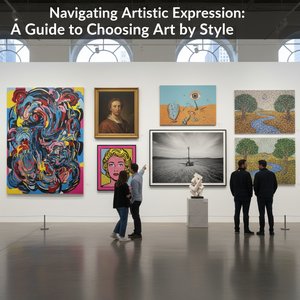
The journey into the heart of fine art begins not with a glance, but with a deep, intentional reading of the canvas. For the aspiring student, understanding art requires moving beyond mere recognition of subjects to grasping the profound dialogue between technique and meaning. Consider the revolutionary impact of Abstract Expressionism, where artists like Jackson Pollock abandoned traditional representation in favor of raw energy. In works such as Black Pouring over Color, the medium itself becomes the message; the rhythmic, drip-based application of paint captures a visceral emotion that transcends form, inviting the viewer to experience movement and spontaneity rather than a static image. Similarly, the vibrant world of Expressionism, exemplified by Wassily Kandinsky’s Dreamy Improvisation, utilizes a dynamic interplay of color and shape to evoke spiritual resonance, proving that color can function as a musical composition for the eyes. To master this language, one must learn to identify the subtle nuances of Naive Art, where bold colors and folk-inspired styles—seen in David Burliuk’s The Stand—reclaim the simplicity of rural life through a uniquely unpretentious lens.
The Eye of the Critic: Developing Your Personal Aesthetic and Emotional Connection
Developing an aesthetic eye is an intimate process of cultivation, where one learns to balance objective analysis with subjective feeling. It is an evolution from seeing to perceiving. As you study the Franco-Flemish masters of the 15th century, you begin to notice how their meticulous realism and pioneering oil techniques were not merely displays of skill, but tools for profound symbolism and religious devotion. This era teaches us that every detail—the texture of a fabric or the glint of light on a jewel—carries weight. As an art student, your goal is to find where your own emotional frequency meets these historical echoes. Whether you are drawn to the heavy, textured impasto of the masters or the soft, atmospheric light of the Impressionists, your connection to art grows as you recognize how different eras attempt to solve the same human problem: how to capture the ephemeral beauty of existence. This critical development allows you to move from a passive observer to an active participant in the artistic narrative.
From Museum Walls to Modern Homes: The Art of Curating and Collecting Masterpieces
The transition of art from the hallowed, silent halls of museums into the living spaces of private collectors is one of the most beautiful democratizations of culture in recent history. Curating a collection is an act of storytelling within one's own environment. It is no longer necessary to be a titan of industry to surround oneself with greatness; through high-fidelity reproductions and Giclée prints, the essence of a masterpiece can be brought into the contemporary home. A sophisticated collector understands that curation is about more than filling empty walls; it is about creating a cohesive atmosphere. This might involve the strategic use of Triptychs or Polyptychs to add architectural depth to a room, or selecting works that utilize specific color palettes to complement modern interiors. The true art of collecting lies in the ability to bridge the gap between historical significance and personal lifestyle, treating each piece as a vital component of a larger, lived-in gallery.
Bridging Eras: How Technology and Custom Commissions are Redefining Artistic Expression
We stand at a remarkable intersection where centuries-old craftsmanship meets the cutting edge of digital innovation. The boundaries of what constitutes "art" are expanding through AI-driven transformations and custom commissions that allow for unprecedented creative agency. Today, an individual can act as their own art director, utilizing technology to reimagine personal memories through the lens of historical movements. Imagine transforming a contemporary photograph into a work that possesses the dramatic chiaroscuro of a Rembrandt or the swirling energy of a Van Gogh. This synergy between the digital and the physical—where an AI-generated vision can be handed to a master painter to be rendered in authentic, multi-layered oil on canvas—ensures that the legacy of human creativity remains dynamic. As we move forward, the tools may change, but the fundamental pursuit remains the same: the eternal quest to capture beauty, emotion, and truth through the transformative power of the brush.