The Dawn of Devotion: Early Religious Art & Its Origins
Religious art is a visual representation of religious ideologies and their relationship with humans. Sacred art directly relates to religious art in the sense that its purpose is for worship and religious practices. According to one set of definition...
The impulse to create sacred art is as old as humanity itself, born from a fundamental need to connect with the unseen and express the ineffable. Long before formalized religions took shape, prehistoric cave paintings depicting animal spirits suggest an early form of shamanistic devotion. These weren’t merely representations; they were believed to *be* imbued with power, conduits to other realms. As civilizations arose in Mesopotamia and Egypt, art became inextricably linked with ritual and governance. Sumerian votive figures, small sculptures offered to deities, demonstrate a desire for divine favor, while the monumental scale of Egyptian temple reliefs served to glorify pharaohs as earthly embodiments of gods. These early examples weren’t simply aesthetic endeavors; they were integral components of a worldview where art *was* religion – a tangible manifestation of belief and a means of ensuring cosmic order.
The concept of “melammu,” a brilliant, visible glamour emanating from the divine in Mesopotamian literature, foreshadows later artistic conventions like halos. In Persia, the Khvarenah, depicted as a radiant bird, symbolized the legitimacy of kingship. These early visual languages laid the groundwork for more complex systems of iconography that would emerge with the rise of organized religions.
Byzantine Brilliance & The Rise of Iconography
A halo (from Ancient Greek ἅλως, hálōs, 'threshing floor, disk'), also called a nimbus, aureole, glory or gloriole (Latin: gloriola, lit. 'little glory'), is a crown of light rays, circle or disk of light that surrounds a person in works of art. Th...
The adoption of Christianity by Constantine in the 4th century marked a turning point in the history of religious art. Early Christian art, initially derivative of Roman styles, gradually developed its own distinct character, characterized by symbolism and spiritual intensity. However, it was within the Byzantine Empire that iconography truly flourished. Byzantine icons weren’t intended as mere portraits; they were considered windows to heaven, sacred objects through which believers could commune with God, the Virgin Mary, and the saints. The meticulous detail, flattened perspective, and use of gold leaf weren't stylistic choices but deliberate attempts to transcend earthly representation and evoke a sense of otherworldly beauty.
The halo, evolving from earlier Mesopotamian and Greek traditions, became a ubiquitous symbol of sanctity, signifying divine grace and spiritual illumination. Artists adhered to strict canons, ensuring consistency in depicting religious figures – a testament to the belief that these images were not products of human creativity but reflections of eternal truths. The mosaics adorning churches like Hagia Sophia exemplify this aesthetic—a shimmering tapestry of gold and light designed to inspire awe and reverence.
Renaissance Reverence: Humanism, Spirituality & Artistic Innovation
 Cimabue
Cimabue (c. 1240-1302): Pioneer of Italian painting! Explore his Byzantine & Renaissance blend, realistic figures, and influence on Giotto. Discover masterpieces now!
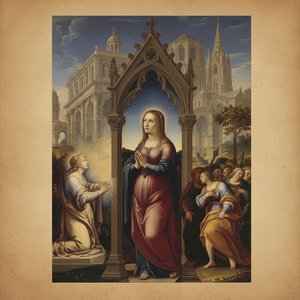
The Renaissance witnessed a profound shift in artistic sensibilities, fueled by the rediscovery of classical learning and a growing emphasis on humanism. While embracing realism and anatomical accuracy, Renaissance artists didn’t abandon religious themes; rather, they infused them with new emotional depth and psychological complexity. Figures like Lorenzo di Bicci exemplified this transition, creating devotional works commissioned by guilds and clergy that balanced precise execution with vibrant color palettes. The focus shifted from the purely symbolic to a more nuanced portrayal of human experience within a spiritual context.
Fra Angelico, a Dominican friar, stands as a quintessential Renaissance example. His frescoes, such as “Saint Dominic Adoring the Crucifixion” and “The Dispute of St. Dominic and the Miracle of the Book,” are imbued with both piety and artistic mastery. He skillfully blended realistic detail with ethereal light, creating scenes that were simultaneously grounded in earthly reality and infused with divine grace. The use of perspective, pioneered during this period, added a new dimension to religious narratives, drawing viewers into the sacred space.
Baroque Drama & Emotional Intensity in Sacred Paintings
 Adoración de San José
Discover Francisco Zurbarán’s ‘Adoración de San José’. A Baroque masterpiece of religious devotion, featuring dramatic chiaroscuro & intricate detail. Explore this iconic Spanish painting.
The Baroque era embraced drama, grandeur, and emotional intensity, transforming religious art into a powerful tool for conveying faith. Artists sought to engage viewers on a visceral level, employing dynamic compositions, rich colors, and dramatic chiaroscuro – the interplay of light and shadow. Francisco Zurbarán, a Spanish master, exemplified this aesthetic in his depictions of monastic life and religious figures. His “Adoración de San José” is a striking example, featuring an austere setting, intense focus on the central figure, and meticulous detail that conveys a sense of profound devotion.
Carlo Dolci, known for his highly detailed and pious works, further exemplified this Baroque sensibility. His paintings often depict intimate moments of religious contemplation, emphasizing emotional connection and spiritual purity. The use of soft lighting and delicate brushwork created an atmosphere of serenity and reverence, inviting viewers to share in the characters’ faith.
Beyond the West: Exploring Non-European Traditions of Devotional Art
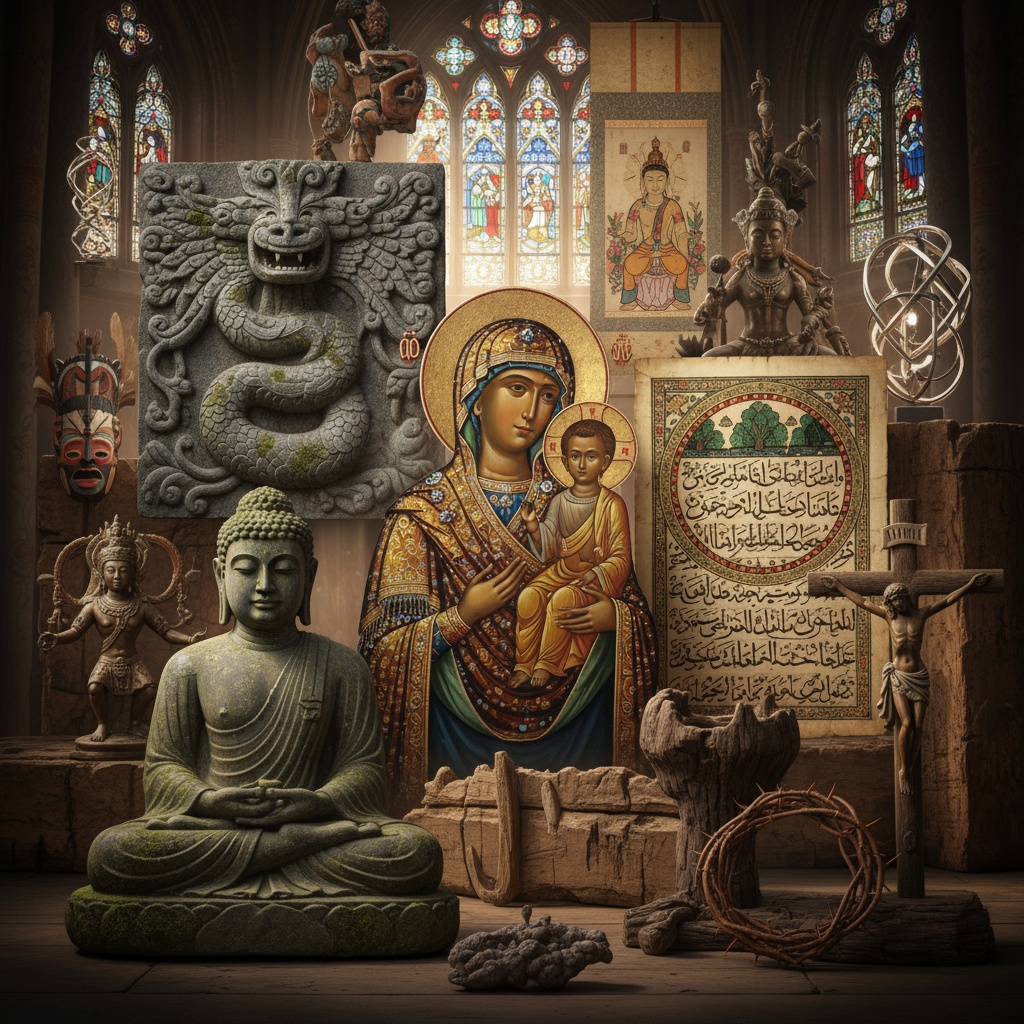
While Western art often dominates discussions of religious imagery, devotional traditions flourished across the globe. In Buddhism, art served as a vital tool for meditation and spiritual practice. From the cave paintings of Ajanta to the intricate mandalas created by Tibetan monks, Buddhist art aimed to represent the principles of enlightenment and guide practitioners on their path to liberation. The use of halos, often depicted as flames, symbolized the radiant energy of enlightened beings.
Sacred art in India, deeply intertwined with Hindu cosmology, features elaborate iconography representing a vast pantheon of deities. The vibrant colors, intricate details, and symbolic gestures convey complex theological concepts and invite viewers to connect with the divine. Similarly, Japanese Buddhist art blends indigenous traditions with Chinese influences, creating unique forms of devotional imagery that emphasize harmony, balance, and spiritual enlightenment.
Symbolism and Meaning: Deciphering the Language of Sacred Imagery
Throughout history, sacred art has employed a rich language of symbolism to convey complex theological concepts. The halo, as previously discussed, signifies sanctity and divine grace. Colors also carry profound meaning—gold representing divinity, blue symbolizing heaven, and red signifying passion or sacrifice. Gestures, such as the *mudras* in Buddhist art, communicate specific states of mind or spiritual intentions.
Understanding these symbolic codes is crucial to appreciating the depth and nuance of religious imagery. Images are often divided into “iconic images,” focusing on individual figures, and “narrative images,” depicting scenes from sacred stories. The careful arrangement of elements within a composition—the positioning of figures, the use of light and shadow, the choice of colors—all contribute to the overall message. Ultimately, sacred art transcends mere representation; it is a visual language designed to inspire faith, evoke emotion, and connect viewers with the divine.
At OriginalUniqueArt.com, we are passionate about making the world’s great artworks accessible to everyone. Explore our extensive collection of handmade oil paintings and museum-quality prints, and discover the beauty and power of sacred art for yourself.