The Nabis Roots: Bonnard’s Early Influences & Artistic Awakening
Pierre Bonnard, a name synonymous with intimate domesticity and shimmering color, didn't emerge fully formed as the artist we know today. His journey began within the vibrant, often esoteric circles of Les Nabis – “the prophets” – a group of young French painters in the 1890s who sought to revolutionize art by imbuing it with emotion and spirituality. Unlike the Impressionists’ pursuit of capturing fleeting light, the Nabis aimed for something deeper: an inner resonance expressed through symbolic forms and flattened perspectives. Bonnard's initial training was conventional enough; he attended the Académie Julian in Paris after a brief foray into law, but it was his encounter with Paul Sérusier that proved pivotal. Sérusier’s painting, created under Gauguin’s influence – a small wooden panel ablaze with arbitrary color – became a touchstone for the group, a rejection of naturalistic representation in favor of subjective experience. This wasn't merely about *what* was painted but *how* it felt, and Bonnard wholeheartedly embraced this ethos.
Early works reveal a fascinating tension between academic skill and nascent Nabis tendencies. While possessing a clear talent for draftsmanship – evident even in his self-portrait from 1889 – he began to experiment with bolder color combinations and simplified forms. The influence of Japanese woodblock prints, readily available in Paris at the time, is also palpable; their flattened planes, decorative patterns, and unconventional compositions offered an alternative to Western pictorial traditions. These early explorations weren’t simply stylistic exercises but a fundamental questioning of art's purpose – moving away from objective reality towards a more subjective, emotionally charged vision.
Intimism Defined: A World Seen Through Private Lenses
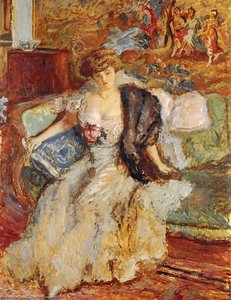 Misia
MisiaExperience the elegance of Pierre Bonnard's 'Misia.' This stunning Post-Impressionist painting captures intimate beauty with vibrant colors & loose brushstrokes.
From the broader context of Les Nabis emerged Bonnard’s signature style: Intimism. This wasn’t a formally declared movement but rather a shared sensibility among a group of artists – including Édouard Vuillard – who turned their gaze inward, focusing on the quiet moments of domestic life. Forget grand historical narratives or sweeping landscapes; Intimism celebrated the beauty of the everyday—a woman reading by a window, a family gathered around a table, a sun-drenched interior. Bonnard’s scenes aren't dramatic or overtly emotional; their power lies in their subtlety and understated grace.
The term “Intimist” aptly describes his approach. He wasn’t interested in depicting public life but rather the private sphere—the emotions, relationships, and fleeting sensations experienced within the home. His paintings aren't about *events* so much as *atmospheres*. The backgrounds often rival the figures in importance, creating a sense of enveloping space and psychological depth. Light plays a crucial role, not as a means of accurately rendering form but as a mood-setting element—softening edges, casting long shadows, and imbuing the scenes with a dreamlike quality.
Colour as Emotion: Bonnard's Revolutionary Palette and Technique
 Beyond Light & Color: Impressionism vs. Post-Impressionism for the Discerning Collector
Explore the nuances of Impressionism & Post-Impressionism with . Expert insights for collectors on style, investment, and acquiring museum-quality reproductions.
If Intimism defined *what* Bonnard painted, his use of color defined *how*. He wasn’t interested in simply replicating colors found in nature; instead, he employed them to evoke emotions and create a unique visual language. His palette is often described as luminous—a vibrant interplay of reds, yellows, greens, and blues that seem to radiate from within the canvas. This wasn't achieved through meticulous blending but rather through a layering technique – thin washes of color applied over one another, creating a shimmering effect.
Bonnard famously didn’t paint directly from life, preferring instead to work from memory and notes. He would sketch his subjects—often his wife, Marthe de Méligny—and then meticulously record the colors he observed, often returning to them repeatedly. This allowed him to build up layers of color over time, creating a sense of depth and complexity that is rarely seen in other artists’ works. He described painting as a process of “reflection” and “dreaming,” emphasizing the importance of subjective experience over objective observation. His canvases weren't merely representations of reality but rather emotional landscapes—a testament to his unique vision.
Domesticity & the Figure: Marthe de Méligny and the Poetics of Daily Life
Central to Bonnard’s Intimist vision was his wife, Marthe de Méligny. She became his muse, his constant companion, and the subject of countless paintings over several decades. Unlike traditional portraits that aimed for likeness or social status, Bonnard's depictions of Marthe are deeply personal—intimate glimpses into her daily life. He painted her bathing, drying her hair, reading, or simply resting, capturing moments of quiet contemplation and vulnerability.
Marthe wasn’t merely a model but rather a symbol of domesticity itself—a representation of the beauty and complexity of everyday life. Bonnard's paintings aren't overtly sensual; their power lies in their tenderness and psychological depth. He often depicted her from unusual angles, cropping her figure or obscuring her face, creating a sense of mystery and intimacy. The backgrounds are equally important, enveloping Marthe in a world of color and pattern that reflects her inner state. These paintings aren't about *seeing* Marthe so much as *feeling* her presence.
Beyond Representation: Landscapes, Memory, and Late-Life Masterpieces
While Bonnard is best known for his Intimist scenes, he also painted landscapes throughout his career—often blurring the lines between interior and exterior space. His later works, created in the south of France, are particularly striking—lush gardens ablaze with color, sun-drenched terraces overlooking the Mediterranean Sea. These paintings aren't simply depictions of nature; they’re emotional responses to it—a celebration of light, color, and atmosphere.
Even in his landscapes, Bonnard retained his signature style—layered washes of color, simplified forms, and a focus on subjective experience. He often painted from memory, allowing him to distill the essence of a place rather than simply replicating its appearance. His final painting, *The Almond Tree in Blossom*, completed just a week before his death in 1947, is a testament to his enduring passion for color and light—a fitting culmination of a lifetime dedicated to capturing the beauty of the everyday. Bonnard’s legacy lies not only in his exquisite paintings but also in his ability to transform ordinary moments into extraordinary works of art.
Discover the timeless elegance and emotional depth of Pierre Bonnard's work with OriginalUniqueArt. Explore our collection of museum-quality reproductions, meticulously crafted by skilled artists. From iconic Intimist scenes to vibrant landscapes, bring the beauty of Bonnard’s world into your home.