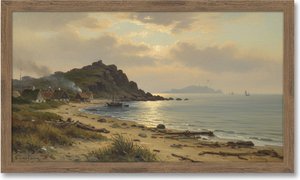
The Skagen Years: A Crucible of Light and Camaraderie
Impressionism was a 19th-century art movement characterized by visible brush strokes, open composition, emphasis on accurate depiction of light in its changing qualities (often accentuating the effects of the passage of time), ordinary subject matter...
The northernmost tip of Denmark, a windswept peninsula known as Skagen, holds an almost mythical place in the history of Scandinavian art. It was here, beginning in the 1870s, that a remarkable community of artists gathered, drawn by the unique quality of light and the raw beauty of the coastal landscape. Among them, Peder Severin Krøyer emerged as a leading figure, not merely documenting Skagen but embodying its spirit. He wasn’t simply *at* Skagen; he became inextricably linked to it, his artistic identity forged in the interplay between the sea, the sky, and the vibrant social life of this remote fishing village. Krøyer arrived already possessing considerable skill, having trained at the Royal Danish Academy of Art, but it was in Skagen that he discovered a new freedom – a willingness to abandon academic constraints in pursuit of capturing fleeting moments of beauty and genuine human connection.
The allure of Skagen lay in its dramatic light. The constantly shifting weather patterns created an ever-changing palette, from the brilliant clarity of summer days to the soft, melancholic hues of twilight. This presented a unique challenge for painters accustomed to more stable conditions, but Krøyer embraced it wholeheartedly. He sought to convey not just what he *saw*, but how it *felt* to be immersed in this environment – the bracing wind, the smell of salt air, and the warmth of companionship. His early works from Skagen often depict fishermen mending nets or hauling boats ashore, scenes rendered with a realism that acknowledged the hardships of their lives while simultaneously celebrating their resilience. However, it was his depictions of social gatherings—artists dining together, strolling along the beach, simply enjoying each other’s company—that truly captured the essence of the Skagen community and would come to define his most celebrated style.
From Realism to Impressionism: Krøyer’s Artistic Evolution
 Mujeres y pescadores de Hornbaek3
Peder Severin Kroyer (1851-1909) was a prominent Norwegian-Danish painter associated with the Skagen school of Impressionism. Born in Stavanger, Norway, he became renowned for his depictions of coastal life, particularly scenes featuring fishermen an
Krøyer's artistic journey wasn’t a sudden leap from one style to another, but rather a gradual evolution shaped by his travels and encounters with other artists. Initially grounded in realism, he absorbed the lessons of French Impressionism during several trips to Paris in the 1870s and 80s. He studied under Léon Bonnat and observed the techniques of masters like Claude Monet, Edgar Degas, and Pierre-Auguste Renoir. However, Krøyer didn’t simply imitate these artists; he synthesized their innovations with his own sensibilities, creating a distinctly Scandinavian brand of Impressionism.
While sharing the Impressionists' focus on light and color, Krøyer retained a greater emphasis on form and composition. His brushstrokes are often more deliberate than those of Monet or Renoir, and his paintings possess a sense of structure that sets them apart. He was particularly adept at capturing the nuances of human expression, imbuing his portraits with psychological depth and emotional resonance. This ability to blend realism with Impressionistic techniques allowed him to create works that were both visually stunning and emotionally engaging. He wasn’t interested in merely recording appearances; he sought to capture the *soul* of his subjects and the atmosphere of a particular moment.
Masterpieces of Coastal Life: Exploring Key Paintings
Peder Severin Kroyer lived in the XIX – XX cent., a remarkable figure of Realism and Impressionism. Find more works of this artist at Wikiart.org – best ...
Perhaps Krøyer's most iconic work is Summer Evening on Skagen's Southern Beach with Anna Ancher and Marie Krøyer (1893). This painting encapsulates everything that made his Skagen period so special – the luminous light, the relaxed atmosphere, and the sense of camaraderie among friends. The scene depicts a group of artists enjoying an evening stroll along the beach, bathed in the warm glow of the setting sun. The composition is masterful, with figures arranged in a naturalistic yet carefully balanced manner. Krøyer’s use of color is particularly striking, capturing the subtle gradations of light and shadow that define the Skagen coastline.
Another notable work, Hip, Hip, Hurrah! (1886), offers a glimpse into the lively social life of the Skagen community. This painting depicts a group of artists celebrating a summer festival, their faces alight with joy and enthusiasm. The dynamic composition and vibrant colors convey a sense of energy and excitement. Mujeres y pescadores de Hornbaek3, while less well-known, demonstrates Krøyer’s ability to capture the everyday lives of coastal communities beyond Skagen, showcasing his broader interest in Scandinavian life.
Portraits of a Generation: Capturing Danish Society
While celebrated for his landscapes and scenes of social life, Krøyer was also a highly sought-after portrait painter. He received numerous commissions from prominent members of Danish society, capturing their likenesses with remarkable skill and sensitivity. These portraits offer a fascinating glimpse into the lives of the Danish elite during the late 19th century.
Krøyer’s approach to portraiture was far from conventional. He didn't simply aim to create flattering representations; he sought to capture the personality and inner life of his subjects. His portraits are often characterized by a sense of psychological depth, revealing subtle emotions and hidden complexities. He paid close attention to detail, capturing not just physical features but also gestures, expressions, and clothing that conveyed social status and character. These works demonstrate Krøyer’s versatility as an artist and his ability to excel in both outdoor scenes and intimate portraits.
Krøyer's Legacy: Influence and Enduring Appeal
Peder Severin Krøyer’s influence on Scandinavian art is undeniable. He played a pivotal role in establishing Skagen as a major artistic center, inspiring generations of painters to embrace the beauty of their surroundings and capture the essence of modern life. His works continue to resonate with audiences today, not only for their technical brilliance but also for their emotional depth and evocative atmosphere.
His ability to convey the fleeting moments of joy, camaraderie, and connection remains particularly poignant in our increasingly fragmented world. The Hirschsprung Collection in Copenhagen houses a significant collection of Krøyer’s works, offering visitors a chance to experience his masterpieces firsthand. His paintings are also featured in museums around the world, ensuring that his legacy will continue to inspire and captivate art lovers for generations to come. OriginalUniqueArt.com offers high-quality reproductions of Krøyer's most celebrated works, allowing you to bring the luminous beauty of Skagen into your own home.