Introduction
There’s a quiet power in subtlety, a depth that resonates not through vibrant hues but through the nuanced dance of shadows and grays. Often overlooked in favor of bolder palettes, 'Payne's Gray' – a cool, versatile shade born from the blending of black, white, and umber – holds a unique dominion over some of art history’s most captivating masterpieces. These aren’t paintings that shout for attention; they whisper stories, inviting us into worlds steeped in atmosphere, introspection, and often, a touch of melancholy.
The use of gray tones has ebbed and flowed throughout artistic movements. From the somber religious scenes of the Early Renaissance, where grays conveyed humility and spiritual weight, to the dramatic chiaroscuro of Baroque masters like Rembrandt, who used shadow to sculpt form and emotion, the color’s capacity for depth has always been recognized. The 19th century saw a particular fascination with atmospheric effects – think Turner's misty landscapes or Whistler's 'Nocturnes' – where Payne's Gray became instrumental in capturing fleeting moments of light and mood. It wasn’t merely about replicating reality, but evoking feeling.
These paintings endure not simply as technical achievements, though they are undeniably brilliant, but because they tap into something profoundly human. They reflect our own experiences with ambiguity, loss, and the beauty found in quiet contemplation. The skillful manipulation of Payne's Gray allows artists to create a sense of distance – both physical and emotional – drawing us into their worlds while simultaneously holding us at arm’s length, prompting reflection rather than dictating interpretation.
Over the following list, we will explore ten iconic paintings where Payne's Gray isn’t just a color choice, but a defining characteristic. Prepare to be captivated by works that demonstrate the extraordinary power of restraint, and discover how these masters transformed shadow into substance, and gray into gold.
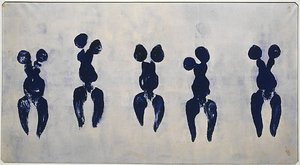
Anthropometry of the blue period - Yves Klein
 Anthropometry of the blue period - Yves Klein
A primal echo resonates from Yves Klein’s Anthropometry of the Blue Period (1960), a work where human form dissolves into pure, arresting color – a silence made visible.
This piece earns its place among the Top 10 not for meticulous detail, but for its radical simplicity and profound emotional impact. Klein’s groundbreaking technique—using female models coated in his signature International Klein Blue (IKB) to imprint their bodies directly onto canvas—bypassed traditional painting methods entirely. The resulting silhouettes aren't portraits; they are archetypes, imbued with a raw energy that speaks to the fundamental human experience.
The deep blues, set against a subtly textured pale background, create an atmosphere of both vulnerability and power. These spectral figures, arranged in rhythmic procession, evoke ancient rituals or ancestral spirits. The limited palette intensifies the emotional resonance, hinting at isolation and a yearning for connection. It’s a work that transcends the Nouveau Réalisme movement Klein helped pioneer, anticipating Minimal Art with its reductive forms.
Today, Anthropometry of the Blue Period offers more than just aesthetic appeal; it's a statement piece that infuses modern interiors with depth and sophistication. Its minimalist elegance and bold color palette create a calming yet captivating presence—a reminder of art’s ability to evoke spiritual experiences and connect us to something beyond the material world. This painting is an invitation to contemplate the essence of being, rendered in the mesmerizing language of blue.
Family Reunion - Jean Frédéric Bazille
 Family Reunion - Jean Frédéric Bazille
Imagine a late summer afternoon, sunlight dappling through leaves, the murmur of conversation blending with birdsong… This is the world Jean Frédéric Bazille invites us into with Family Reunion (1867), a painting that captures not just a moment in time, but the very essence of convivial warmth.
Though brimming with life and detail, this masterpiece earns its place among the Top 10 for its subtle mastery of Payne’s Gray tones. The shadows beneath the trees, the delicate gradations within the figures' clothing, and even the hazy distance are rendered with a nuanced palette that creates an atmosphere of both intimacy and wistful reflection. It’s not about bold statements; it’s about capturing the fleeting beauty of everyday life.
Bazille, a pivotal figure in the burgeoning Impressionist movement, used this scene to explore themes of unity and shared experience. The composition—a gathering under the protective canopy of a tree—suggests harmony with nature and the simple joys of human connection. While vibrant colors enliven the canvas, it’s the skillful use of gray that grounds the painting, lending it a timeless quality.
Today, Family Reunion offers more than just aesthetic pleasure; it's an invitation to cultivate serenity within our own spaces. Its harmonious composition and subtle palette create a calming presence—a reminder to cherish moments of connection and find beauty in the quiet rhythms of life. This painting is a testament to art’s ability to evoke emotion, inspire reflection, and transform any room into a haven of peace.
Interior (My dining room) - Wassily Kandinsky
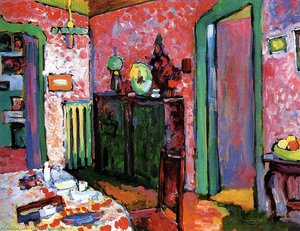 Interior (My dining room) - Wassily Kandinsky
Step into a world brimming with life – a vibrant echo of domesticity captured by Wassily Kandinsky in Interior (My dining room) (1909). This isn’t merely a depiction of a space; it's an emotional landscape, pulsating with the energy of everyday existence.
Its inclusion among the Top 10 Famous Paintings Dominated by 'Payne's Gray' Tones might seem surprising at first glance, given its bold color palette. However, look closer. It’s in the subtle interplay of shadows, the nuanced gradations within the reds and greens, that Kandinsky masterfully employs Payne’s Gray to create depth and atmosphere. These aren’t flat planes of color; they are layered with a quiet complexity.
This painting marks a pivotal moment in Kandinsky's artistic journey—a transition from representational art towards abstraction. The distorted perspective, the expressive brushwork, and the vibrant hues reflect his exploration of spiritual resonance and emotional expression. It’s a work that anticipates the birth of abstract art itself.
Today, Interior (My dining room) offers more than just aesthetic appeal; it's an invitation to infuse your own space with warmth and vitality. Through OriginalUniqueArt, you can experience the texture and emotion of this masterpiece firsthand—a faithful reproduction that captures Kandinsky’s revolutionary spirit and brings a touch of artistic brilliance into your home.
The Great Parade - Fernand Léger
 The Great Parade - Fernand Léger
Imagine a burst of energy – a kaleidoscope of movement and sound, the thrill of a spectacle unfolding before your eyes… This is the world Fernand Léger captures in The Great Parade (1954), a painting that embodies the dynamism of modern life.
Though celebrated for its vibrant colors and bold forms, this masterpiece earns its place among the Top 10 Famous Paintings Dominated by 'Payne's Gray' Tones through a subtle yet crucial interplay of shadow. The grounding grays within the mechanical elements and architectural structures provide a vital counterpoint to the exuberant hues, creating depth and preventing the composition from becoming overwhelming.
Léger’s unique style—a fusion of Cubism and Fauvism—reflects his fascination with the intersection of humanity and technology. The fragmented figures and stylized shapes evoke the energy of a bustling city, while the use of flat colors and thick outlines lends a graphic quality reminiscent of comic book art.
Today, The Great Parade offers more than just aesthetic pleasure; it’s an invitation to infuse your space with vitality. Through OriginalUniqueArt, you can experience the texture and emotion of this iconic work firsthand—a faithful reproduction that captures Léger’s revolutionary spirit and brings a touch of artistic brilliance into your home.
Water-Lilies - Claude Monet
 Water-Lilies - Claude Monet
Close your eyes and imagine a world bathed in soft light, where reflections dance on water and time seems to slow… This is the realm Claude Monet invites us into with Water-Lilies (1908), a painting that transcends mere representation to become an experience of pure serenity.
Its inclusion among the Top 10 Famous Paintings Dominated by 'Payne's Gray' Tones may surprise some, yet it’s in the subtle interplay of grays within the shadows and reflections – the delicate gradations that define the water’s depths – that Monet achieves his remarkable atmospheric effect. These aren’t bold contrasts; they are nuanced harmonies.
Part of Monet's expansive series, Water-Lilies represents a lifelong exploration of his beloved garden at Giverny. He wasn’t simply painting flowers; he was capturing the fleeting beauty of light and atmosphere, pioneering a revolutionary approach that paved the way for abstract expressionism.
Today, Water-Lilies offers more than just aesthetic pleasure; it's an invitation to cultivate tranquility within your own space. Through OriginalUniqueArt, you can experience the texture and emotion of this iconic work firsthand—a faithful reproduction that captures Monet’s revolutionary spirit and brings a touch of peaceful contemplation into your home.
Island in the Attersee - Gustav Klimt
 Island in the Attersee - Gustav Klimt
Imagine a summer afternoon shimmering with heat, the gentle lapping of water against the shore… This is the world Gustav Klimt invites us into with Island in the Attersee (1901-1902), a painting that transcends mere landscape to become an immersion in light and tranquility.
Its inclusion among the Top 10 Famous Paintings Dominated by 'Payne's Gray' Tones might seem unexpected, but it’s within the subtle gradations of gray – the shadows beneath the distant islands, the muted tones reflecting on the water’s surface – that Klimt achieves his remarkable atmospheric effect. These aren’t harsh contrasts; they are delicate harmonies.
Painted during a pivotal moment in Klimt's artistic evolution, Island in the Attersee represents a departure from traditional representation. The square format and flattened perspective prioritize feeling over realism, inviting viewers to experience the scene as a decorative field of color and light. It’s a work that anticipates abstract developments, hinting at the power of form and hue to evoke emotion independently of narrative.
Today, Island in the Attersee offers more than just aesthetic pleasure; it's an invitation to cultivate serenity within your own space. Through OriginalUniqueArt, you can experience the texture and emotion of this iconic work firsthand—a faithful reproduction that captures Klimt’s revolutionary spirit and brings a touch of peaceful contemplation into your home.
The Pyramids, Cliffs at Belle-Ile - Claude Monet
 The Pyramids, Cliffs at Belle-Ile - Claude Monet
Unveiling The Pyramids, Cliffs at Belle-Île (1881) is to encounter a rare and dramatic vision of coastal power – a testament to Claude Monet’s mastery of light and atmosphere.
Its place among the Top 10 Famous Paintings Dominated by 'Payne's Gray' Tones isn’t immediately obvious, yet it’s within the subtle gradations of gray—the shadows cast upon the rugged cliffs, the muted tones of the turbulent sea—that Monet achieves his remarkable depth and emotional resonance. These aren’t bold statements; they are nuanced harmonies.
Painted during a pivotal period in the artist's career, this work embodies the core tenets of Impressionism: capturing fleeting moments, prioritizing subjective perception over precise representation. The loose brushstrokes and thickly applied paint (impasto) create a tactile surface that evokes the raw energy of nature.
Today, The Pyramids, Cliffs at Belle-Île offers more than just aesthetic pleasure; it’s an invitation to infuse your space with a sense of timeless beauty. Through OriginalUniqueArt, you can experience the texture and emotion of this iconic work firsthand—a faithful reproduction that captures Monet’s revolutionary spirit and brings a touch of refined elegance into your home.
Birth of a Divinity - Salvador Dalí
 Birth of a Divinity - Salvador Dalí
A haunting stillness pervades Birth of a Divinity (1960) by Salvador Dalí, a painting that feels less like an image and more like a dreamscape unfolding before your eyes.
Its inclusion among the Top 10 Famous Paintings Dominated by 'Payne's Gray' Tones might seem surprising given its vibrant colors, yet it’s in the subtle interplay of grays—the muted tones of the mountainous landscape, the shadows within the fragmented form—that Dalí achieves his signature surreal atmosphere. These aren’t harsh contrasts; they are delicate gradations that heighten the sense of unease and mystery.
This work exemplifies Dalí's mastery of symbolism and his exploration of the subconscious mind. The melting face, the angelic figure, and the vast landscape invite contemplation on themes of fragmentation, divinity, and the fluidity of reality. It’s a painting that challenges our perceptions and invites us to question the boundaries between dream and waking life.
Today, Birth of a Divinity offers more than just aesthetic appeal; it's an invitation to infuse your space with intrigue and sophistication. Through OriginalUniqueArt, you can experience the texture and emotion of this iconic work firsthand—a faithful reproduction that captures Dalí’s revolutionary spirit and brings a touch of surreal beauty into your home.
Low Tide at Pourville 02 - Claude Monet
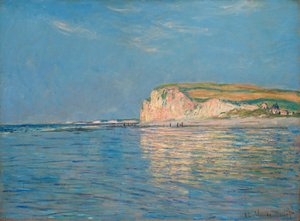 Low Tide at Pourville 02 - Claude Monet
Low Tide at Pourville 02 (1882) by Claude Monet isn’t merely a depiction of a coastal scene; it's a meditation on the passage of time, the ephemeral nature of light, and the quiet beauty of everyday life.
Its inclusion among the Top 10 Famous Paintings Dominated by 'Payne's Gray' Tones reveals Monet’s subtle genius. While celebrated for his vibrant palettes, it’s within the nuanced grays—the muted tones of the sky and sea, the shadows cast upon the exposed beach—that he creates a sense of atmosphere and depth. These aren’t absences of color; they are essential elements in capturing the fleeting moment.
Painted during Monet's time in Normandy, this work exemplifies his dedication to plein air painting – working directly from nature to record the ever-changing effects of light and atmosphere. The composition—figures scattered along the shore, boats resting on the sand—evokes a sense of peaceful contemplation.
Today, Low Tide at Pourville 02 offers more than just aesthetic pleasure; it’s an invitation to infuse your space with tranquility and timeless elegance. Through OriginalUniqueArt, you can experience the texture and emotion of this iconic work firsthand—a faithful reproduction that captures Monet’s revolutionary spirit and brings a touch of coastal serenity into your home.
The House at Giverny Viewed from the Rose Garden - Claude Monet
 The House at Giverny Viewed from the Rose Garden - Claude Monet
There’s a quiet intimacy to The House at Giverny Viewed from the Rose Garden (1924) by Claude Monet, a painting that feels like stepping into a cherished memory—a sun-drenched afternoon spent in a beloved garden.
Its place among the Top 10 Famous Paintings Dominated by 'Payne's Gray' Tones is earned not through dramatic contrast, but through subtle mastery. Monet’s genius lies in his ability to capture light and atmosphere, and within the muted grays of this scene—the shadows dappling the house, the soft haze of the distant sky—he creates a sense of peaceful serenity.
Painted during his later years at Giverny, this work is more than just a landscape; it’s a distillation of a life lived in harmony with nature. The vibrant roses aren't rendered with precise detail but as bursts of color and light, evoking the feeling of being immersed in their fragrance.
Today, The House at Giverny Viewed from the Rose Garden offers more than just aesthetic appeal; it’s an invitation to infuse your space with tranquility and timeless beauty. Through OriginalUniqueArt, you can experience the texture and emotion of this iconic work firsthand—a faithful reproduction that captures Monet’s revolutionary spirit and brings a touch of pastoral elegance into your home.
Conclusion
As the light fades on our journey through these ten masterpieces, one truth remains clear: the power of 'Payne's Gray'—and indeed, all color—lies not in its boldness, but in its subtlety. These paintings are a testament to the human capacity for observation, emotion, and the enduring search for beauty.
They remind us that art isn’t merely about what is depicted, but how it makes us *feel*. The quiet contemplation of Monet's gardens, the unsettling dreamscapes of Dalí, the raw energy of Turner—these are not just images; they are invitations to connect with something deeper within ourselves.
And in a world often defined by noise and distraction, these works offer a sanctuary—a space for reflection, inspiration, and a renewed appreciation for the simple elegance of life. They echo through our homes, shaping our interiors not just as décor, but as expressions of our own unique sensibilities.
At OriginalUniqueArt, we believe that everyone deserves to experience the transformative power of art firsthand. Explore our full collection and discover a world of timeless beauty waiting to be brought into your own space—a living dialogue between history, emotion, and the enduring human spirit.