The Shattered Lens: Deconstructing the Birth of Cubism
To understand the seismic shift that occurred at the dawn of the twentieth century, one must first envision the world as it was perceived before the fracture. For centuries, the Western tradition had been anchored by the Renaissance ideal of the single-point perspective—a window through which the viewer gazed upon a stable, unified reality. However, as the industrial age accelerated and the boundaries of time and space began to blur through new scientific discoveries, the traditional canvas could no longer contain the complexity of modern existence. The birth of Cubism was not merely a change in style; it was an ontological rebellion against the tyranny of the fixed viewpoint.
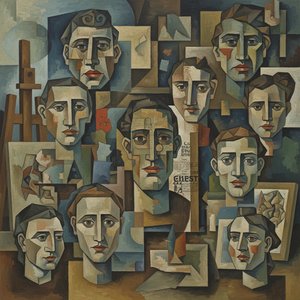
This revolution emerged from a profound desire to represent the totality of an object rather than its mere appearance from a single, fleeting moment. By dismantling the subject into geometric constituents, artists began to explore the concept of simultaneity—the ability to present multiple facets of a form at once. This was a radical departure from the mimetic tradition, moving away from the imitation of nature toward the construction of a new, autonomous reality. It required the viewer to abandon passive observation and instead engage in an active, intellectual reconstruction of the fragmented imagery presented before them.
Analytical vs. Synthetic: The Evolution of Form and Texture
The trajectory of Cubism is often categorized into two distinct yet interconnected phases: Analytical and Synthetic. In its initial, more rigorous stage, known as Analytical Cubism, the palette was intentionally muted, often restricted to monochromatic ochres, greys, and browns. This austerity served a specific purpose: to prevent the emotional distraction of color from obscuring the structural investigation of form. During this period, the subject matter—often still lifes or portraits—was meticulously dissected into overlapping planes and translucent facets. The boundaries between the object and its surrounding space became increasingly ambiguous, creating a rhythmic, interlocking web of lines that challenged the very notion of depth.
As the movement matured, it transitioned into the Synthetic phase, a period marked by a newfound exuberance and a shift in methodology. Rather than breaking down existing forms, artists began to build them up through the integration of diverse materials and textures. This era introduced the revolutionary technique of collage, where fragments of newspaper, wallpaper, or cloth were adhered directly to the canvas. This infusion of "real-world" elements bridged the gap between high art and everyday life, introducing a tactile dimension that transformed the painting from a window into a physical object in its own right. The introduction of bolder colors and flatter, more legible shapes allowed for a playful yet profound exploration of composition and symbolic meaning.
Picasso and Braque: The Architects of a New Visual Language
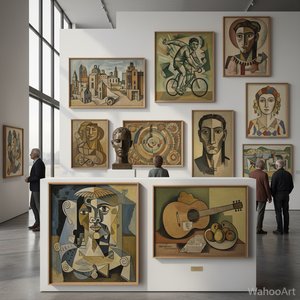
At the heart of this aesthetic upheaval stood two titans of modernism: Pablo Picasso and Georges Braque. Their collaboration, often described as being akin to two mountain climbers roped together, was the crucible in which Cubism was forged. Picasso, with his restless, transformative energy, brought an unprecedented sculptural intensity to the movement. His ability to deconstruct the human figure, as seen in seminal works like Les Demoiselles d'Avignon, shattered long-standing conventions of beauty and proportion. His later explorations, such as the vibrant Frutero y frutas, demonstrate how he could weave complex geometric motifs with a masterful command of color and light.
Braque, conversely, provided a more lyrical and structured approach to the movement’s development. His sensitivity to space and texture allowed for a sophisticated interplay of light and shadow within the fractured planes. Together, they moved beyond the depiction of recognizable subjects to create a language of pure form. Their shared experimentation with typography and collage fundamentally altered the DNA of modern art, establishing a precedent for the abstraction that would follow. To study their work is to witness the very moment when the artist ceased to be a recorder of the visible world and became an architect of the conceptual one.
Beyond the Canvas: The Influence of Cubist Geometry on Modern Design
The ripples of the Cubist revolution extended far beyond the confines of the oil painting, permeating the very fabric of modern visual culture. The movement’s emphasis on geometric essentialism and the reduction of form to its fundamental components became a cornerstone of twentieth-century design. From the sleek, streamlined aesthetics of Art Deco to the functional rigor of the Bauhaus school, the Cubist legacy is visible in every era of modernism. The fragmentation of space and the use of overlapping planes found new expression in graphic design, typography, and even the burgeoning field of architecture.
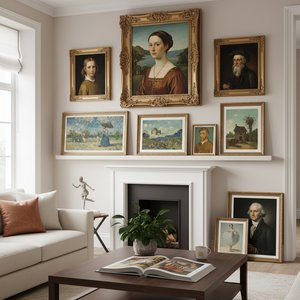
In the realm of interior design, the influence remains strikingly potent. The ability to balance complex patterns with structural clarity allows contemporary spaces to evoke a sense of dynamic energy without sacrificing elegance. The Cubist principle of seeing an object from multiple perspectives encourages a more layered and multidimensional approach to decor, where texture, light, and form are orchestrated to create a cohesive yet stimulating environment. This enduring relevance proves that Cubism was not merely a fleeting trend, but a fundamental shift in the way we organize and perceive our physical surroundings.
Collecting the Revolution: Evaluating Cubist Aesthetics in Contemporary Interiors
For the discerning collector, acquiring works that echo the Cubist spirit offers an opportunity to introduce intellectual depth and structural sophistication into a curated space. Whether through the acquisition of authentic historical pieces or the commissioning of high-quality, hand-painted reproductions, the presence of Cubist aesthetics commands attention. The movement’s inherent tension between fragmentation and unity provides a perfect focal point for modern interiors, acting as a bridge between classical tradition and contemporary innovation.
When integrating such works into a collection, one must consider the interplay of texture and light. A reproduction that captures the palpable impasto and visible brushstrokes of the masters can transform a flat surface into a tactile experience, much like the original works of Picasso or Braque. For those seeking to personalize their environment, the ability to reimagine modern imagery through a Cubist lens—utilizing advanced techniques to reconstruct photos into geometric abstractions—allows for a bespoke dialogue between personal history and art history. Ultimately, collecting Cubism is an investment in a way of seeing: a celebration of the complex, multifaceted nature of our ever-evolving world.
OriginalUniqueArt.com remains dedicated to preserving this legacy of human creativity. As a global leader in fine art reproductions and custom commissions, we provide collectors with access to museum-quality works that honor the academic excellence of the masters. From meticulously hand-painted oil recreations on 100% cotton canvas to innovative AI-driven transformations, our mission is to make the profound beauty of art history accessible to a modern, global audience.