Early Influences: Madrid & The Foundations of Bonnat’s Realism
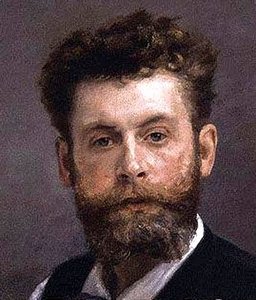 Alfred Philippe Roll
Alfred Philippe Roll (1846-1919) was a prominent French Realist painter known for landscapes, portraits & social realism like 'Miner's Strike'. Official government artist & co-founder of Société Nationale des Beaux-Arts. His works are in major museum
Léon Bonnat's artistic journey, though firmly rooted in the French academic tradition, unexpectedly blossomed under the Iberian sun. Born in Bayonne in 1833, a formative period from 1846 to 1853 spent in Madrid proved pivotal. His father’s bookshop wasn’t merely a source of livelihood but an early academy; young Bonnat diligently copied engravings of Old Masters – Velázquez, Ribera, and others – absorbing their techniques and sensibilities. This immersion wasn't simply about replicating form; it was a deep dive into a tradition prioritizing unflinching realism, a stark contrast to the prevailing Neoclassical ideals then dominating Parisian art circles. The Prado Museum became his sanctuary, where he studied not just *what* these masters painted but *how* – their handling of light, texture, and above all, their commitment to portraying subjects with uncompromising honesty. This early exposure instilled in Bonnat a reverence for Spanish Baroque drama and a dedication to capturing the very essence of life on canvas, a foundation that would define his entire career.
Bonnat's Academic Training & Rise to Prominence in Paris
 PORTRAIT DE M. LE DUC D'AUMALE (1890)
Admire 'Portrait de M. le Duc d’Aumale' by Léon Bonnat (1890). A stunning example of French realism & Spanish Baroque influence. Hand-painted reproduction available.
Returning to Paris, Bonnat embarked on formal training under Federico Madrazo, followed by Léon Cogniet. However, his path wasn’t without its challenges. Repeated attempts to win the prestigious Prix de Rome proved unsuccessful, a testament to his unconventional approach and perhaps a resistance to fully conforming to academic expectations. Yet, this perceived failure didn't deter him. Supported by patrons from Bayonne, he pursued independent study, honing his skills and developing a distinctive style that quickly garnered attention. His early religious paintings, imbued with the Spanish influence absorbed in Madrid, demonstrated a powerful use of chiaroscuro and an emotional intensity rarely seen in contemporary French art. Bonnat’s ability to convey both technical brilliance and genuine feeling propelled him into the Parisian art scene, establishing him as a rising star – a painter who dared to blend academic rigor with raw, emotive power.
The Spanish Influence: Velázquez, Ribera & the Pursuit of 'Truth'
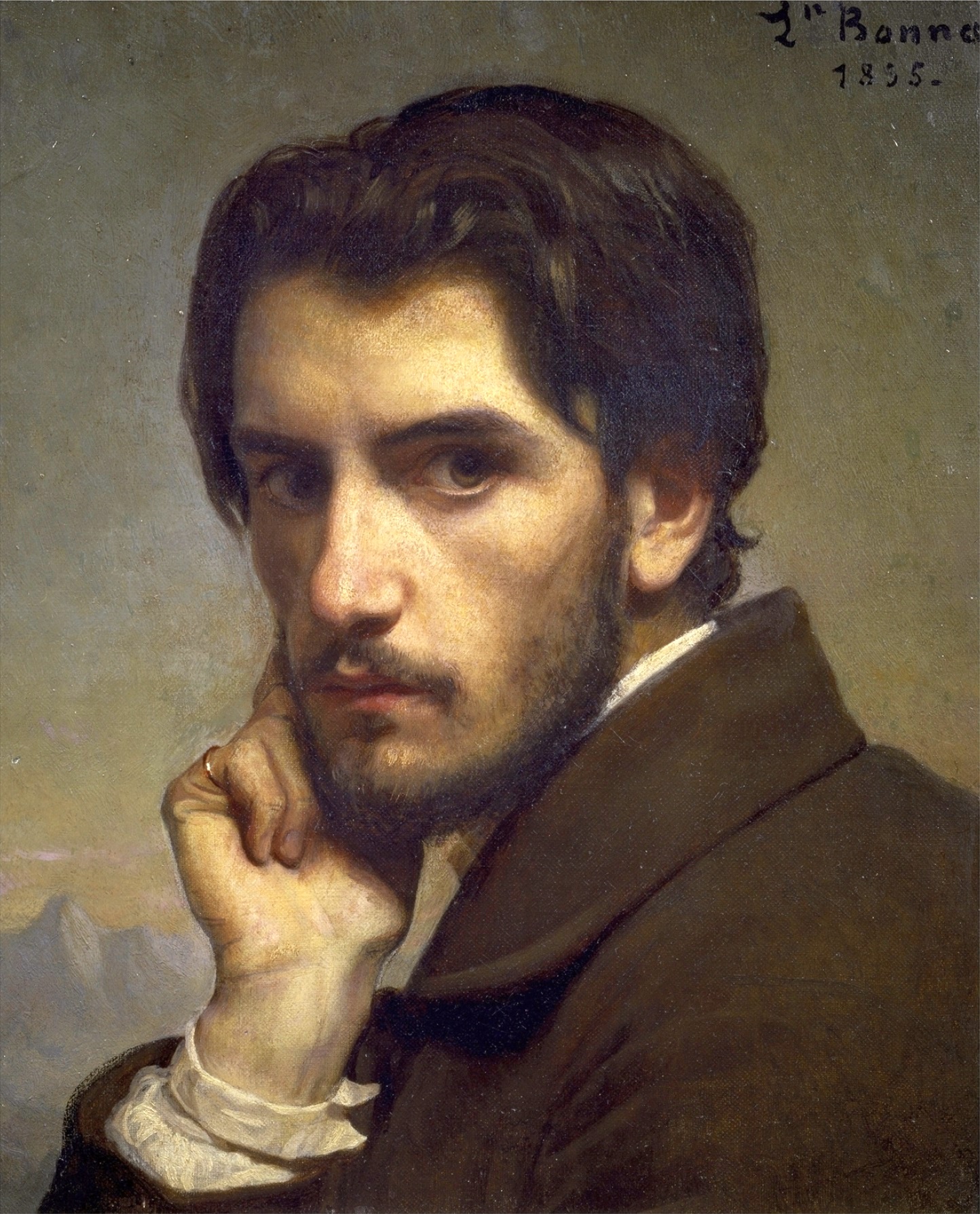 Wikipedia: Léon Bonnat
Léon Joseph Florentin Bonnat (French pronunciation: [leɔ̃ ʒozɛf flɔʁɑ̃tɛ̃ bɔna]; 20 June 1833 – 8 September 1922) was a French painter, Grand Officer of the Légion d'honneur, art collector and professor at the Ecole des Beaux Arts. == Early life ==...
To understand Bonnat is to understand his profound debt to the Spanish masters. Diego Velázquez wasn’t merely an admired artist; he was a guiding principle. Bonnat sought to emulate Velázquez’s ability to capture not just likeness but *character* – the inner life of his sitters revealed through subtle gestures, nuanced expressions, and masterful use of light and shadow. Jusepe de Ribera, with his dramatic tenebrism and unflinching depictions of human suffering, also exerted a significant influence. Bonnat wasn’t simply copying their styles; he was internalizing their philosophy – the belief that true art lay in portraying nature “as she is,” devoid of idealization or embellishment. This pursuit of ‘truth,’ as Bonnat understood it, manifested in his meticulous attention to detail, his rejection of superficial polish, and his willingness to confront uncomfortable realities within his subjects. He believed that a portrait should be more than just an image; it should be a window into the soul.
Beyond Technique: Psychological Depth and Portraiture as a Reflection of Character
Bonnat’s portraits stand apart not for their technical virtuosity alone – though they are undeniably masterful – but for their profound psychological depth. He moved beyond mere representation, striving to capture the essence of his sitters' personalities. Consider ‘Portrait du Docteur Adrien Doyon,’ where the doctor’s gaze is both intelligent and compassionate, revealing a man dedicated to healing and service. Or ‘Portrait de M. le Duc d’Aumale (1890),’ which conveys not just aristocratic bearing but also a sense of quiet contemplation. Bonnat achieved this depth through careful observation, meticulous brushwork, and an almost photographic accuracy in his rendering of features. However, it wasn't simply about replicating physical details; it was about understanding the *inner life* of the subject and translating that understanding onto canvas. He famously said he sought to paint “the man behind the face,” a testament to his commitment to psychological realism.
Bonnat as Educator: Mentorship & The École des Beaux-Arts Legacy
Bonnat’s influence extended far beyond his own canvases; he became a highly respected and sought-after teacher. Appointed professor at the École des Beaux-Arts in 1888, and later its director in 1905, he fostered a liberal approach to art education, emphasizing simplicity, direct observation, and overall effect over rigid academic formalism. He encouraged his students – including John Singer Sargent, Henri de Toulouse-Lautrec, and Thomas Eakins – to travel to Madrid to study the Spanish masters firsthand. His studio was a vibrant hub of artistic exchange, where he stressed rigorous drawing as the foundation for all painting. Bonnat’s emphasis on individual expression, coupled with his insistence on technical proficiency, produced a generation of artists who challenged conventional norms while remaining deeply grounded in classical principles. He wasn't simply teaching technique; he was instilling a philosophy – a belief in the power of art to reveal truth and capture the human spirit.
A Lasting Impression: Bonnat’s Place in 19th-Century Art History
Léon Bonnat occupies a unique position within the landscape of 19th-century art. He wasn't an Impressionist, nor was he a staunch academician; rather, he forged his own path – a synthesis of rigorous training, Spanish influence, and unwavering commitment to realism. His portraits remain powerful testaments to his skill and sensitivity, offering glimpses into the lives and personalities of prominent figures of his time. While often overshadowed by more radical movements, Bonnat’s legacy endures through his students, who carried forward his principles of direct observation, psychological depth, and technical mastery. Today, OriginalUniqueArt.com offers exquisite reproductions of Bonnat's masterpieces, allowing art enthusiasts to experience the power and beauty of his work firsthand. His dedication to capturing “the man behind the face” continues to resonate with viewers, reminding us that true artistry lies not just in what is seen but in what is felt – a testament to the enduring power of realism and the pursuit of psychological truth.