Early Influences & Artistic Foundations: From Cincinnati to Boston
Jim Dine’s artistic journey, though often categorized within the broad strokes of Pop Art, possesses a deeply personal and idiosyncratic character rooted in his formative years. Born in 1935 in Cincinnati, Ohio, Dine's early exposure to art wasn’t through the hallowed halls of museums but rather the pragmatic world of his grandfather’s hardware store. This seemingly mundane environment proved profoundly influential, imbuing him with a fascination for everyday objects – tools, implements, and the very textures of working-class life – that would become a defining motif throughout his career. His initial formal training at the Art Academy of Cincinnati in 1952, while still a high school student, provided a foundational skillset, but it was the discovery of a copy of Paul J. Sachs’ *Modern Prints and Drawings* in 1954 that truly ignited his passion. The German Expressionist woodcuts within its pages – particularly those by Kirchner, Nolde, and Beckmann – resonated deeply with Dine, offering a powerful alternative to the prevailing aesthetic currents and inspiring him to begin experimenting with this demanding medium in the basement of his grandparents’ home.
Further studies at the University of Cincinnati and later at the Boston Museum School honed his technical abilities. However, it was during his time at Ohio University, earning a BFA in 1957, that Dine began to articulate a distinctly personal artistic vision—one characterized by gestural brushwork, raw emotion, and an increasing interest in exploring the boundaries between representation and abstraction.
The Emergence of Happenings & Autobiographical Objects (1959-1963)
 Chief Blanket (Third Phase)
Discover "Chief Blanket (Third Phase)" by Jim Dine – a vibrant 1860 Pop Art textile. Explore this large-scale masterpiece’s bold colors & Neo-Dada style. Acquire unique art today!
Relocating to New York City in 1958 marked a pivotal moment in Dine’s artistic development. He quickly became immersed in the burgeoning avant-garde scene, co-founding the Judson Gallery with Claes Oldenburg and Marcus Ratliff. This collaborative spirit fostered an environment of experimentation that led directly to his involvement in the creation of “Happenings”—proto-performance art events designed to dismantle traditional notions of artistic boundaries. Dine’s most famous Happening, *The Smiling Workman* (1959), was a deliberately chaotic and visceral act—a rejection of Abstract Expressionism's perceived solemnity. Wearing painter’s clothing splattered with paint, his face adorned in clownish makeup, Dine enacted a symbolic ritual that challenged the very definition of art itself.
Simultaneously, Dine began to create collage paintings incorporating real objects – household items, tools, and personal belongings—directly onto the canvas. These weren’t merely decorative additions; they were imbued with autobiographical significance, acting as stand-ins for memory, experience, and identity. This period saw the genesis of his fascination with everyday imagery, a preoccupation that would define much of his subsequent work.
Dine and Pop Art: A Complex Relationship – Beyond the Surface
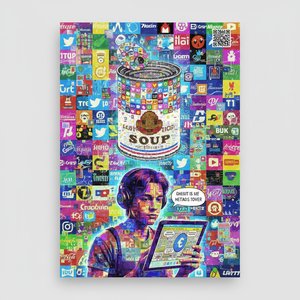 Pop Art 2.0: Recontextualizing Appropriation & Consumerism for a Digital Native Generation
Explore the evolution of Pop Art for today's digital world! Discover how appropriation & consumerism are reimagined by a new generation of artists. Expert insights & collecting tips.
The early 1960s witnessed Dine’s increasing association with Pop Art, largely due to his emphasis on commonplace objects. His inclusion in Walter Hopps' groundbreaking 1962 exhibition “New Painting of Common Objects” at the Pasadena Art Museum solidified this connection. However, Dine consistently resisted easy categorization within the movement. While acknowledging a shared interest in popular culture, he maintained that his work differed fundamentally from Pop’s often ironic and detached engagement with consumerism.
Unlike artists like Warhol or Lichtenstein who focused on mass-produced imagery, Dine's objects were deeply personal—charged with subjective meaning and emotional resonance. As he himself stated, “Pop is concerned with exteriors. I’m concerned with interiors.” His gestural style, reminiscent of Abstract Expressionism, further distinguished his work from the clean lines and mechanical reproduction characteristic of many Pop artists. Dine saw a closer kinship with Neo-Dada—a movement that questioned artistic conventions and embraced collage and assemblage—and particularly with Robert Rauschenberg and Jasper Johns.
Recurring Motifs & Symbolic Language: Tools, Robes, Hearts, and Pinocchio
Throughout his prolific career, Dine has returned repeatedly to a core set of motifs – tools, robes, hearts, and, perhaps most famously, Pinocchio. The tools, harking back to his childhood experiences in his grandfather’s hardware store, represent not merely implements of labor but also symbols of memory, masculinity, and the passage of time. The “Bathrobe” series, initiated in 1963 with a clipped newspaper advertisement featuring an airbrushed-out figure, became a powerful vehicle for self-portraiture—a way to explore identity without directly depicting his own likeness.
The robes, often monumental in scale and rendered in vibrant colors, evoke a sense of absence and longing. They are simultaneously inviting and unsettling, suggesting both comfort and isolation. The hearts, appearing across various media—paintings, sculptures, prints—represent vulnerability, passion, and the complexities of human emotion. And Pinocchio, the wooden puppet brought to life, embodies themes of transformation, authenticity, and the search for selfhood.
Printmaking as Exploration: Expanding Dine’s Visual Vocabulary
While widely recognized as a painter and sculptor, Jim Dine has also made significant contributions to the field of printmaking. He embraced a wide range of techniques—lithography, etching, gravure, intaglio, woodcuts, letterpress, and linocuts—using each medium to explore different facets of his artistic vision. Printmaking allowed him to experiment with repetition, variation, and scale in ways that were not always possible with painting or sculpture.
His prints often revisit the motifs found in his other work – tools, robes, hearts – but they also introduce new elements and perspectives. The process of printmaking itself—the layering of colors, the manipulation of textures, the inherent reproducibility of the image—became an integral part of Dine’s artistic exploration.
Jim Dine's Enduring Legacy: Influence on Contemporary Artists & Collectors
Jim Dine’s impact on contemporary art is undeniable. His willingness to challenge conventional boundaries, his embrace of personal narrative, and his innovative use of everyday objects have inspired generations of artists. He paved the way for a more subjective and emotionally resonant approach to Pop Art, bridging the gap between abstraction and figuration.
Today, Dine’s work is held in major museum collections worldwide, including the Smithsonian American Art Museum and the Musée d’Art Modern de la Ville de Paris. For collectors, his paintings, sculptures, and prints represent not only significant artistic achievements but also compelling explorations of identity, memory, and the human condition. OriginalUniqueArt.com offers a curated selection of high-quality reproductions of Jim Dine's iconic works, allowing art enthusiasts to experience the power and poetry of his vision firsthand. Explore our collection today and discover the enduring legacy of this remarkable artist.