
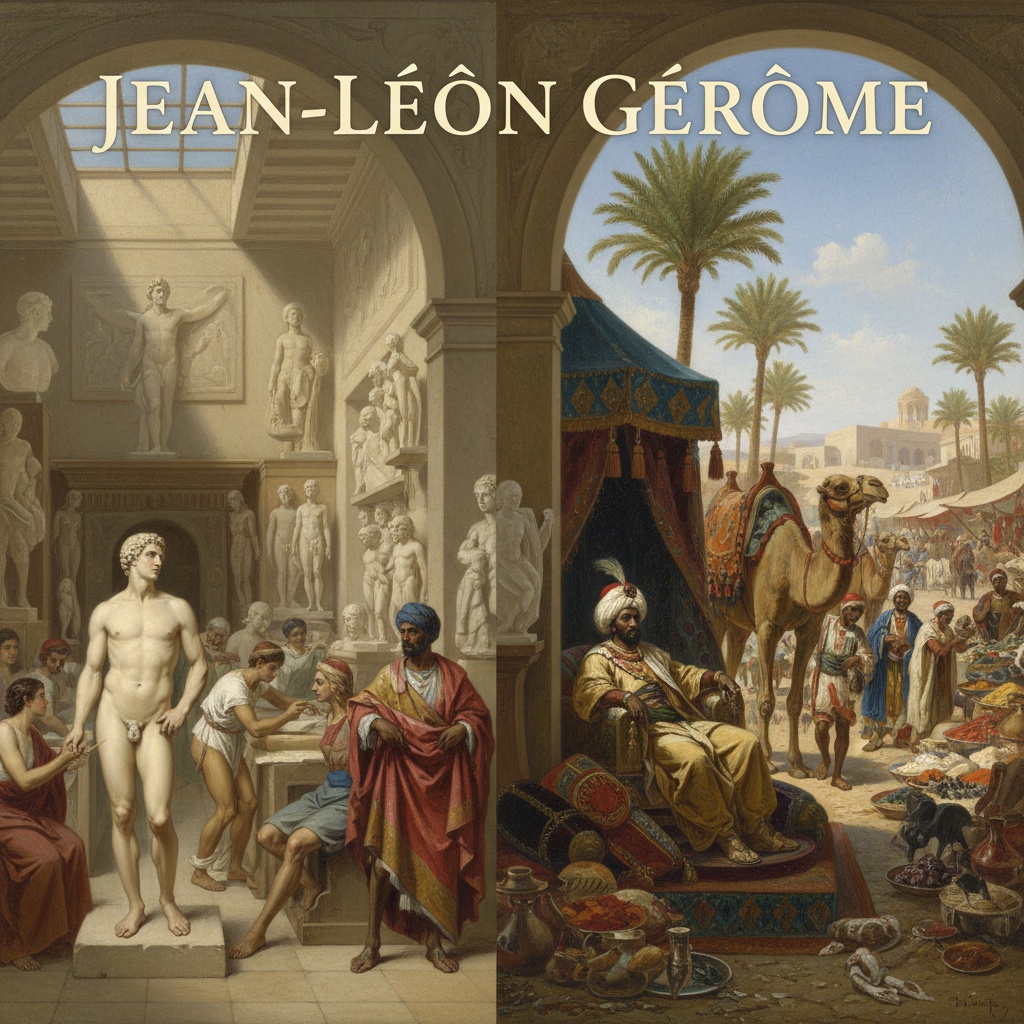
The Foundations of Academic Mastery: Gérôme's Early Training & Influences
 Wikipedia: Jean-Léon Gérôme
Jean-Léon Gérôme (French pronunciation: [ʒɑ̃ leɔ̃ ʒeʁom]; 11 May 1824 – 10 January 1904) was a French painter and sculptor in the style now known as academicism. His paintings were so widely reproduced that he was "arguably the world's most famous li...
Jean-Léon Gérôme, a name synonymous with the meticulous detail and dramatic flair of 19th-century French academic painting, wasn’t born into artistic renown but cultivated it through rigorous training and an unwavering dedication to his craft. Born in Vesoul in 1824, his early aptitude for drawing was nurtured by local artist Claude-Basile Cariage, providing a foundation upon which he would build a formidable career. His journey truly began at the age of sixteen when he arrived in Paris, entering the studio of Paul Delaroche – a pivotal moment that steered him towards historical painting and an appreciation for precise realism. This apprenticeship wasn’t merely about technique; it was an immersion into a world where accuracy was paramount, and narrative clarity reigned supreme. Delaroche's influence is palpable in Gérôme’s early works, characterized by a similar attention to detail and a penchant for recreating historical moments with almost photographic fidelity. A subsequent trip to Italy with Delaroche further solidified his commitment to classical forms and the study of ancient ruins – experiences that would later profoundly shape his depictions of the Orient.
Historical Painting Reimagined: Accuracy, Drama, and Narrative Detail
Academic art, academicism, or academism, is a style of painting and sculpture produced under the influence of European academies of art. This method extended its influence throughout the Western world over several centuries, from its origins in Italy...
Gérôme didn’t simply paint history; he *reconstructed* it. His canvases weren't merely illustrations of past events but meticulously researched and dramatically staged scenes designed to transport viewers directly into the heart of the action. Works like “The Age of Augustus, the Birth of Christ” (1852) exemplify this approach – a complex allegorical composition blending classical grandeur with religious narrative. The commission itself, secured through Alfred Emilien Comte de Nieuwerkerke, speaks volumes about Gérôme’s rising status and his ability to cater to the tastes of the Second Empire. He wasn't content with simply depicting figures; he painstakingly recreated costumes, architecture, and weaponry, ensuring an unparalleled level of authenticity. This dedication extended beyond mere visual accuracy; Gérôme sought to capture the *atmosphere* of the past – the light, the textures, the very air that would have surrounded these historical moments. His travels to Constantinople in 1853 and subsequent explorations further fueled this commitment, providing firsthand observations that informed his increasingly detailed and compelling compositions.
The Allure of the Orient: Exploring Gérôme’s Exotic Visions and Artistic Process
While celebrated for his historical paintings, it is perhaps Gérôme's depictions of the Middle East – his “Orientalist” works – that remain most iconic. Paintings like “Le Charmeur de Serpents” (The Snake Charmer) and “Bathers in a Turkish Bath” captivated audiences with their exotic locales, vibrant colors, and sensuous portrayals of Eastern life. However, it’s crucial to understand these paintings not as objective representations but as carefully constructed fantasies – visions shaped by his own experiences, artistic license, and the prevailing cultural attitudes of the time. Gérôme's process was methodical. He meticulously documented details from his travels, sketching costumes, architecture, and everyday life. But he wasn’t simply a reporter; he synthesized these observations with his imagination, creating scenes that were often idealized or romanticized. The Boîte à Thé, a Parisian studio frequented by artists, writers, and actors, served as a crucial space for developing these compositions – a place where ideas were exchanged and exotic imagery was brought to life.
Orientalism Under Scrutiny: Contextualizing Gérôme within a Complex Discourse
In art history, literature, and cultural studies, Orientalism is the imitation or depiction of aspects of the Eastern world (or "Orient") by writers, designers, and artists from the Western world. Orientalist painting, particularly of the Middle East...
The term “Orientalism,” popularized by Edward Said’s seminal work in 1978, has fundamentally altered our understanding of Western representations of the East. Said argued that Orientalist paintings often perpetuated stereotypes and served to justify colonial power dynamics – portraying Eastern societies as exotic, irrational, and ultimately inferior to the West. Gérôme's works are undeniably products of their time, reflecting a European fascination with the “other” that was inextricably linked to imperial ambitions. However, dismissing his work solely as an exercise in colonial propaganda is overly simplistic. While acknowledging the problematic aspects of his depictions – the romanticized portrayals, the exoticism, and the inherent power imbalance – it’s also important to recognize Gérôme's genuine artistic skill and his desire to capture the beauty and complexity of Eastern cultures. Contemporary critics like Jonathan Jones have argued that many Orientalist paintings stemmed from a sincere admiration for the East, not malice or prejudice. The debate surrounding Orientalism remains complex, requiring a nuanced understanding of historical context and artistic intent.
Gérôme as Educator: Shaping a Generation of Artists & His Lasting Legacy
Beyond his prolific output as a painter, Gérôme was a highly influential teacher, shaping the sensibilities of an entire generation of artists. His atelier attracted students from across Europe and America, including Mary Cassatt, Thomas Eakins, and Osman Hamdi Bey – each of whom would go on to achieve significant recognition in their own right. He instilled in his pupils a commitment to technical mastery, meticulous observation, and the importance of historical research. Gérôme’s teaching methods were rigorous, emphasizing drawing from life and the study of classical forms. He wasn't afraid to challenge his students, pushing them to refine their skills and develop their own unique voices. His influence extended beyond the studio walls; he actively promoted academic art and championed traditional values in a rapidly changing artistic landscape. While modernism eventually eclipsed academic painting, Gérôme’s legacy endures – not only through his stunning canvases but also through the countless artists who were inspired by his dedication to craft and his unwavering pursuit of beauty.
Beyond the Canvas: Sculpture, Archaeology, and the Breadth of Gérôme’s Talent
Jean-Léon Gérôme's artistic pursuits extended far beyond painting. He was also a skilled sculptor, creating works that shared the same meticulous detail and dramatic intensity as his canvases. Furthermore, he possessed a deep fascination with archaeology, fueled by his travels to Greece and Turkey. This interest informed not only his Orientalist paintings but also his broader understanding of history and culture. His involvement in archaeological excavations, though sometimes controversial, demonstrates a genuine desire to understand the past – a pursuit that underpinned much of his artistic work. Gérôme’s commitment to authenticity extended beyond mere visual representation; he sought to recreate entire worlds, immersing viewers in historical moments and exotic locales. This dedication, combined with his exceptional technical skill, cemented his reputation as one of the most important painters of the 19th century – a master who continues to captivate audiences today. At OriginalUniqueArt.com, we are proud to offer high-quality reproductions of Gérôme’s iconic works, allowing you to experience the beauty and drama of his paintings firsthand.



