The Dawn of Dutch Realism: Van Goyen’s Artistic Context
Dutch Golden Age painting is the painting of the Dutch Golden Age, a period in Dutch history roughly spanning the 17th century, during and after the later part of the Eighty Years' War (1568–1648) for Dutch independence. The new Dutch Republic was th...
The early 17th century Netherlands was a nation undergoing profound transformation. Newly independent, fueled by burgeoning trade and scientific inquiry, the Dutch Republic fostered an environment ripe for artistic innovation. This wasn't a period demanding grandiose historical narratives or religious spectacle; instead, a quiet revolution unfolded in the depiction of everyday life and the natural world. Jan van Goyen emerged as a pivotal figure within this shift, rejecting the established Mannerist traditions in favor of a strikingly realistic portrayal of the Dutch countryside. Unlike his contemporaries who often embellished scenes with dramatic flourishes, Van Goyen sought to capture the subtle nuances of light, atmosphere, and the very essence of place. His work wasn’t merely *about* landscapes; it was an attempt to embody them, to convey the feeling of being present within the vastness of a Dutch sky or along the tranquil banks of the Rhine. He trained initially in Leiden with Esaias van de Velde, absorbing foundational techniques before forging his own distinct path – one characterized by meticulous observation and a remarkably restrained palette.
A Palette of Subtlety: Exploring Van Goyen's Unique Technique
Aerial perspective, or atmospheric perspective, is the effect the atmosphere has on the appearance of an object as viewed from a distance. As the distance between an object and a viewer increases, the contrast between the object and its background de...
Van Goyen’s artistic power resided not in vibrant hues or elaborate compositions, but in the masterful control of a limited range of earth tones – grays, browns, ochres, and greens. This deliberate restriction wasn’t born of necessity, but rather a conscious aesthetic choice. By employing a tonal approach, he prioritized atmospheric effects, creating paintings that evoke a sense of spaciousness and depth rarely seen before. He began with thin layers of animal hide glue on oak panels, followed by a tinted ground to establish the overall mood. His sketches, executed rapidly in walnut ink, served as blueprints for his compositions, but it was the application of paint – thinly layered and blended with varnish oil – that truly brought his visions to life. The darker areas remained almost transparent, allowing the ground to shimmer through, while lighter tones were built up with greater opacity. This technique, coupled with a lowered horizon line, emphasized the expansive skies for which he became renowned. Consider ‘Landscape with Dunes’ (1630), where the subtle gradations of color and light perfectly capture the serenity of the coastal landscape; it's not simply a depiction of dunes, but an *experience* of them.
Skies and Waterways: Recurring Themes in Van Goyen’s Oeuvre
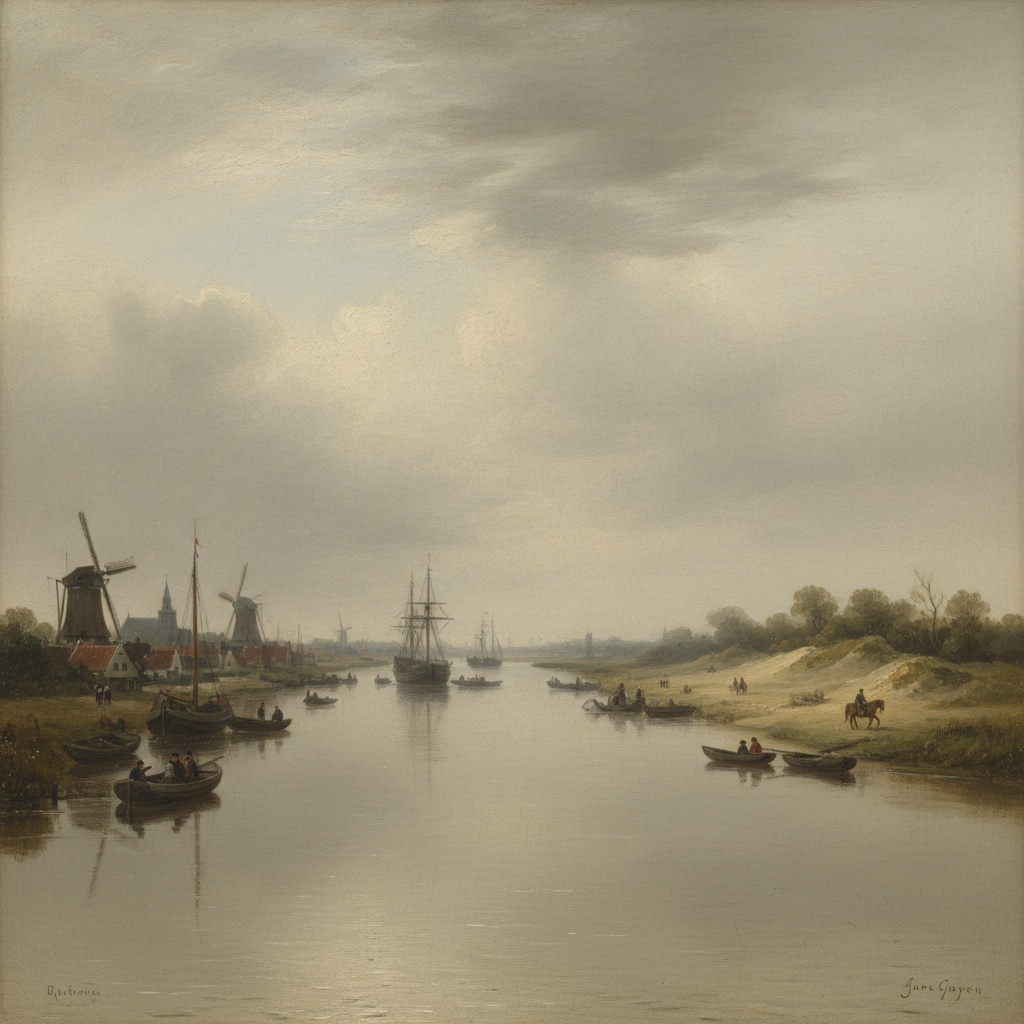
 The Rhine at Arnhem
Discover 'The Rhine at Arnhem' by Jan van Goyen (1645). A stunning Dutch landscape painting showcasing atmospheric realism & serene river scenes. Explore this masterpiece in Vienna!
While Van Goyen painted a diverse range of subjects – forests, marine scenes, cityscapes – certain motifs consistently reappear throughout his prolific body of work. Skies dominate many compositions, often vast and cloud-filled, reflecting the ever-changing weather conditions of the Netherlands. These weren't merely backdrops; they were integral to the emotional impact of the paintings, conveying a sense of tranquility, drama, or even foreboding. Waterways – rivers like the Rhine, canals near The Hague, and inland seas – also feature prominently, serving as mirrors reflecting the sky and providing a dynamic element within otherwise static scenes. ‘The Rhine at Arnhem’ (1645) exemplifies this fascination with waterways; the serene river scene is imbued with a sense of realism and atmospheric depth that draws the viewer into the landscape. He frequently depicted everyday life unfolding along these rivers – fishermen hauling nets, boats transporting goods, people engaged in leisurely activities – grounding his landscapes in the tangible realities of Dutch society.
Beyond Representation: The Symbolism Within the Landscapes
Although Van Goyen is celebrated for his realism, dismissing his work as purely topographical would be a mistake. Beneath the surface of these seemingly straightforward depictions lie subtle layers of symbolism. While not overtly allegorical, his paintings often contain motifs that resonated with contemporary audiences. The inclusion of pilgrims or travelers, for example, could represent the journey of life and the search for spiritual meaning. Weather-beaten trees were sometimes interpreted as symbols of resilience and mortality, while idle figures might allude to the transience of worldly pleasures. However, it’s crucial to avoid imposing rigid interpretations; Van Goyen's symbolism is often ambiguous, allowing viewers to project their own meanings onto the scenes. His landscapes weren’t didactic pronouncements but rather invitations to contemplation, prompting reflection on themes of nature, faith, and the human condition. The muted tones themselves can be seen as symbolic, representing a sense of humility and restraint – qualities valued within Dutch society.
Van Goyen’s Legacy: Influence and Lasting Impact on Landscape Painting
Jan van Goyen's influence extended far beyond his own lifetime. He was an incredibly prolific artist, leaving behind approximately twelve hundred paintings and over a thousand drawings, ensuring the widespread dissemination of his style. His emphasis on realism, atmospheric perspective, and the subtle beauty of the Dutch countryside profoundly impacted subsequent generations of landscape painters, including Jacob van Ruisdael and Aelbert Cuyp. He pioneered a new approach to landscape painting – one that prioritized observation, emotional resonance, and the depiction of everyday life. His work continues to captivate audiences today, offering a glimpse into the world of 17th-century Netherlands and reminding us of the enduring power of art to capture not just what we see, but how it *feels* to be present within a particular place and time. At OriginalUniqueArt, we are proud to offer high-quality reproductions of Van Goyen’s masterpieces, allowing you to experience the serenity and beauty of his landscapes firsthand. Explore our collection today and discover the enduring legacy of this remarkable artist.