Early Life & Apprenticeship: From Merchant’s Clerk to Maritime Artist
 Wikipedia: Ludolf Bakhuizen
Ludolf Bakhuizen (28 December 1630 or 1632 – 7 November 1708) was a German-born Dutch painter, draughtsman, calligrapher and printmaker. He was the leading Dutch painter of maritime subjects after Willem van de Velde the Elder and Younger left for En...
Ludolf Backhuysen, born in Emden, East Frisia around 1630 (or possibly 1632), embarked on a path remarkably divergent from the artistic calling he would ultimately embrace. Initially destined for commerce, young Ludolf followed a conventional route, finding employment as a merchant’s clerk in Amsterdam – a bustling hub of trade and burgeoning cultural life. However, fate, or perhaps an innate predisposition, intervened. He discovered within himself a compelling aptitude for drawing, initially expressed through meticulous pen drawings and elegant calligraphy. This nascent talent proved so strong that he relinquished the predictable security of business to dedicate himself fully to art in the late 1650s.
His early artistic development was shaped by two significant figures: Allart van Everdingen, a painter known for his Italianate landscapes and dramatic lighting effects, and Hendrik Dubbels, an established master specializing in sea-pieces. Under their tutelage, Backhuysen honed his skills, absorbing the techniques of landscape rendering and the intricacies of depicting maritime scenes. This period was crucial; it laid the foundation for his future mastery, blending a keen observational eye with a growing understanding of artistic principles. The transition from meticulous clerk to dedicated artist wasn’t merely a change in profession—it was a transformation fueled by passion and an undeniable gift.
The Rise of Dutch Marine Painting: A Golden Age Context
Ludolf Backhuysen I lived in the XVII – XVIII cent., a remarkable figure of Dutch Baroque. Find more works of this artist at Wikiart.org – best visual art ...
To understand Backhuysen's significance, one must appreciate the unique cultural climate of the 17th-century Netherlands. The Dutch Republic, newly independent after decades of struggle, experienced a period of unprecedented prosperity and naval dominance. This “Golden Age” fostered a vibrant artistic market driven by a burgeoning middle class eager to acquire paintings reflecting their world—a world intimately connected to the sea. Unlike earlier traditions where maritime art often served religious or allegorical purposes, Dutch marine painting focused on realism, depicting everyday life at sea, ship portraits, and dramatic storm scenes.
The departure of Willem van de Velde the Elder and Younger for England in 1672 created a void in the Dutch artistic landscape. Van de Velde’s unparalleled skill had long defined the genre; his absence opened an opportunity for other artists to step forward, and Backhuysen was uniquely positioned to fill it. He wasn't simply replicating van de Velde’s style but developing his own distinct voice—one characterized by a meticulous attention to detail, a nuanced understanding of light and shadow, and a remarkable ability to capture the raw power and unpredictable beauty of the ocean.
Backhuysen's Signature Style: Realism, Detail, and the Evocation of Atmosphere
Backhuysen’s paintings are immediately recognizable for their extraordinary realism. He wasn’t content with merely representing ships; he sought to capture the very *essence* of the sea—its turbulent energy, its shifting moods, and its subtle interplay of light and shadow. This dedication to accuracy stemmed from a profound engagement with nature. Accounts describe Backhuysen frequently venturing out onto the water in an open boat, braving storms to directly observe the effects of wind, waves, and weather on ships and the sea’s surface.
His technique was equally meticulous. He employed layers of oil paint to build up texture and depth, creating a sense of three-dimensionality that draws the viewer into the scene. The sails of his ships are rendered with painstaking detail, each rope and seam carefully delineated. But it wasn’t simply about technical skill; Backhuysen possessed an exceptional ability to convey atmosphere. His skies are often dramatic and expansive, filled with billowing clouds and shifting light, creating a sense of both grandeur and foreboding. He masterfully used color—subtle gradations of gray, blue, and green—to evoke the feeling of salt spray, damp air, and the vastness of the ocean.
Key Works & Techniques: Exploring 'Marine, Un Phare Sur Le Cote' and Beyond
 MARINE, UN PHARE SUR LE COTE
Discover Ludolf Backhuysen’s "Marine, Un Phare Sur Le Cote" – a stunning 18th-century maritime painting of turbulent seas & sailing ships. Explore realism & Dutch Golden Age artistry.
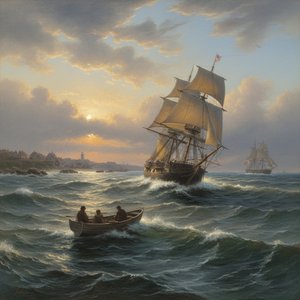
A compelling example of Backhuysen’s artistry is “Marine, Un Phare Sur Le Cote” (Marine, A Lighthouse on the Coast). This 18th-century painting exemplifies his signature style—turbulent seas, sailing ships battling the elements, and a dramatic sky. The lighthouse itself serves as a beacon of hope amidst the chaos, its light cutting through the gloom. Notice the intricate detail in the rigging of the ships, the realistic depiction of waves crashing against the hull, and the subtle variations in color that convey the feeling of movement and spray.
Backhuysen’s technique involved careful observation combined with a sophisticated understanding of perspective and composition. He often employed a high vantage point to provide a panoramic view of the scene, allowing him to capture the interplay between ships, sea, and sky. His use of light is particularly noteworthy—he skillfully manipulated shadows to create depth and drama, drawing the viewer’s eye towards key elements within the composition. While he primarily focused on maritime subjects, Backhuysen also painted portraits of his family and friends, offering glimpses into his personal life and social circle.
Legacy and Influence: Backhuysen’s Impact on Subsequent Artists
Ludolf Backhuysen left an indelible mark on the landscape of Dutch marine painting. His meticulous realism, atmospheric perspective, and dedication to capturing the raw power of the sea influenced generations of artists who followed. While he didn't establish a formal “school” in the same way as some other masters, his style served as a benchmark for quality and authenticity within the genre.
His work continued to be admired and studied long after his death in 1708. Artists sought to emulate his techniques, striving to achieve the same level of detail and atmospheric realism. Backhuysen’s paintings also played a role in shaping public perception of maritime life—they offered a glimpse into the dangers and rewards of seafaring, celebrating both the skill of sailors and the majesty of the ocean. Today, his works are highly sought after by collectors and museums worldwide, serving as enduring testaments to his artistic genius.
Collecting Backhuysen Today: Authenticity, Value, and Appreciation
Acquiring a work by Ludolf Backhuysen is an investment in both art history and aesthetic beauty. However, navigating the market requires careful consideration. Authentication can be challenging due to the prevalence of forgeries and misattributions. Consulting with reputable art experts and examining provenance records are crucial steps.
The value of a Backhuysen painting depends on several factors, including size, condition, subject matter, and historical significance. Larger works in excellent condition typically command higher prices. Paintings depicting dramatic storm scenes or specific ships of historical importance are also particularly valuable. Beyond monetary considerations, the true reward lies in appreciating the artistry and skill of this remarkable master—his ability to capture the essence of the sea and convey its power and beauty for generations to come. At OriginalUniqueArt.com, we offer high-quality reproductions of Backhuysen’s masterpieces, allowing you to experience his art firsthand and bring a touch of Dutch Golden Age elegance into your home.