The Dawn of Chiaroscuro: Renaissance Foundations
Tenebrism, from Italian tenebroso ('dark, gloomy, mysterious'), also occasionally called dramatic illumination, is a style of painting using especially pronounced chiaroscuro, where there are violent contrasts of light and dark, and where darkness be...
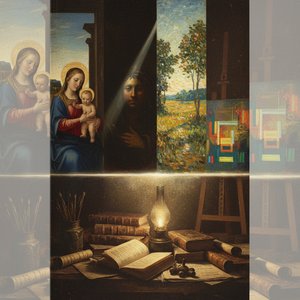
Before the dramatic spotlighting of Caravaggio, before Rembrandt’s introspective use of shadow, lay a gradual awakening – the Renaissance rediscovery of light as a sculptor of form and emotion. While not yet the stark contrast we associate with later masters, artists of the 14th and 15th centuries began to move beyond the flat, gilded surfaces of medieval art, seeking ways to represent volume and depth on canvas. This nascent exploration wasn’t merely technical; it was a philosophical shift, reflecting a growing humanist interest in the natural world and the individual experience. Early pioneers like Masaccio, though not solely focused on light-dark effects, laid crucial groundwork with their pioneering use of perspective and modeling. Their frescoes demonstrated an understanding of how light interacts with surfaces, creating subtle gradations that suggested three-dimensionality. Leonardo da Vinci, ever the innovator, further refined these techniques through his meticulous study of sfumato – a delicate blurring of edges that created atmospheric depth and softened forms. This wasn’t about harsh contrasts; it was about nuanced transitions, a gentle unfolding of light that mirrored the complexities of human perception. The groundwork was being laid for an artistic revolution, one where light wouldn't just illuminate a scene but would become a powerful narrative force in its own right.
Caravaggio and Tenebrism: A Revolution in Darkness
 untitled
Discover Caravaggio’s "untitled" – a dramatic Baroque oil painting featuring intense chiaroscuro & poignant figures. Explore realism, grief, & the artist's revolutionary style.
The arrival of Michelangelo Merisi da Caravaggio in the late 16th century irrevocably altered the course of art history. Rejecting the idealized forms and balanced compositions favored by many of his contemporaries, Caravaggio embraced realism with a visceral intensity. His paintings weren’t simply depictions of biblical scenes or mythological narratives; they were raw, unflinching portrayals of human life, often featuring ordinary people as models. But it was his revolutionary use of light – specifically, the technique now known as tenebrism – that truly set him apart. Tenebrism, derived from the Italian word for “darkness,” is characterized by dramatic contrasts between intensely illuminated areas and deep, enveloping shadows. This wasn’t merely a stylistic choice; it was a deliberate attempt to heighten emotional impact and create a sense of psychological drama. Consider his “untitled” (as referenced in OriginalUniqueArt's collection), where the figures emerge from an almost absolute blackness, their faces etched with grief and vulnerability. The single, unseen light source acts as a spotlight, focusing our attention on the most crucial elements of the composition – the poignant expressions, the gestures of despair. This bold approach wasn’t universally appreciated; Caravaggio faced criticism for his unconventional style and often controversial subject matter. Yet, his influence was immediate and profound, inspiring generations of artists to explore the expressive power of light and shadow.
Rembrandt’s Mastery: Psychological Depth Through Light
In art, chiaroscuro (English: kee-AR-ə-SKOOR-oh, -SKURE-, Italian: [ˌkjaroˈskuːro]; lit. 'light-dark') is the use of strong contrasts between light and dark, usually bold contrasts affecting a whole composition. It is also a technical term used by ...
While Caravaggio ignited the revolution, Rembrandt van Rijn perfected it. Unlike Caravaggio's often theatrical use of tenebrism, Rembrandt employed chiaroscuro with a more subtle and nuanced approach, focusing on psychological depth rather than sheer dramatic effect. His paintings aren’t simply about what is illuminated; they are about *how* things are illuminated – the way light reveals character, exposes inner turmoil, and creates a sense of intimacy. Rembrandt's masterful use of light often feels internal, as if emanating from within the subjects themselves. He wasn’t interested in idealized beauty or heroic narratives; he sought to capture the complexities of human emotion, the weight of experience etched onto every face. His self-portraits, spanning decades of his life, are a testament to this – each one a profound exploration of aging, loss, and self-discovery. The shadows aren’t simply darkness; they are spaces of contemplation, hinting at hidden depths and unspoken truths. He used light not just to define form but to sculpt the very soul of his subjects, creating portraits that resonate with an unparalleled emotional power.
Beyond Italy: The Spread and Adaptation of Light Studies
The impact of Caravaggio and Rembrandt wasn’t confined to Italy and the Netherlands. Their techniques quickly spread throughout Europe, inspiring artists in Spain, France, and beyond to experiment with light and shadow. In Spain, José de Ribera adopted tenebrism with a similar intensity to Caravaggio, often focusing on religious themes and depictions of martyrdom. Georges de La Tour, working in France, developed a unique style characterized by nocturnal scenes illuminated by a single candle flame – creating an atmosphere of quiet contemplation and spiritual mystery. These artists weren’t simply copying Caravaggio or Rembrandt; they were adapting the techniques to their own cultural contexts and artistic sensibilities. The Dutch Golden Age saw numerous painters embrace chiaroscuro, often focusing on genre scenes and portraits that captured the everyday lives of ordinary people. The technique became a versatile tool for exploring a wide range of subjects and emotions, demonstrating its enduring power and adaptability.
Chiaroscuro's Enduring Legacy: Influence on Modern Art & Photography
The legacy of chiaroscuro extends far beyond the Baroque period. Its influence can be seen in the works of Goya, whose dramatic use of light and shadow foreshadowed the Romantic movement. Even into the 20th and 21st centuries, artists continue to draw inspiration from these techniques, using them to create powerful visual effects and explore complex themes. The technique’s impact is perhaps most evident in photography and cinema, where light and shadow are essential tools for creating mood, atmosphere, and narrative tension. Film noir, with its stark contrasts and dramatic lighting, owes a clear debt to the masters of chiaroscuro. Contemporary photographers continue to employ these techniques to create evocative portraits and capture the beauty of darkness. At OriginalUniqueArt.com, we celebrate this enduring legacy by offering high-quality reproductions of masterpieces from throughout art history – allowing you to bring the power of light and shadow into your own home. Whether you’re drawn to the raw realism of Caravaggio, the psychological depth of Rembrandt, or the subtle nuances of da Vinci, exploring chiaroscuro is a journey into the heart of artistic expression.