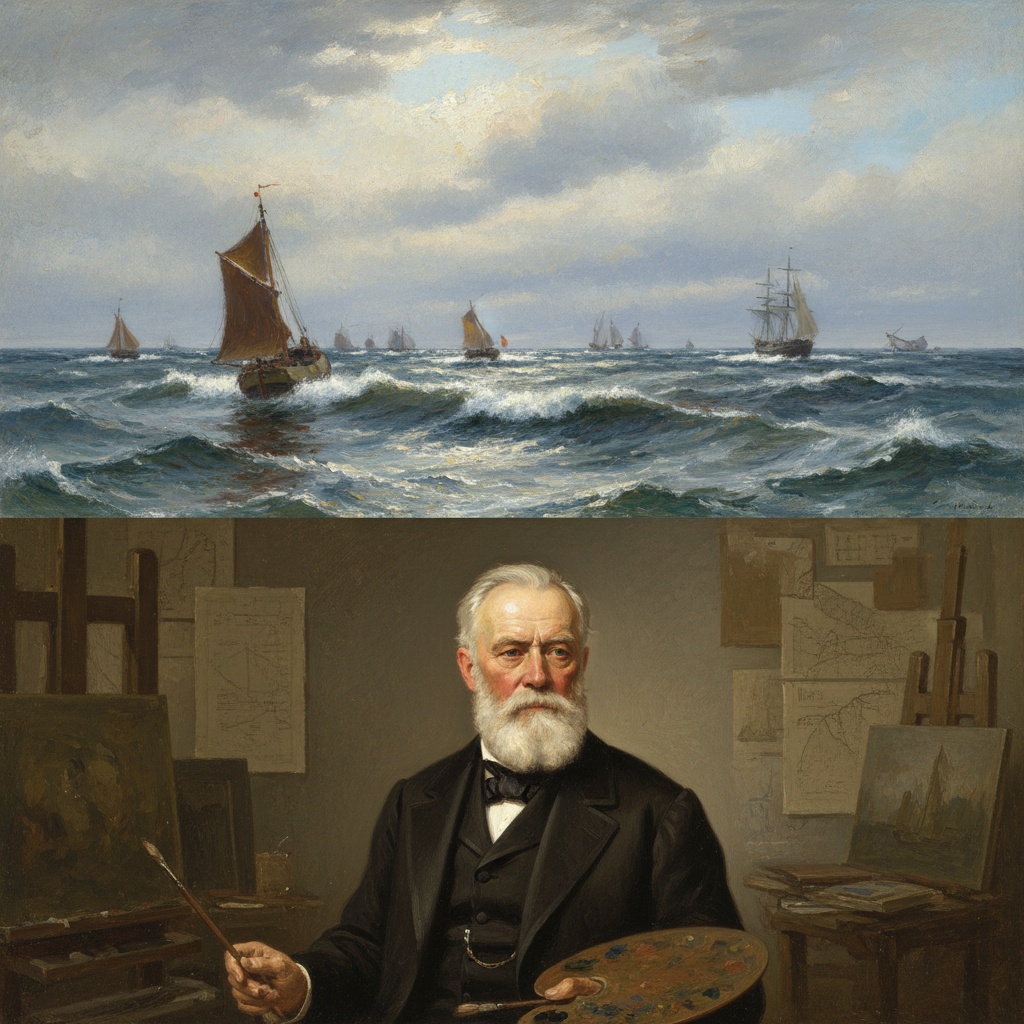
Early Life & Artistic Beginnings: From Banking to Brushstrokes
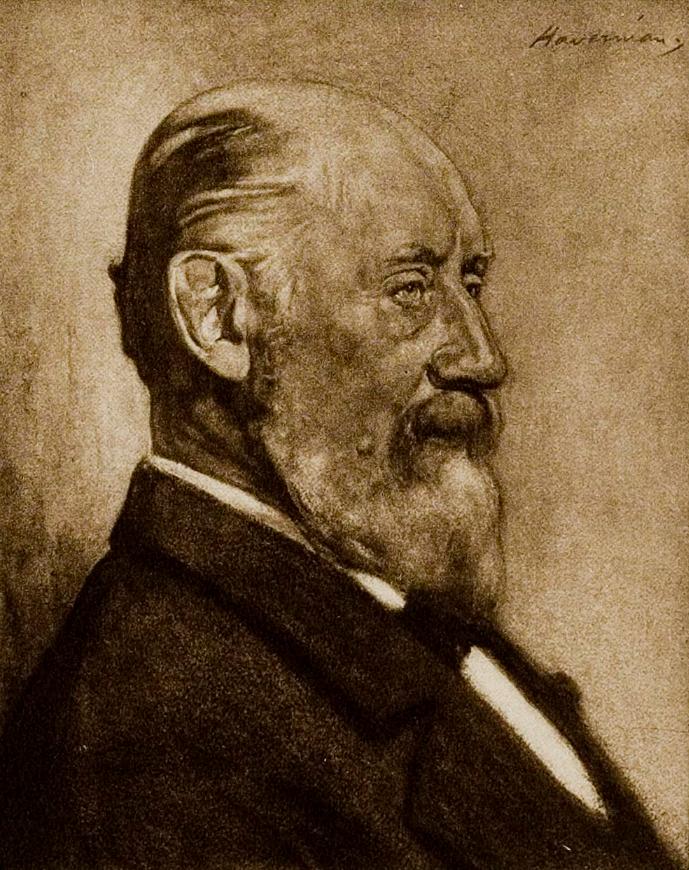 Wikipedia: Hendrik Willem Mesdag
Hendrik Willem Mesdag (Dutch pronunciation: [ˈɦɛndrɪk ˈʋɪləm ˈmɛzdɑx]; 23 February 1831 – 10 July 1915) was a Dutch marine painter. == Biography == He was born in Groningen, the son of the banker Klaas Mesdag and his wife Johanna Wilhelmina van Gi...
Hendrik Willem Mesdag’s journey from the world of finance to that of fine art is a compelling narrative of passion overcoming practicality. Born in Groningen in 1831, he initially followed a conventional path, destined for a career mirroring his father’s success as a banker. Encouraged by his amateur painter father, young Hendrik received early artistic training, but it remained largely a cherished pastime during his formative years. For sixteen years, Mesdag diligently pursued banking, demonstrating competence and stability. However, the allure of the canvas proved too strong to resist. A fortunate inheritance from his wife Sina’s family in 1856 provided the financial freedom to embrace his true calling at the age of thirty-five – a bold decision that would irrevocably alter the course of Dutch art.
This transition wasn't merely a shift in profession; it was a liberation. Mesdag didn’t abandon his meticulous nature, honed by years in banking, but rather channeled it into a deeply considered approach to painting. His early studies in Brussels under Willem Roelofs provided foundational skills, yet it was the subsequent move to The Hague in 1868 that truly ignited his artistic vision. It was here, facing the vast expanse of the North Sea, that Mesdag discovered his enduring subject matter and a style uniquely his own.
The Allure of the North Sea: Mesdag’s Maritime Focus
 Kalme zee, Hendrik Willem Mesdag, 1860 - 1900
Experience 'Kalme Zee' by Hendrik Willem Mesdag – a serene 1900 Impressionist seascape of the North Sea. Admire loose brushwork & tranquil coastal scenes.
The sea wasn't simply a picturesque backdrop for Mesdag; it was a living entity, a source of constant fascination and profound emotional resonance. The often-turbulent waters off the Dutch coast – particularly around Scheveningen – captivated him with their ever-changing moods, dramatic light effects, and the bustling activity of the fishing fleets. Unlike many marine painters who focused on grand historical naval scenes or romanticized shipwrecks, Mesdag’s attention was drawn to the everyday realities of life at sea.
His paintings are not about heroic battles but about the quiet dignity of fishermen braving the elements, the subtle shifts in atmospheric conditions, and the raw power of nature. Works like “Kalme Zee” (Calm Sea) exemplify this focus – a serene depiction of tranquil coastal waters rendered with loose brushwork that captures the shimmering light and gentle movement of the waves. He wasn’t interested in photographic precision; instead, he sought to convey the *feeling* of being at sea, the vastness of the horizon, and the inherent drama of the natural world. This commitment to capturing atmosphere and emotion would become a defining characteristic of his style.
Mesdag and the Hague School: A Shared Vision of Realism
The Hague School (Dutch: Haagse School) is a group of artists who lived and worked in The Hague between 1860 and 1890. Their work was heavily influenced by the realist painters of the French Barbizon school. The painters of the Hague school generally...
Mesdag’s artistic development unfolded within the context of the Hague School, a group of Dutch painters who shared a common rejection of academic conventions in favor of realism. Influenced by the Barbizon school in France, these artists sought to depict scenes from everyday life with honesty and authenticity. While not rigidly unified in style, they were united by their somber palettes, emphasis on atmosphere, and focus on rural landscapes and coastal subjects.
Mesdag distinguished himself within this group as a dedicated marine painter – a specialization that set him apart. He became an active member of the Pulchri Studio artists’ society in The Hague, contributing to its vibrant artistic community and eventually serving as its chairman. His commitment to realism wasn't merely technical; it was a philosophical stance. Mesdag believed in portraying the world as he saw it, without idealization or romantic embellishment. This dedication resonated with his contemporaries and helped establish him as a leading figure of the Hague School.
Panorama Mesdag: An Immersive Masterpiece
Perhaps Mesdag’s most ambitious undertaking – and enduring legacy – is the Panorama Mesdag, completed in 1881. Commissioned by a Belgian company, this colossal cylindrical painting offers an immersive 360-degree view of Scheveningen beach. Measuring 14 meters high and 120 meters in circumference, it’s a breathtaking spectacle that transports viewers directly into the heart of a bustling coastal scene.
The creation of the panorama was a collaborative effort, involving Mesdag and his wife Sina, along with several students. However, it was Mesdag's artistic vision that guided the project, resulting in a remarkably detailed and atmospheric depiction of Dutch maritime life. The painting’s success was initially hampered by changing tastes – the vogue for panoramas waned shortly after its completion. Undeterred, Mesdag purchased the panorama at auction and continued to fund its operation from his own pocket, ensuring that this remarkable work remained accessible to the public. Today, it stands as a testament to his artistic dedication and a unique example of 19th-century immersive art.
Legacy and Influence: Shaping Dutch Art History
Hendrik Willem Mesdag’s impact on Dutch art history extends far beyond his captivating seascapes and the monumental Panorama Mesdag. He played a crucial role in establishing the Hague School as a significant artistic movement, championing realism and atmospheric painting at a time when academic conventions still held sway. His dedication to capturing the essence of the North Sea – its moods, its light, and its inherent drama – inspired generations of Dutch artists.
His influence can be seen in the works of later painters who embraced his commitment to plein air painting and atmospheric realism. Mesdag’s legacy is also preserved through The Mesdag Collection, which he bequeathed to the Netherlands in 1903. This extraordinary collection, housed in his former home in The Hague, showcases not only his own work but also masterpieces from the French Barbizon School and other contemporary artists – a testament to his discerning eye and passion for art.
Collecting & Patronage: The Mesdag Collection's Enduring Impact
Mesdag was not merely an artist; he was a dedicated collector and astute patron of the arts. His home in The Hague became a haven for contemporary paintings, drawings, and applied arts, reflecting his refined taste and commitment to supporting fellow artists. He amassed an impressive collection of works by French Barbizon School masters like Millet, Rousseau, and Daubigny, recognizing their influence on Dutch painting.
The Mesdag Collection is particularly renowned for its holdings of French masterpieces, offering a unique glimpse into the artistic influences that shaped his own work. His patronage extended beyond simply acquiring art; he actively fostered relationships with artists and promoted their work within the Dutch art community. By donating his house and collection to the Netherlands, Mesdag ensured that his legacy would endure, providing future generations with access to a remarkable treasure trove of 19th-century art. Today, The Mesdag Collection stands as a testament to his artistic vision, his dedication to collecting, and his enduring contribution to Dutch cultural heritage.
Discover the timeless beauty of Hendrik Willem Mesdag’s work and explore our curated collection of fine art reproductions at OriginalUniqueArt.com – where history comes alive on canvas.