Early Life and Artistic Foundations: From Decorator to Aspiring Painter
Gustave Loiseau (3 October 1865 – 10 October 1935) was a French Post-Impressionist painter, remembered above all for his landscapes and scenes of Paris streets. == Early life == Loiseau was born in Paris and was brought up there, and at Pontoise, b...
Gustave Loiseau’s journey to becoming a celebrated Post-Impressionist painter was not one of immediate artistic recognition, but rather a gradual unfolding fueled by quiet determination and a keen sensitivity to the world around him. Born in Paris in 1865, his early life offered little indication of the luminous landscapes that would eventually define his oeuvre. His parents, modest shopkeepers, instilled a practical sensibility, and Loiseau initially followed a path dictated by necessity, apprenticing with a family friend as a decorator. This formative experience, however, proved surprisingly influential. It honed his eye for detail, fostered an appreciation for color harmony, and provided him with a foundational understanding of visual composition – skills that would later prove invaluable.
A turning point arrived in 1887 when a modest inheritance from his grandmother liberated Loiseau from the constraints of his apprenticeship. This newfound freedom allowed him to pursue his burgeoning passion for painting, enrolling at the prestigious École des Arts Décoratifs. Yet, the rigid academic curriculum soon proved stifling. He chafed against the emphasis on precise replication and yearned for a more expressive approach. A brief but pivotal mentorship with Fernand Quignon, a landscape artist who encouraged *plein air* painting – working directly from nature – ignited Loiseau’s artistic spirit and set him on a course that would lead him away from convention and towards his own distinctive style.
The Pont-Aven Influence and the Birth of Loiseau’s Unique Style
 Near Pontoise
Explore 'Near Pontoise' by Gustave Loiseau – a captivating Impressionist winter landscape featuring cross-hatching & muted tones. Discover this 1901 oil painting’s serene beauty.
The year 1890 marked a significant shift in Loiseau's artistic development with his first journey to Pont-Aven, Brittany. This small coastal village had already become a magnet for artists seeking refuge from the Parisian art world and an environment conducive to experimentation. It was here that Loiseau encountered Paul Gauguin and Émile Bernard, figures who were actively challenging traditional painting techniques and exploring new avenues of expression. While he didn’t fully embrace their Synthetist principles, the atmosphere of Pont-Aven – its emphasis on subjective experience and bold color – profoundly impacted his artistic sensibilities.
Initially experimenting with Pointillism, Loiseau quickly moved beyond this technique, seeking a method that better captured the nuances of light and atmosphere. He began to develop what would become his signature style: a distinctive approach to Post-Impressionism characterized by a unique form of cross-hatching, known as “en treillis.” This wasn’t merely a technical innovation; it was an attempt to translate the very essence of nature onto canvas – the shimmering play of light on leaves, the subtle variations in color across a field, the dynamic energy of a windswept landscape. His early works from this period demonstrate a growing confidence and a willingness to depart from established norms.
Mastering 'En Treillis': A Signature Technique of Light and Texture
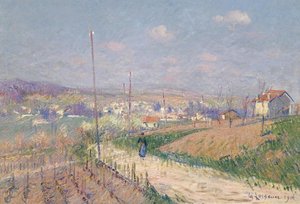 Village in Spring
Discover Gustave Loiseau’s "Village in Spring," a serene Impressionist landscape painting evoking tranquility & rural beauty. Explore its unique cross-hatching technique.
The “en treillis” technique is arguably the defining characteristic of Gustave Loiseau’s art, setting him apart from his contemporaries. Unlike the broken brushstrokes of Impressionism, which aimed to capture fleeting moments of light, Loiseau's method involved layering short, repetitive strokes of paint in a deliberate crisscrossing pattern. This created a textured surface that wasn’t simply descriptive but actively *constructed* form and depth. Imagine sunlight filtering through leaves – it isn’t a uniform wash of color, but rather a complex interplay of highlights and shadows, a network of interwoven light and dark.
Loiseau meticulously built up these layers, often using contrasting colors to create a subtle vibrancy that seemed to emanate from within the canvas. The effect is one of shimmering movement, as if the landscape itself were breathing. This technique wasn’t simply about visual representation; it was an attempt to capture the *feeling* of being immersed in nature, the sensation of light and air on the skin. It required immense patience and skill, a testament to Loiseau's dedication to his craft.
Loiseau's Landscapes: Capturing the Seasons and French Rural Life
 Road to Versailles
Gustave Loiseau’s ‘Road to Versailles’ (1910) captures a tranquil village scene in Impressionistic brushstrokes. Explore its atmospheric beauty, muted tones & subtle symbolism – a timeless piece for art lovers.
Loiseau’s passion lay in depicting the changing moods of the French countryside throughout the seasons. He frequently returned to the same locations – orchards, gardens, riverbanks – observing how light transformed familiar scenes over time. Series of paintings often depict a single subject across different times of day or during various stages of the year, offering a nuanced and intimate portrait of nature’s rhythms. This dedication to serial imagery echoes Claude Monet's explorations of water lilies and haystacks, but Loiseau imbued his works with a distinctively French sensibility.
His landscapes are not grand vistas; they are intimate scenes of rural life – fields ripening under the summer sun, snow-covered villages in winter, poplar trees lining the banks of the Seine. He captured the quiet beauty of everyday moments: dockers working alongside their boats, villagers returning from Sunday service, carriages traversing Parisian boulevards. These weren’t merely picturesque depictions; they were imbued with a sense of authenticity and genuine affection for the French landscape.
Parisian Scenes and Beyond: Expanding Artistic Horizons
While Loiseau is best known for his landscapes, he also demonstrated a remarkable ability to capture the energy and atmosphere of Parisian streets. From the bustling Rue de Clignancourt to the elegant Avenue de Fiedland, his paintings offer glimpses into the life of the city at the turn of the 20th century. These urban scenes share many of the characteristics of his landscapes – the same attention to light and texture, the same sense of movement and vibrancy.
However, Parisian scenes allowed Loiseau to explore new compositional challenges, capturing the dynamic interplay of architecture, people, and vehicles. He wasn’t interested in depicting grand monuments or historical events; rather, he focused on the everyday rhythms of city life – a woman carrying flowers, children playing in the street, a horse-drawn carriage passing by. From the 1920s onwards, Loiseau also turned his attention to still lifes, further demonstrating his versatility and mastery of technique.
Legacy and Recognition: Loiseau’s Place in Post-Impressionist History
 Gustave Loiseau
Explore Gustave Loiseau’s captivating Post-Impressionist landscapes & Parisian street scenes. Discover his unique ‘cross-hatching’ technique and artistic legacy.
Despite facing periods of relative obscurity during his lifetime, Gustave Loiseau is now recognized as a significant figure within the Post-Impressionist movement. His unique “en treillis” technique, combined with his sensitive portrayal of light and atmosphere, set him apart from his contemporaries. While he never fully aligned himself with any particular artistic group, his work bridged the gap between Impressionism and more structured approaches to painting.
Loiseau’s paintings are held in major collections worldwide, including the Metropolitan Museum of Art, Musée d’Orsay, and the Thyssen-Bornemisza Museum. His legacy lies not only in his beautiful and evocative landscapes but also in his dedication to capturing the essence of nature with sincerity and skill. Today, OriginalUniqueArt.com offers a stunning collection of Loiseau's masterpieces, allowing art enthusiasts to experience the beauty and tranquility of his work firsthand. Explore our selection and discover the captivating world of Gustave Loiseau – a hidden gem of French Post-Impressionism whose landscapes continue to inspire and delight.