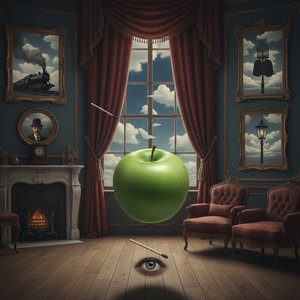
The Genesis of Metaphysical Painting: A Rejection of Modernism
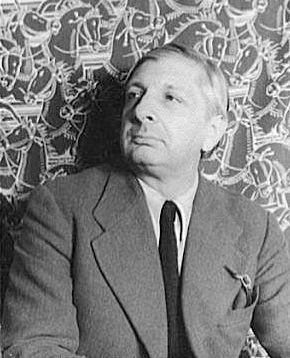 Wikipedia: Giorgio de Chirico
Giuseppe Maria Alberto Giorgio de Chirico ( KIRR-ik-oh; Italian: [ˈdʒordʒo de ˈkiːriko]; 10 July 1888 – 20 November 1978) was an Italian artist and writer born in Greece. In the years before World War I, he founded the scuola metafisica art movement...
The early years of the 20th century were a crucible of artistic innovation, yet for Giorgio de Chirico, the prevailing currents of Cubism and Futurism felt…incomplete. While others fractured form or celebrated speed, De Chirico sought something deeper—a realm beyond the visible, a space where memory, emotion, and philosophical inquiry converged. Born in Greece to Italian parents, his formative years were steeped in both classical mythology and the melancholic beauty of Mediterranean light. This unique background fueled a rejection of what he perceived as the superficiality of contemporary art movements. He wasn’t interested in depicting *what* things looked like, but rather *how* they felt—the unsettling resonance of objects divorced from their context, the weight of unspoken histories. This nascent dissatisfaction would blossom into Metaphysical painting, a style that profoundly altered the course of modern art and laid the groundwork for Surrealism.
Dreamscapes & Disquiet: Key Characteristics of De Chirico’s Style
To encounter a de Chirico painting is to step into a world both familiar and deeply unsettling. Long shadows stretch across deserted piazzas, Roman arcades loom with an almost oppressive grandeur, and mannequins—often faceless or fragmented—populate the scenes like silent observers. These aren’t depictions of specific places, but rather evocations of psychological states. The perspective is often deliberately skewed, creating a sense of spatial ambiguity that disorients and intrigues. Colors are typically muted, lending an air of nostalgia and isolation. De Chirico masterfully employed chiaroscuro—the dramatic contrast between light and shadow—to heighten the emotional impact of his compositions. This wasn’t merely about technical skill; it was a deliberate attempt to create a sense of unease, to tap into the subconscious anxieties lurking beneath the surface of everyday life. The stillness is paramount; these are frozen moments, pregnant with unspoken narratives.
Philosophical Undercurrents: Schopenhauer, Nietzsche, and the Subconscious
De Chirico’s art wasn't born in a vacuum. It was deeply informed by his rigorous study of philosophy, particularly the works of Arthur Schopenhauer and Friedrich Nietzsche. Schopenhauer’s concept of the “Will”—a blind, irrational force driving all existence—resonates powerfully within De Chirico’s desolate landscapes. The mannequins can be seen as representations of this impersonal Will, devoid of agency or emotion. Nietzsche's ideas about the death of God and the search for meaning in a nihilistic world also permeate his work. The absence of human figures, or their depiction as detached and alienated, reflects a sense of existential loneliness. De Chirico wasn’t simply illustrating philosophical concepts; he was *visualizing* them—translating abstract thought into tangible form. He sought to paint “that which cannot be seen,” the hidden realities that lie beneath the veneer of conscious experience.
Iconic Imagery: Arcades, Mannequins, and the Enigma of Objects
Certain motifs recur throughout De Chirico’s oeuvre, each imbued with symbolic weight. The arcades, often borrowed from Renaissance architecture, represent a lost sense of order and harmony—a yearning for a bygone era. They are simultaneously majestic and melancholic, suggesting both grandeur and decay. Mannequins, perhaps his most recognizable symbol, are particularly enigmatic. They aren’t simply representations of human figures; they are stand-ins for the absence of humanity, embodying alienation and the loss of individuality. The placement of objects—a rubber glove, a fish, a train—is equally significant. These everyday items are deliberately juxtaposed in illogical combinations, disrupting our expectations and forcing us to question their meaning. A lone train track stretching into infinity might symbolize an unattainable future or the relentless march of time. De Chirico’s genius lies in his ability to imbue these seemingly mundane objects with a profound sense of mystery.
De Chirico's Influence on Surrealism & Beyond
Surrealism is an art and cultural movement that developed in Europe in the aftermath of World War I in which artists aimed to allow the unconscious mind to express itself, often resulting in the depiction of illogical or dreamlike scenes and ideas. I...
Though he later distanced himself from the movement, Giorgio de Chirico is widely considered the precursor to Surrealism. Artists like André Breton and Salvador Dalí were profoundly influenced by his dreamlike imagery and exploration of the subconscious. The Surrealists adopted De Chirico’s techniques—juxtaposition, illogical perspective, symbolic objects—to create their own unsettling visions. However, it's crucial to understand that De Chirico wasn’t interested in simply depicting dreams; he was striving for something more profound—a metaphysical reality beyond the realm of conscious thought. His impact extended beyond Surrealism as well, influencing artists working in various styles, from Abstract Expressionism to contemporary figurative painting. His legacy lies not only in his distinctive aesthetic but also in his willingness to challenge conventional notions of representation and explore the hidden depths of human consciousness.
Exploring De Chirico’s Legacy Through Select Masterpieces
Consider “The Song of Love”(1914), with its haunting juxtaposition of a mannequin, a glove, and a classical statue. The scene evokes a sense of longing and isolation, hinting at the fragility of human connection. Or examine “The Prodigal Son”(1922), where bold colors and distorted forms create a powerful emotional impact. This work demonstrates De Chirico’s ability to imbue traditional religious themes with a distinctly modern sensibility. Finally, “The Child's Brain”(1916) encapsulates the core of his artistic vision—a surreal landscape that invites contemplation and challenges our perceptions of reality. These paintings, and countless others, offer a glimpse into a world where the boundaries between dream and waking life blur, and the subconscious takes center stage. At OriginalUniqueArt, we are proud to offer high-quality reproductions of De Chirico’s masterpieces, allowing you to experience the power and mystery of his art firsthand.