The Belgian Context: Art Before Surrealism
Despite its size, Belgium has a long and distinguished artistic tradition that goes back to the Middle Ages, considerably pre-dating the foundation of the current state in 1830. Art from the areas making up modern Belgium is called in English Netherl...
To understand the revolutionary impact of René Magritte, one must first consider the artistic landscape of Belgium in the late 19th and early 20th centuries. While often overshadowed by its larger European neighbors, Belgium possessed a rich artistic tradition, deeply rooted in Flemish realism and later embracing Symbolism. Artists like James Ensor, with his unsettling carnival scenes and grotesque imagery, paved the way for a questioning of established norms and a fascination with the darker aspects of human experience. This pre-Surrealist current, characterized by a rejection of academic conventions and an exploration of psychological themes, provided fertile ground for Magritte’s later innovations. The country's history – its periods of prosperity followed by political upheaval – also instilled a sense of unease and ambiguity that would permeate his work. Unlike the grand narratives often found in French art, Belgian painting tended towards introspection and a subtle critique of societal structures. This nuanced approach is crucial to understanding Magritte’s unique position within the broader Surrealist movement; he wasn't simply interested in shocking or disrupting, but in probing the very foundations of reality itself.
Challenging Representation: Magritte's Early Experiments & De Chirico’s Influence
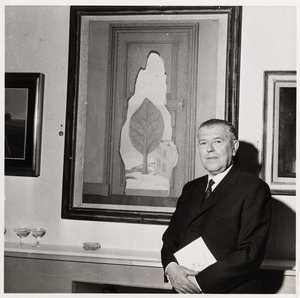 René Magritte
René Magritte (1898-1967): Explore the surreal world of this Belgian master! Discover iconic paintings like 'The Lovers,' challenging reality & perception.
Magritte’s early artistic journey was marked by a restless experimentation with various styles – from Impressionism and Cubism to Futurism. However, these explorations felt ultimately unsatisfying, lacking the intellectual depth he craved. A pivotal moment arrived in 1923 when he encountered the work of Giorgio de Chirico. De Chirico’s *metaphysical* paintings—with their desolate cityscapes, illogical perspectives, and unsettling juxtapositions of everyday objects—struck a profound chord within Magritte. The Italian artist's ability to create an atmosphere of dreamlike alienation resonated deeply with his own burgeoning desire to challenge conventional representation. De Chirico wasn’t merely depicting what he *saw*, but rather evoking a sense of mystery and psychological unease. This influence is readily apparent in Magritte’s early works, which began to feature similar architectural motifs and ambiguous spaces. He moved away from purely aesthetic concerns towards a more conceptual approach, seeking to disrupt the viewer's expectations and question the relationship between image and reality. It was through De Chirico that Magritte discovered the power of unsettling familiarity – taking ordinary objects out of their context to create something profoundly strange and thought-provoking.
The Logic of Illogic: Juxtaposition, Paradox, and the Subversion of Reality
Juxtaposition is an act or instance of placing two opposing elements close together or side by side. This is often done in order to compare/contrast the two, to show similarities or differences, etc. == Speech == Juxtaposition in literary terms is ...
At the heart of Magritte’s artistic practice lies a masterful manipulation of *juxtaposition*. He deliberately combined seemingly unrelated objects in unexpected ways, creating images that defy logical interpretation. This wasn't simply about randomness; it was a carefully calculated strategy to undermine our preconceived notions of reality and expose the arbitrary nature of representation. Consider his iconic “The Treachery of Images” (1929), featuring a meticulously rendered pipe accompanied by the inscription “Ceci n’est pas une pipe” (“This is not a pipe”). The painting isn't *the* pipe, but merely an image *of* a pipe, forcing us to confront the distinction between object and representation. This seemingly simple gesture encapsulates Magritte’s entire project: to question the very language of art and its ability to accurately reflect the world around us. He employed paradox with equal skill, creating impossible scenarios and challenging the laws of physics. Floating rocks, distorted perspectives, and objects morphing into other forms all contribute to a sense of disorientation and wonder. This deliberate disruption wasn’t intended as mere visual trickery; it was an invitation to engage in philosophical contemplation, prompting viewers to question their own perceptions and assumptions.
Identity and the Obscured Self: Recurring Motifs in Magritte’s Oeuvre
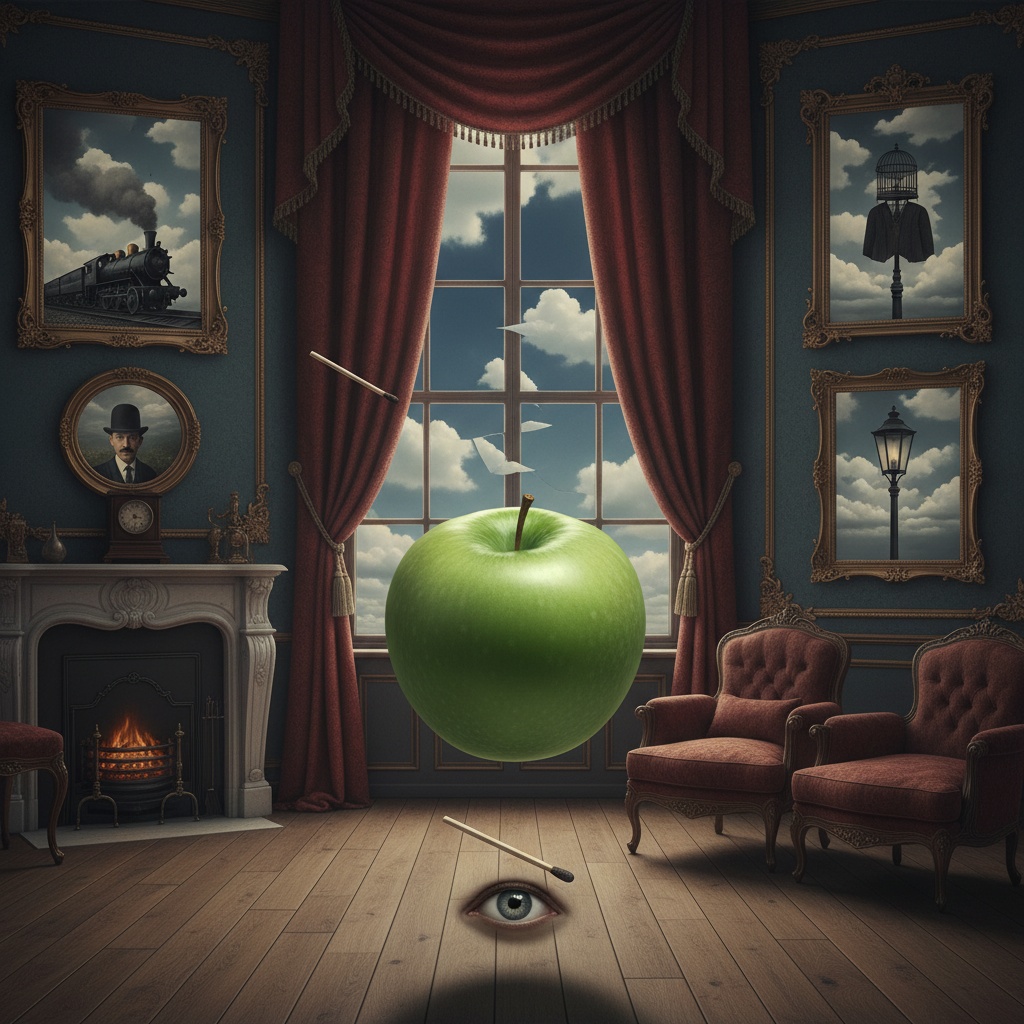
Throughout his career, Magritte returned repeatedly to certain motifs—bowler-hatted men, shrouded faces, windows, curtains, and apples—each imbued with layers of symbolic meaning. The bowler-hatted man, often appearing anonymous and faceless, became a recurring symbol of modern alienation and the loss of individuality. These figures aren’t portraits in the traditional sense; they represent archetypes rather than specific individuals. The obscuring of faces – whether hidden behind curtains, apples, or shadows—is particularly significant, reflecting Magritte's lifelong fascination with concealment and the mysteries of identity. This preoccupation stemmed, in part, from the traumatic loss of his mother at a young age, an event that left him deeply disturbed by themes of absence and unresolved grief. Windows and curtains often serve as metaphors for perception itself – barriers between the viewer and reality, or glimpses into hidden worlds. The apple, appearing in works like “The Son of Man” (1964), functions as both a symbol of temptation and an obstruction to clear vision. These recurring motifs aren’t arbitrary; they are carefully chosen elements that contribute to the overall sense of ambiguity and psychological depth within his paintings.
Beyond the Canvas: Magritte's Influence on Art, Film & Contemporary Thought
René Magritte’s influence extends far beyond the realm of painting. His work has profoundly impacted subsequent generations of artists, filmmakers, and thinkers. The Surrealist aesthetic—characterized by dreamlike imagery, unexpected juxtapositions, and a questioning of reality—has permeated popular culture, influencing everything from advertising to music videos. Filmmakers like David Lynch have explicitly acknowledged Magritte’s influence on their work, employing similar techniques of disorientation and psychological unease. His exploration of the subconscious mind resonated with psychoanalytic theory, while his critique of representation anticipated postmodern thought. Magritte's ability to challenge our perceptions, to make us question what we see and believe, continues to inspire artists today. His paintings aren’t simply beautiful objects; they are intellectual puzzles that demand engagement and contemplation. The enduring appeal of Magritte lies in his refusal to offer easy answers, instead inviting viewers to embark on their own journey of discovery and interpretation. He remains a pivotal figure in 20th-century art, a master of illusion who continues to challenge our understanding of the world around us. Explore more masterpieces and discover your own artistic inspiration at OriginalUniqueArt.com, where history’s greatest artworks are brought to life.