Early Life and Artistic Training: Foundations of a Realist Vision
Edward Morland Lewis, born in 1903, emerged from a Britain steeped in tradition yet poised on the cusp of modernity. While biographical details remain somewhat elusive, his artistic trajectory reveals a deliberate cultivation of realist principles. Unlike artists drawn to abstraction or overt symbolism, Lewis found inspiration in the tangible world around him – the quiet dignity of everyday life, the subtle nuances of interior spaces, and the evocative beauty of the British countryside. His early training, though not extensively documented, clearly instilled a dedication to observational accuracy and a refined technical skill. This foundation would become the hallmark of his work, setting him apart as a painter deeply committed to representing the world as he saw it, with all its imperfections and understated charm.
The influence of earlier British genre painters is palpable in Lewis’s approach. Artists like William Powell Frith, known for their meticulously detailed depictions of Victorian society, likely served as early models. However, Lewis wasn't merely an imitator; he possessed a unique sensitivity to light and atmosphere that infused his paintings with a distinctly personal quality. He eschewed the grand narratives often favored by his predecessors, instead focusing on smaller, more intimate moments – a street scene bustling with activity, a family gathered in their parlor, or a solitary figure lost in thought.
The Charm of Everyday Scenes: Lewis's Distinctive Style and Subject Matter
 Street Scene
Own a stunning 'Street Scene' by Edward Morland Lewis! This evocative oil painting captures daily life with realism. Explore this iconic British artwork today.
Lewis’s paintings are characterized by an almost uncanny ability to capture the essence of a particular place and time. “Street Scene”, for example, is not simply a depiction of urban life; it’s a portal into the rhythms and textures of early 20th-century Britain. The figures within the scene are rendered with remarkable detail, each face hinting at a story untold. His brushwork, while precise, isn't overly polished – there’s a sense of immediacy and spontaneity that lends his work a refreshing vitality. He masterfully employs light to create depth and atmosphere, drawing the viewer into the heart of the composition.
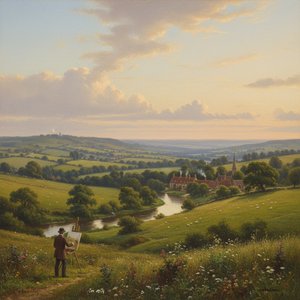
Beyond urban landscapes, Lewis demonstrated a keen eye for the natural world. “Beach, Llanstephan” (1935) showcases his impressionistic leanings, with loose brushstrokes and muted tones evoking the serenity of the Welsh coastline. This painting isn’t about precise topographical accuracy; it's about capturing the *feeling* of being by the sea – the cool breeze, the sound of waves, the vastness of the horizon. His landscapes often feature a sense of quiet contemplation, inviting the viewer to share in a moment of peaceful reflection.
A recurring theme in Lewis’s work is the interior space. He possessed an exceptional talent for depicting the warmth and intimacy of domestic life. These paintings aren't merely representations of rooms; they are studies of light, texture, and human connection. The careful arrangement of objects, the subtle play of shadows, and the presence (or absence) of figures all contribute to a sense of narrative ambiguity.
A Brief but Impactful Career: War Art and the Interruption of Promise
Kathleen Margaret "Kit" Lewis (27 September 1911 – 1998) was a British painter. The daughter of Henry Bryan Godfrey Godfrey-Faussett-Osborne and Margaret Sydney Bourns, she was born Kathleen Margaret Godfrey-Faussett-Osborne in Lichfield, Staffordshi...
Lewis’s artistic career was tragically cut short by World War II. In 1940, he married Kathleen Margaret “Kit” Lewis, herself a talented painter who studied under Graham Sutherland. The couple shared a passion for art and a commitment to capturing the world around them. However, their time together was brief. Lewis served as a war artist, documenting the realities of conflict in North Africa. This period represents a significant shift in his subject matter, moving from peaceful scenes of everyday life to the harsh realities of wartime.
While details about his specific commissions remain scarce, it’s clear that Lewis approached his role with the same dedication and sensitivity he brought to his earlier work. His war paintings likely offered a stark contrast to the more heroic depictions often favored by official propaganda, focusing instead on the human cost of conflict. Sadly, Lewis died in North Africa in 1943, leaving behind a relatively small but remarkably cohesive body of work.
Lewis’s Place in Victorian Genre Painting: Influences and Contemporaries
Edward Morland Lewis occupies a unique position within the broader context of Victorian genre painting. He wasn't part of any particular school or movement; rather, he forged his own path, blending elements of realism, impressionism, and narrative ambiguity. His contemporaries included artists like Walter Sickert, known for their gritty depictions of urban life, and Paul Nash, who explored themes of landscape and national identity.
While Lewis’s work shares certain affinities with these artists, he possessed a distinctly personal style that sets him apart. He lacked the overt social commentary of Sickert or the symbolic depth of Nash, instead focusing on capturing the quiet beauty and understated dignity of everyday life. His paintings offer a glimpse into a world that is both familiar and strangely haunting – a world on the cusp of change, grappling with the uncertainties of modernity.
His wife, Kit Lewis, continued to paint after his death, becoming a member of The London Group in 1948 and exhibiting frequently at the Leicester Galleries. Her work provides valuable insight into the artistic milieu in which Edward Morland Lewis operated.
Rediscovering Edward Morland Lewis: Modern Appreciation and Market Value
For many years, Edward Morland Lewis remained a relatively obscure figure. However, recent scholarship and growing interest in Victorian art have led to a renewed appreciation for his work. His paintings are now sought after by collectors and museums alike, offering a compelling glimpse into a bygone era.
The market value of Lewis’s works has steadily increased in recent years, reflecting the growing demand for his distinctive style and subject matter. Auction prices vary depending on size, condition, and provenance, but even smaller paintings can command significant sums. His work is increasingly featured in art publications and exhibitions, solidifying his place as a key figure in Victorian genre painting.
Today, Edward Morland Lewis’s paintings offer more than just aesthetic pleasure; they provide a window into the past – a glimpse into the lives, landscapes, and interiors of early 20th-century Britain. Discover his evocative scenes and experience the charm of a truly remarkable artist. Explore the collection at OriginalUniqueArt.com to find your own piece of history.