The Salon: Gatekeeper of Taste & Artistic Innovation
For much of the 19th century, the Parisian Salon wasn’t merely an exhibition; it was the epicenter of artistic life in France—and by extension, a powerful force shaping aesthetic sensibilities across Europe and beyond. Established in 1667 under Louis XIV as a showcase for the Académie Royale de Peinture et Sculpture, the Salon initially served to legitimize the King's patronage and promote a Classical style emphasizing order, symmetry, and idealized forms. Artists aspired not just to exhibit *at* the Salon, but to be accepted *by* it; success here meant commissions, prestige, and a secure place within the established art world. The annual show dictated trends, influenced collectors, and effectively controlled access to public recognition. However, this control also bred resistance. As societal shifts began to ripple through France—the rise of industrialization, burgeoning middle classes, and evolving philosophical ideas—a new generation of artists challenged the Salon’s rigid standards, setting the stage for revolutionary movements like Realism and Impressionism.
The very structure of the Salon reinforced its authority. A jury comprised of Académie members held immense power, favoring historical paintings with moralizing narratives over landscapes or scenes of contemporary life. This preference wasn't simply aesthetic; it was ideological. The Académie valued works that upheld traditional values and reinforced the status quo. Consequently, artists who dared to deviate from these norms often found themselves excluded—or relegated to less prominent positions within the exhibition halls. This exclusion, however, inadvertently fueled a spirit of independence among those seeking alternative avenues for expression.
Realism's Revolt: Depicting Life Unvarnished
Realism, Realistic, or Realists may refer to: == In the arts == Realism (arts), the general attempt to depict subjects truthfully in different forms of the arts Arts movements related to realism include: == In philosophy == Philosophical realism ...
The mid-19th century witnessed the emergence of Realism, a movement that directly confronted the idealized world presented by the Académie. Artists like Gustave Courbet rejected mythological or historical subjects in favor of depicting everyday life with uncompromising honesty. His monumental work, *Burial at Ornans*, for example, scandalized Salon audiences not because of its subject matter—a rural funeral—but because of its scale and lack of embellishment. Courbet treated ordinary people with the same dignity typically reserved for historical figures, challenging conventional notions of artistic hierarchy. This commitment to “truth” extended beyond subject matter; Realist painters also embraced a darker palette and looser brushwork, further distancing themselves from the polished surfaces favored by the Académie.
Édouard Manet, though often associated with Impressionism, began his career as a Realist. His *Luncheon on the Grass* (1863) caused an uproar due to its blatant depiction of nudity and contemporary setting—a picnic scene featuring fully clothed men alongside a nude woman staring directly at the viewer. Manet wasn’t interested in portraying idealized beauty; he sought to capture the realities of modern life, even if those realities were considered shocking or vulgar by societal standards. This unflinching gaze, coupled with his innovative use of light and shadow, paved the way for the radical experiments that would define Impressionism.
Impressionism’s Fleeting Moments: Capturing Light and Perception
Impressionism was a 19th-century art movement characterized by visible brush strokes, open composition, emphasis on accurate depiction of light in its changing qualities (often accentuating the effects of the passage of time), ordinary subject matter...
The rejection of Manet's work—and that of other like-minded artists—led to the formation of independent exhibitions in the 1870s, culminating in the eight “Impressionist” expositions. This marked a pivotal moment in art history: artists taking control of their own narrative and challenging the authority of the Salon directly. Impressionism, as it came to be known (somewhat derisively, initially), was characterized by its focus on capturing fleeting moments—the effects of light and atmosphere on ordinary subjects. Claude Monet’s *Impression, soleil levant* (1872) – the painting that gave the movement its name – exemplifies this approach. Visible brushstrokes, open composition, and a vibrant palette were employed to convey the sensation of being present in a specific time and place.
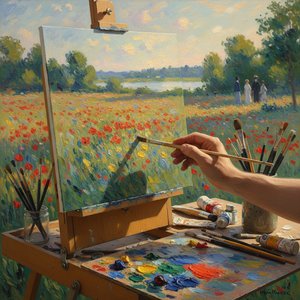
The Impressionists weren’t simply interested in depicting what they *saw*; they sought to capture how they *perceived* it. They moved outdoors—painting en plein air—to directly observe the changing qualities of light, often working rapidly to record their impressions before the moment passed. This emphasis on immediacy and subjective experience was a radical departure from the academic tradition, which prioritized meticulous detail and idealized forms. Artists like Renoir, Sisley, and Pissarro joined Monet in exploring these new techniques, creating a body of work that celebrated the beauty of everyday life and the ephemeral nature of perception.
Beyond Representation: Symbolism and the Inner World
While Impressionism focused on external reality, another movement began to emerge towards the end of the 19th century—Symbolism. Artists associated with this style rejected the objective depiction of the world in favor of exploring inner emotions, dreams, and spiritual themes. Paul Gauguin, initially influenced by Impressionism, ultimately sought a more profound form of expression, traveling to Tahiti in search of “primitive” authenticity. His paintings, such as *Fatata te Miti (also known as By the Sea)*, are characterized by flattened forms, bold colors, and symbolic imagery that evoke a sense of mystery and spirituality.
Symbolism represented a shift away from the purely visual concerns of Impressionism towards a more psychological and subjective approach. Artists like James Ensor explored themes of death, religion, and social alienation through unsettling and often grotesque imagery. This movement paved the way for Expressionism and other avant-garde styles that would dominate the 20th century.
Techniques of Transformation: Brushwork, Color, & Composition
Underlying these stylistic shifts were fundamental changes in artistic techniques. Realist painters employed a more subdued palette and looser brushwork to convey the weightiness of their subjects. Impressionists embraced broken color—applying small dabs of pure pigment directly to the canvas—to create a sense of vibrancy and movement. They also experimented with unusual visual angles and open compositions, challenging traditional notions of perspective and balance. The use of light became paramount; artists sought to capture its fleeting effects on surfaces, creating paintings that shimmered with color and atmosphere.
The development of new pigments—made possible by advances in chemistry—also played a role. Artists had access to brighter, more saturated colors than ever before, allowing them to create bolder and more expressive works. Furthermore, the rise of photography influenced painting in complex ways. While some artists saw photography as a threat, others embraced it as a tool for capturing reality, freeing them to explore more subjective forms of expression.
The Legacy of 19th-Century Painting: A Foundation for Modern Art
The 19th century was a period of profound transformation in art history. The challenges posed by Realism and Impressionism—and the subsequent emergence of Symbolism—fundamentally altered the course of artistic development. These movements rejected traditional norms, embraced new techniques, and paved the way for the radical experiments that would define Modern Art. From the bold brushstrokes of Monet to the symbolic imagery of Gauguin, the artists of the 19th century left an indelible mark on our visual culture.
At OriginalUniqueArt.com, we celebrate this rich artistic heritage by offering high-quality reproductions of masterpieces from this era—and beyond. Whether you’re seeking a timeless classic or a unique statement piece, our skilled artists can bring your vision to life with authentic brushwork and museum-quality materials. Explore our collection today and discover the enduring power of 19th-century painting.