The Barbizon School: A Revolt Against Academic Tradition
In the early nineteenth century, the art world was largely dictated by the rigid conventions of the French Academy. History painting reigned supreme, demanding grand narratives and idealized forms. Landscape, while present, occupied a decidedly subordinate position – often serving merely as a backdrop for mythological or biblical scenes. A growing discontent simmered amongst a group of artists who felt stifled by these constraints, yearning to capture the raw beauty and authenticity of the natural world directly before them. This burgeoning rebellion found its epicenter in Barbizon, a small village nestled on the edge of the Forest of Fontainebleau, giving rise to what would become known as the Barbizon School.
These weren’t revolutionaries seeking to overthrow the system with manifestos; rather, they were painters driven by a shared passion – a desire to elevate landscape painting to its rightful place as an independent and expressive genre. They sought not to imitate classical ideals but to observe nature meticulously, to paint what they *saw*, not what they were *told* to see. This commitment to realism wasn’t simply about accurate depiction; it was about conveying the emotional power of the countryside, the subtle nuances of light and atmosphere, and the dignity of rural life. The Forest of Fontainebleau, with its ancient trees, varied terrain, and proximity to Paris, provided the perfect sanctuary for their artistic explorations.
The early gatherings were informal, fueled by mutual encouragement and a shared rejection of academic dogma. Artists like Théodore Rousseau, Jean-François Millet, and Camille Corot began to frequent Barbizon, establishing a community that fostered experimentation and innovation. They weren’t unified in style – each artist brought their own unique sensibility to the canvas – but they were bound by a common ethos: a deep respect for nature and a determination to exhibit their work, even if it meant challenging the conservative Salon establishment.
Daubigny’s Early Influences & Artistic Development
Charles-François Daubigny entered this vibrant artistic milieu with a family legacy already steeped in painting. Initially instructed by his father, Edmé-François Daubigny, and later by his uncle Pierre Daubigny, he received a traditional academic training. However, it was his exposure to the work of John Constable, whose naturalistic landscapes had made waves at the Paris Salon in 1824, that truly ignited his passion for direct observation. He also studied under Jacques Raymond Brascassat and Paul Delaroche, but quickly began to forge his own path, diverging from their more classical approaches.
Daubigny’s early career was marked by a pragmatic approach; he supplemented his income through illustration work, contributing vignettes to books and magazines. This period honed his technical skills and instilled in him a meticulous attention to detail – qualities that would later become hallmarks of his landscape paintings. In 1838, Daubigny established a community with fellow artists like Adolphe-Victor Geoffroy-Dechaume, Hippolyte Lavoignat, and Ernest Meissonnier, further solidifying his commitment to depicting everyday life and nature. However, it was his move to Barbizon in 1843 that proved pivotal.
The encounter with Camille Corot in 1852 at Optevoz marked a turning point. Corot’s influence encouraged Daubigny to embrace a more atmospheric approach, focusing on the subtle effects of light and shadow. This period saw him move away from precise detail towards a looser, more expressive style, laying the groundwork for his later masterpieces.
Mastering Landscape: Technique, Composition, and the Pursuit of Realism
 Charles-François Daubigny
Explore the art of Charles-François Daubigny (1817-1878), a key Barbizon School & Impressionism precursor. Discover evocative landscapes like 'Harvest' and his innovative use of light at OriginalUniqueArt.
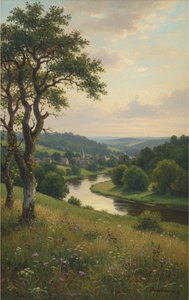
Daubigny’s dedication to realism wasn't simply about replicating what he saw; it was about capturing the *feeling* of a place. He meticulously studied the effects of light on different surfaces – the shimmering leaves of trees, the rippling water of rivers, the vast expanse of open fields. His technique involved layering thin washes of oil paint to create depth and luminosity, often working directly from nature with remarkable speed and precision.
Compositionally, Daubigny favored a horizontal format, emphasizing the breadth and expansiveness of the landscape. He skillfully employed aerial perspective – the subtle blurring of details and softening of colors in the distance – to create a sense of depth and atmosphere. This technique, evident in works like “Harvest,” draws the viewer’s eye into the scene, evoking a feeling of immersion within the natural world. His paintings weren't merely representations of landscapes; they were invitations to experience them.
Daubigny also demonstrated a keen understanding of tonal qualities, using subtle variations in color and value to create mood and atmosphere. He wasn’t afraid to depict overcast skies or muted colors, recognizing that beauty could be found even in the most seemingly unremarkable scenes. This commitment to portraying nature honestly, without idealization, was central to his artistic vision.
The ‘Botin’ and Painting *En Plein Air*: Daubigny's Mobile Studio
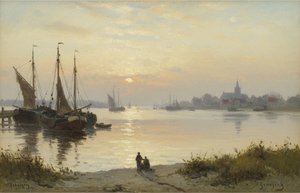
Perhaps the most iconic symbol of Daubigny’s dedication to painting *en plein air* – directly from nature – is his beloved boat, affectionately known as the “Botin.” Originally a simple cargo vessel, Daubigny transformed it into a floating studio, allowing him to navigate the Seine and Oise rivers and paint landscapes from unique vantage points. This innovative approach allowed him unparalleled access to the ever-changing light and atmosphere of the French countryside.
The Botin wasn’t merely a practical solution; it was an extension of Daubigny’s artistic philosophy. By living and working in close proximity to nature, he could capture its fleeting beauty with greater immediacy and authenticity. He often painted along the banks of the Seine near Auvers, a region that would become synonymous with his name. The river scenes produced during this period are characterized by their intimate scale and evocative atmosphere.
The freedom afforded by the Botin allowed Daubigny to experiment with different compositions and perspectives, capturing the subtle nuances of light and shadow as they shifted throughout the day. It also fostered a sense of solitude and contemplation, allowing him to fully immerse himself in the natural world and translate his experiences onto canvas.
Atmospheric Perspective and Emotional Resonance in Daubigny’s Work
Aerial perspective, or atmospheric perspective, is the effect the atmosphere has on the appearance of an object as viewed from a distance. As the distance between an object and a viewer increases, the contrast between the object and its background de...
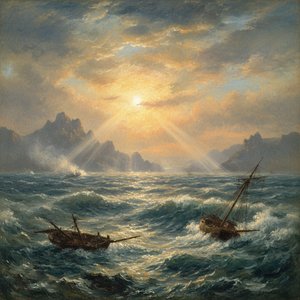
Daubigny's mastery of atmospheric perspective wasn’t merely a technical skill; it was a means of conveying emotion. By subtly blurring details, softening colors, and creating a sense of depth, he evoked a feeling of distance, tranquility, and even melancholy. Works like “Seascape” (1876) exemplify this technique, capturing the vastness of the ocean and the subtle interplay of light and water.
His use of monochrome etchings, such as “The Steamboats (Steamy Harbor),” further demonstrates his ability to create atmosphere. The dramatic contrast between light and shadow in these works evokes a sense of industrial power juxtaposed with the natural world. The turbulent river scene, masterful line work, and atmospheric perspective combine to create a powerful visual statement.
Daubigny’s paintings weren't simply about depicting landscapes; they were about evoking emotions – a sense of peace, solitude, or awe. He understood that nature wasn’t merely a subject to be observed but an experience to be felt. His ability to translate these experiences onto canvas is what sets him apart as one of the most important landscape painters of his time.
Daubigny’s Legacy: Bridging Realism and Impressionism
Charles-François Daubigny occupies a unique position in art history, serving as a crucial bridge between the Barbizon School's commitment to realism and the burgeoning Impressionist movement. His emphasis on painting *en plein air*, his innovative use of light and atmosphere, and his rejection of academic conventions paved the way for artists like Monet, Renoir, and Pissarro.
While firmly rooted in the Barbizon tradition of depicting nature with fidelity and sincerity, his paintings increasingly emphasized atmospheric effects. He was a prolific printmaker, experimenting with techniques like cliché verre – a process that combined photography and etching – further pushing the boundaries of artistic expression. His influence on younger artists was profound; many traveled to Barbizon to learn from him and study his methods.
Daubigny’s legacy extends beyond his paintings themselves. He demonstrated that landscape painting could be more than just a decorative art form; it could be a powerful means of expressing emotion, capturing the beauty of the natural world, and challenging artistic conventions. Today, his works continue to inspire artists and captivate audiences with their timeless beauty and evocative atmosphere. Explore Daubigny’s masterpieces at OriginalUniqueArt.com, where high-quality reproductions allow you to experience the serenity and artistry of this remarkable painter firsthand.