The Shattered Lens: Understanding the Cubist Revolution
To understand the birth of Cubism is to witness the moment the single, fixed viewpoint of the Renaissance was irrevocably shattered. For centuries, Western art had been a window—a transparent pane through which we viewed a coherent, three-dimensional world governed by linear perspective. However, at the dawn of the 20th century, a radical shift occurred, driven by an urge to represent not just what the eye sees in a fleeting moment, but what the mind knows to be true about form and volume. This was no longer about capturing a static illusion; it was about the reconstruction of reality itself.
The movement emerged as a profound rebellion against the limitations of traditional representation. Instead of observing a subject from one seated position, Cubist pioneers sought to orbit the object, capturing its front, profile, and top simultaneously. This intellectual approach transformed the canvas from a passive mirror into an active site of geometric investigation. For the discerning collector, recognizing this shift is essential; it marks the transition from art as mere imitation to art as a complex, multi-layered language of symbols and structures.
Analytical vs. Synthetic Cubism: A Study in Form and Texture
The evolution of Cubism is traditionally categorized into two distinct yet interconnected phases: Analytical and Synthetic. The early period, known as Analytical Cubism, was characterized by a rigorous, almost scientific deconstruction of the subject. Artists utilized a muted, monochromatic palette—heavy with ochres, greys, and browns—to ensure that the viewer’s attention remained fixed on the complex interplay of overlapping planes rather than the distraction of color. In these works, the subject is fractured into countless facets, creating a dense, rhythmic web of lines that challenges the viewer to reassemble the image mentally.
As the movement matured, it transitioned into Synthetic Cubism, a phase that brought a newfound sense of vibrancy and material experimentation to the canvas. If the Analytical phase was about taking things apart, the Synthetic phase was about putting them back together using a broader vocabulary of textures and shapes. This era introduced the concept of collage, incorporating real-world elements like newspaper clippings or sand into the paint. The compositions became flatter and more decorative, utilizing brighter hues and larger, more legible shapes. For those who appreciate the tactile nature of fine art, this period offers a fascinating study in how texture and layering can breathe life into abstract forms.
The Picasso Legacy: Deconstructing the Master of Modernity
No discussion of Cubism is complete without acknowledging the monumental influence of Pablo Picasso. As a co-founder of the movement, Picasso’s trajectory serves as a roadmap for the entire genre's development. His early experiments, such as the groundbreaking Les Demoiselles d'Avignon, signaled the end of classical beauty and the beginning of a fractured, aggressive new aesthetic. Through his hands, the human figure was stripped of its traditional grace and reimagined through the lens of African tribal masks and Iberian sculpture.
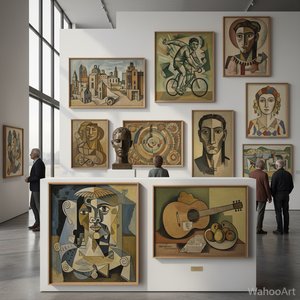
Picasso’s mastery lay in his ability to oscillate between extreme abstraction and profound emotional resonance. Consider works like Guitar (1920), a seminal piece of Synthetic Cubism where geometric forms and earthy tones create a dynamic, sculptural presence on a two-dimensional surface. His ability to manipulate space—as seen in the serene yet structurally complex La Pareja—demonstrates how he used fractured planes and masterful impasto to capture the essence of a moment. For the collector, Picasso’s legacy is not merely found in his fame, but in his relentless pursuit of a new visual truth that continues to define the boundaries of modern art.
Geometric Narratives: How Cubism Redefined Spatial Perception
Cubism fundamentally altered our relationship with space. By rejecting the vanishing point, the movement introduced a "shallow" depth that forced the viewer to engage with the surface of the painting as much as the subject within it. This created a new kind of narrative—one that is not linear but simultaneous. In a Cubist landscape or portrait, time seems to collapse; we are presented with a totality of experience rather than a single, frozen instant.
This reconfiguration of space relies heavily on geometric scaffolding. Circles, triangles, and quadrilaterals act as the building blocks of a new reality, providing a structural integrity that allows the eye to navigate through layers of overlapping transparency. This method of representation mirrors the complexity of modern life, where information is fragmented and multi-directional. To view a Cubist work is to participate in an intellectual puzzle, finding beauty in the tension between the recognizable subject and its geometric abstraction.
Curating the Fragmented: Integrating Cubist Aesthetics into Modern Interiors
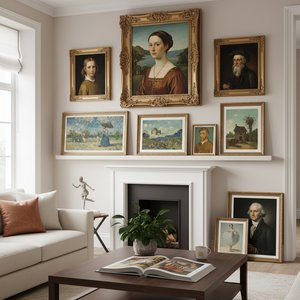
Integrating Cubist-inspired art into a contemporary interior requires a sophisticated understanding of balance and contrast. Because Cubism is inherently high-energy and visually complex, it serves as an extraordinary focal point for modern architectural spaces. In a room characterized by clean lines and minimalist furniture, a fragmented, textured oil painting can provide the necessary "visual friction" to prevent the space from feeling sterile.
When curating such a collection, consider the interplay of color and scale. A large-scale, multi-panel Cubist arrangement—often referred to as a group set painting—can transform a wide wall or a grand staircase into a cinematic experience, with brushstrokes flowing seamlessly across multiple canvases. For those seeking to harmonize these bold works with their existing decor, selecting pieces that echo the room's color palette through subtle geometric motifs can create a cohesive, museum-like atmosphere that feels both curated and intentional.
Preserving the Avant-Garde: The Collector's Guide to Acquiring Cubist Reproductions
For many collectors, the allure of Cubism lies in its profound historical significance, yet acquiring original masterpieces from this era is often a feat reserved for the world's most elite institutions. This has paved the way for the rise of high-quality, hand-painted reproductions, which allow enthusiasts to bring the spirit of the avant-garde into their private homes. The key to a successful acquisition lies in seeking out works that honor the original's tactile soul—specifically those executed with authentic oil techniques and visible impasto.
A true reproduction should not be a mere digital copy, but a reinterpretation that captures the physical depth of the era. Look for artists who specialize in the heavy, textured brushwork characteristic of Synthetic Cubism, ensuring that the light interacts with the ridges of the paint just as it would on an original canvas. Whether you are looking to transform a personal photograph through a Cubist lens using modern AI-assisted tools or seeking a faithful recreation of a Picasso classic, the goal remains the same: to preserve the revolutionary power of the fragmented perspective for generations to come.
At OriginalUniqueArt.com, we are dedicated to making this level of artistic excellence accessible to collectors worldwide. From bespoke oil commissions that reimagine your personal milestones in the style of the masters to museum-quality reproductions of the world's most iconic movements, our mission is to bridge the gap between art history and your living space with unparalleled craftsmanship and authenticity.