The Impressionist Legacy: A Brief Prelude to Change
To understand the seismic shift that occurred at the end of the nineteenth century, one must first appreciate the luminous world established by the Impressionists. For decades, a group of rebellious visionaries had sought to capture the fleeting essence of light, the transient movement of water, and the ephemeral atmosphere of a Parisian afternoon. Through broken brushstrokes and a palette obsessed with the sun's dance across surfaces, they broke free from the rigid, somber dictates of the Académie des Beaux-Arts. Their work was an exercise in optical truth—a way to record the immediate sensation of sight before the mind could impose order upon it.
However, while the Impressionists succeeded in capturing the moment, they often left the underlying structure of the world feeling unanchored. The edges of reality seemed to dissolve into a haze of light and color, leaving behind a beautiful but sometimes ephemeral residue. As the movement matured, a new generation of artists began to feel a profound restlessness. They admired the vibrant luminosity of their predecessors but craved something more substantial. They sought not just to record how the eye perceives a landscape, but to express how the soul interprets it. This yearning for depth, permanence, and psychological resonance would become the catalyst for one of the most significant revolutions in art history.
Breaking the Surface: The Shift from Emotional Depth
The transition from Impressionism to Post-Impressionism was not a rejection of light, but rather an expansion of its purpose. Where the Impressionists used color to mimic the sun, the Post-Impressionists began to use it as a language of emotion and symbolism. The canvas was no longer merely a window into a fleeting afternoon; it became a stage for the artist's internal landscape. This era marked a departure from purely optical realism toward a more subjective, expressive reality where color could be arbitrary, used not because a leaf was green, but because a specific shade of emerald evoked a sense of profound melancholy or vibrant life.
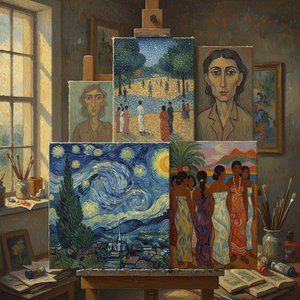
This movement introduced a deliberate weight to the medium. Artists began to move away from the "dissolving" effect of light and toward more defined forms and textures. There was a newfound interest in the tactile quality of paint itself—the way thick, rhythmic applications of pigment could create a sense of physical presence. This shift allowed for a deeper exploration of the human condition, as artists utilized exaggerated colors and distorted forms to communicate complex psychological states. The surface of the painting became a site of struggle and triumph, where the artist's hand was visible, assertive, and deeply personal.
The Architects of Color: Exploring the Pioneers of Post-Impressionism
At the heart of this revolution stood figures whose names have become synonymous with the very essence of modern creativity. Vincent van Gogh, perhaps the most iconic of them all, transformed the landscape into a swirling vortex of emotion. In works such as Farmhouses Among Trees, one can observe a serene yet textured approach to rural life, where muted hues and heavy brushstrokes ground the viewer in the earthiness of the subject. Yet, in his more vibrant compositions like Green Wheat Fields, he utilized a dynamic, luminous technique that captured the pulsating energy of the Provence countryside, proving that color could be both a structural element and an emotional outburst.
Beyond Van Gogh, other masters approached the canvas with distinct philosophies. Georges Seurat introduced a scientific rigor through Pointillism, using tiny, systematic dots of pure color to create a shimmering optical effect that relied on the viewer's eye to blend the spectrum. Meanwhile, Paul Cézanne sought to "make of Impressionism something solid and durable, like the art of the museums." He focused on the underlying geometric essence of nature, treating mountains and trees as compositions of spheres, cones, and cylinders. These artists did not merely paint what they saw; they reconstructed the world through a lens of intellectual and emotional intention.
Structure and Symbolism: How New Techniques Redefined Visual Language
The true revolution of Post-Impressionism lay in its ability to marry structure with symbolism. The movement introduced techniques that would later become the bedrock of 20th-century modernism. By emphasizing the flatness of the canvas and the decorative arrangement of shapes, artists like Paul Gauguin moved toward Cloisonnism, using bold outlines and flat areas of color to evoke a sense of the primitive and the spiritual. This was art stripped of its pretension, focusing instead on the raw power of symbolic imagery and the evocative potential of simplified forms.
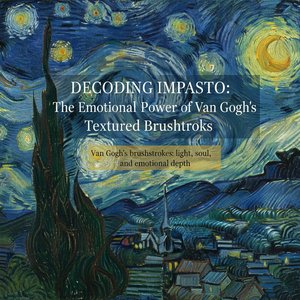
Furthermore, the use of impasto—the thick, sculptural application of oil paint—added a new dimension to the viewing experience. When looking at a Post-Impressionist masterpiece, the eye does not just glide over the surface; it navigates a landscape of ridges and valleys created by the artist's brush. This texture serves as a physical manifestation of the artist's movement and passion. Through this marriage of rigorous structural composition and unrestrained expressive technique, Post-Impressionism provided the vocabulary for everything from Fauvism to Expressionism, forever altering the trajectory of Western art.
From Canvas to Modernity: The Lasting Impact on 20th-Century Movements
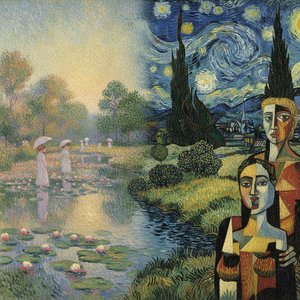
The ripples of the Post-Impressionist movement can be felt across every major art movement that followed. The liberation of color paved the way for the Fauves, who pushed chromatic intensity to its absolute limit. The structural investigations of Cézanne provided the essential blueprint for Cubism, as Picasso and Braque deconstructed objects into multifaceted planes. Even the dreamlike distortions of Surrealism owe a debt to the Post-Impressionists' ability to prioritize the subconscious and the symbolic over the literal representation of reality.
This era fundamentally changed the relationship between the artist, the subject, and the viewer. It established that art could be an autonomous entity, governed by its own internal logic rather than a mere imitation of nature. The movement taught us that truth in art is not found in the perfect replication of a photograph, but in the honest expression of a perspective. This legacy of experimentation and emotional bravery continues to inspire contemporary artists and collectors alike, as we continue to find profound meaning in the textured, vibrant, and structured worlds created by these masters.
Curating the Revolution: Bringing Post-Impressionist Mastery into the Modern Home
For the modern art enthusiast, the allure of Post-Impressionism lies in its ability to breathe life and character into a contemporary space. These works are not merely decorations; they are conversation pieces that bring a sense of historical depth and emotional resonance to any interior. Whether it is the soothing, textured landscapes reminiscent of Van Gogh's rural scenes or the bold, structural compositions of the late 19th century, integrating these styles allows for a sophisticated curation of one's personal environment.
At OriginalUniqueArt.com, we celebrate this enduring legacy by making the beauty of these masterpieces accessible to collectors worldwide. We specialize in high-quality, hand-painted oil reproductions that capture the very soul of the Post-Impressionist movement. Our master artists, each a specialist in their genre, utilize traditional techniques—such as thick impasto and layered glazes—to ensure that every brushstroke reflects the authentic texture and emotional depth of the original works. From custom portraits reimagined in the style of the masters to museum-quality replicas of iconic landscapes, we provide a bridge between art history and your home, ensuring that the revolution of color and emotion continues to inspire generations to come.