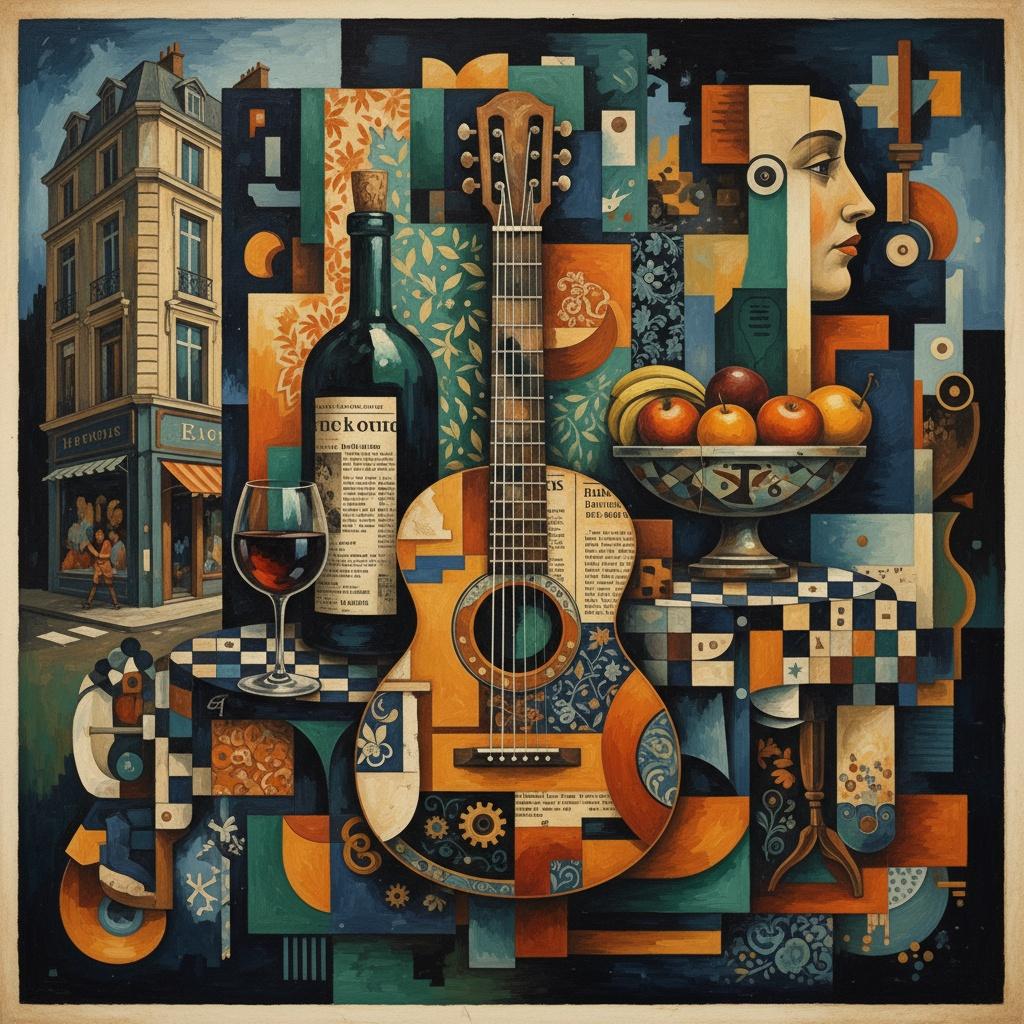
The Genesis of Form: Transitioning from Analytical to Synthetic Cubism
To understand the profound shift that occurred within the early twentieth-century avant-garde, one must first look back at the rigorous, almost clinical deconstruction of Analytical Cubism. In those initial years, artists like Pablo Picasso and Georges Braque were preoccupied with a monochromatic dissection of reality, breaking objects into a complex web of overlapping planes and translucent facets. The goal was an intellectual pursuit of essence, yet it often resulted in a visual density so profound that the subject almost vanished into a labyrinth of grey and ochre tones. However, as the movement matured, a revolutionary metamorphosis began to take place. This transition toward Synthetic Cubism marked a departure from the act of breaking down towards the act of building up.
Where the Analytical phase sought to strip the world into its skeletal components, the Synthetic phase sought to reassemble it using new, unexpected materials and a more vibrant palette. It was no longer merely about the perception of volume through light and shadow, but about the construction of meaning through assemblage. This era introduced a sense of playfulness and tactile reality that had been absent in the earlier, more austere explorations. For the discerning collector, this period represents one of the most significant pivots in art history—a moment where the canvas ceased to be a window into a fractured world and instead became a physical site of creation, where texture and shape were synthesized to create a new, autonomous reality.
The Art of Assemblage: Collage and the Introduction of Real-World Textures
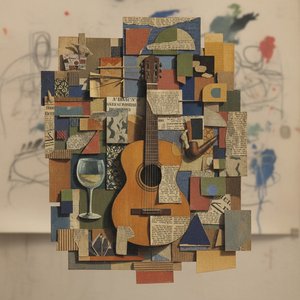
The true heartbeat of Synthetic Cubism lies in its radical embrace of collage. This technique fundamentally altered the relationship between the artwork and the physical world by introducing non-art materials directly onto the canvas. Imagine the shock of a contemporary viewer encountering a work where scraps of newspaper, wallpaper, or even pieces of oilcloth were integrated into the composition. This was not merely an aesthetic choice; it was a philosophical declaration. By incorporating these "low" materials, Picasso and Braque bridged the gap between the high art of the studio and the mundane textures of everyday life.
This infusion of texture brought a newfound materiality to the movement. The works became less about the illusion of depth and more about the physical presence of the medium itself. In masterpieces such as Georges Braque’s 'Still life with Bottle of Bass', one can observe how fragmented forms are paired with paper textures that mimic the grain of wood or the roughness of stone. This layering process—the building up of planes through different substances—created a rhythmic complexity that invited the viewer to touch the art with their eyes. For the modern connoisseur, this era celebrates the beauty of the fragment, where the juxtaposition of a newsprint scrap against a painted stroke creates a tension that is both intellectually stimulating and visually arresting.
Deconstructing Reality: Key Masterpieces by Picasso and Braque
To truly appreciate the depth of this movement, one must engage with the seminal works that defined its trajectory. Pablo Picasso’s 'Violin' (1913) serves as a breathtaking example of how form can be reimagined through a synthetic lens. Here, the instrument is not merely depicted; it is surrounded by a constellation of birds and books, creating a dynamic composition where the boundaries between object and environment are beautifully blurred. The violin becomes a symbol within a larger, orchestrated arrangement of shapes, demonstrating how Synthetic Cubism uses recognizable motifs to anchor abstract concepts.
Similarly, Picasso’s 'Student with Pipe' (1914) showcases the masterful use of collage to evoke character and presence. Through the strategic placement of fragmented forms and varied textures, the artist captures a sense of momentary life within a structured, geometric framework. These works are not mere studies in geometry; they are profound explorations of how we perceive identity and objecthood. For those who curate collections of modern masterpieces, these paintings offer more than just visual interest—they provide a window into the very moment when the traditional rules of perspective were permanently dismantled to make way for a new, multi-dimensional way of seeing.
A New Dimension: The Interplay of Color, Pattern, and Depth in Synthetic Works
As the movement progressed, the monochromatic austerity of the earlier years gave way to a much more exuberant use of color and pattern. In the Synthetic phase, color was no longer used solely to model form or suggest light; instead, it became an independent structural element. Large, flat areas of saturated pigment were juxtaposed with intricate patterns, creating a visual rhythm that danced across the surface of the canvas. This interplay allowed artists to suggest depth without relying on traditional chiarosc de la technique, using instead the contrast between bold hues and delicate motifs.
This era introduced a graphic quality to Cubism that would influence everything from graphic design to modern abstraction. The ability to layer patterns—stripes, dots, or floral motifs—alongside solid blocks of color created a sense of "shallow depth," where the eye moves through layers of information rather than receding into a distant horizon. This technique creates a vibrant, energetic surface that feels alive with movement. For the collector seeking pieces that command attention within a contemporary interior, the rhythmic complexity and coloristic richness of Synthetic Cubist-inspired works offer an unparalleled sense of sophistication and modern vitality.
The Legacy of Synthesis: How Cubist Innovation Redefined Modern Aesthetics
The impact of Synthetic Cubism extends far beyond the early twentieth century; it laid the very foundation for much of the modern art that followed. The concept of the artwork as an autonomous object, constructed from a variety of disparate elements, paved the way for Dadaism, Surrealism, and eventually, the total abstraction of the mid-century masters. The movement’s liberation of color, its celebration of texture, and its revolutionary use of collage fundamentally changed our definition of what a painting could be.
Today, we see the echoes of this innovation in every corner of contemporary visual culture. The way we layer digital images, the way we appreciate the tactile nature of mixed-media art, and even the way modern architecture utilizes fragmented planes—all find their roots in the synthetic experiments of Picasso and Braque. To collect or study Synthetic Cubism is to engage with the very DNA of modernism. It is an invitation to look beyond the surface, to embrace the beauty of the fragment, and to celebrate the enduring power of human creativity to synthesize a new and vibrant reality from the pieces of the old.
About OriginalUniqueArt.com
At OriginalUniqueArt.com, we are dedicated to preserving the profound legacy of art history by bringing museum-quality masterpieces into the homes of collectors worldwide. From exquisite hand-painted oil reproductions that capture every tactile brushstroke to high-fidelity Giclée prints designed for longevity, our mission is to make the extraordinary accessible. Whether you are seeking a bespoke commission that reimagines your personal memories through the lens of a master, or looking for expert consultation to curate your next architectural statement, OriginalUniqueArt provides a bridge between the timelessness of the Old Masters and the sophistication of modern living.