Early Life & Artistic Foundations: The Devis Family Legacy
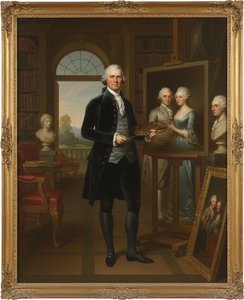
Arthur William Devis (10 August 1762 – 11 February 1822) was an English painter of history paintings and portraits. He painted portraits and historical subjects, sixty-five of which he exhibited (1779–1821) at the Royal Academy. Among his more famous...
Arthur William Devis, born in London in 1762, emerged from a remarkably prolific artistic lineage. His father, Arthur Devis (1712-1787), was already an established painter specializing in small-scale “conversation pieces”—intimate portraits of families engaged in everyday life—a style that would profoundly influence his son’s own career. The elder Devis’s success provided a foundation for both Arthur William and his brother, Thomas Anthony Devis, who also pursued painting. However, the family's story extends beyond mere artistic inheritance; Ellin Devis, their sister, was a respected schoolmistress and grammarian, educating figures like Maria Edgeworth and Frances Burney, demonstrating a broader intellectual environment that fostered creativity. This upbringing within a household valuing both aesthetic skill and scholarly pursuits undoubtedly shaped Arthur William’s approach to his work, imbuing it with a sensitivity to character and social nuance.
The early exposure to the Free Society of Artists, where his father held the presidency, and later at the Royal Academy Schools in 1774, provided crucial training. While Thomas Anthony initially followed a similar path, Arthur William quickly developed a distinct voice, one that blended the familial tradition of portraiture with an emerging interest in historical subjects and, significantly, the dramatic events unfolding on the world stage.
Conversation Pieces: Capturing Georgian Society & Intimacy
 Miss Anderson With Her Dog
Admire 'Miss Anderson With Her Dog' by Arthur Devis – a stunning 18th-century British portrait showcasing familial warmth & realism. Explore this captivating oil painting!
Arthur William Devis excelled at the art of the “conversation piece,” a genre particularly popular among the burgeoning middle class during the Georgian era. These weren’t grand historical narratives or formal portraits designed to project power; instead, they were intimate snapshots of family life, capturing moments of domesticity and social connection. The Clavey Family in Their Garden at Hampstead, for example, exemplifies this style beautifully. The painting isn't merely a record of likenesses but a carefully constructed tableau revealing wealth, leisure, and familial bonds. Note the attention to detail – the meticulously rendered garden, the fabrics of their clothing, the subtle gestures between family members—all contribute to a sense of lived experience.
Devis’s skill lay in his ability to portray not just *who* these people were but also *how* they interacted. He wasn't interested in idealized representations; rather, he sought to capture the quirks and individual personalities within a group setting. This focus on realism, coupled with a delicate touch, made his portraits highly sought after by those seeking a personal and evocative representation of their lives.
Naval Narratives: Devis’s Depictions of Maritime Life and the Death of Nelson
While conversation pieces formed the core of Devis's early success, his career took a dramatic turn with his engagement with naval history. A voyage aboard the East India Company packet Antelope in 1783 proved pivotal. Though marked by hardship—including an injury sustained during an encounter with Papuans and subsequent shipwreck off the Pelew Islands—this journey exposed him to a world far removed from the genteel drawing rooms of Hampstead. This experience would later inform his most famous work, The Death of Nelson.
Devis’s depiction of Nelson's demise at the Battle of Trafalgar wasn’t simply a historical record; it was an attempt to capture the emotional weight of the event and elevate Nelson to heroic status. He was present on board HMS Victory during the autopsy, meticulously sketching details that would later form the basis of his painting. The resulting image—a scene of chaos, grief, and patriotic fervor—resonated deeply with a nation mourning its hero. Numerous copies were made, cementing Devis’s reputation as a painter capable of both intimate portraiture and grand historical narrative.
A Journey to Bengal: Colonial Portraits and Shifting Representations
The voyage on the Antelope ultimately led Devis to Calcutta in 1784, where he remained for eleven years. This period marked a significant shift in his artistic focus. He painted portraits of British colonists, offering a glimpse into the lives of those administering and profiting from the East India Company’s rule. Portrait of an Unknown Man with His Attendant, created during this time, is particularly revealing. Unlike his father's earlier works which focused on polite consumption, Devis portrays a sitter embodying indolence and privilege, reliant on the deferential service of an Indian attendant. This painting subtly reflects the power dynamics inherent in colonial society.
The portrait reveals a shift in representation—a move away from portraying sitters as embodiments of refined taste towards depicting them as figures of authority and control. This period also highlights the complexities of artistic practice within a colonial context, raising questions about perspective, agency, and the portrayal of cultural difference.
Style & Technique: Realism, Detail, and Social Commentary in Devis's Work
Devis’s style is characterized by a remarkable attention to detail and a commitment to realism. He wasn’t interested in flamboyant brushwork or dramatic compositions; instead, he favored a meticulous approach that prioritized accuracy and nuance. His portraits, whether intimate conversation pieces or grand historical scenes, are filled with carefully rendered textures—the sheen of silk, the grain of wood, the subtle expressions on faces. This dedication to realism wasn't merely technical skill; it was integral to his broader project of capturing social life.
However, beneath the surface of this apparent objectivity lies a subtle form of social commentary. His portraits often reveal underlying tensions and power dynamics—the quiet anxieties of the middle class, the complexities of colonial relationships, the weight of historical events. Even in seemingly innocuous family scenes, Devis’s keen eye for detail reveals a world shaped by wealth, status, and societal expectations.
Rediscovering Devis: From Obscurity to Modern Appreciation
Despite achieving some success during his lifetime, Arthur William Devis fell into relative obscurity after his death in 1822. For many years, his work was largely overlooked by art historians. However, beginning in the 1930s, a renewed interest emerged, fueled by a growing appreciation for Georgian portraiture and a desire to understand the social context of British art. Today, Devis is recognized as a significant figure—a painter who captured the spirit of his age with sensitivity, skill, and a subtle but powerful form of social commentary.
His works offer a unique window into the lives of those living during a period of profound change—the rise of the middle class, the expansion of empire, and the emergence of modern Britain. At OriginalUniqueArt, we are proud to offer high-quality reproductions of Devis’s most iconic paintings, allowing you to experience the beauty and nuance of his work firsthand. Explore our collection today and discover the captivating world of Arthur William Devis.