The Cuyp Family Legacy: A Foundation in Dutch Art
Aelbert Jacobszoon Cuyp or Cuijp (Dutch pronunciation: [ˈɑlbər ˈtɕaːkɔpsoːŋ ˈkœyp]; 20 October 1620 – 15 November 1691) was one of the leading Dutch Golden Age painters, producing mainly landscapes. The most famous of a family of painters, the pupil ...
Aelbert Jacobsz Cuyp, a name synonymous with the golden light of the 17th-century Netherlands, didn’t emerge from artistic isolation. His talent blossomed within a family deeply rooted in the visual arts—a lineage that provided both foundational training and a fertile creative environment. His father, Jacob Gerritszoon Cuyp (1594–1652), was a respected portraitist in Dordrecht, establishing a workshop that served as Aelbert’s initial classroom. But the artistic heritage extended further back; his uncle Benjamin Gerritsz Cuyp and grandfather Gerrit were skilled designers of stained glass cartoons, demonstrating a multi-generational commitment to visual expression. This familial dedication wasn't merely about profession; it instilled in young Aelbert an appreciation for meticulous observation, technical skill, and the burgeoning market for art within the Dutch Republic. While his father focused on capturing individual likenesses, Aelbert would ultimately find his calling in a broader, more expansive vision – the depiction of the Dutch landscape itself.
Master of Light: Cuyp’s Unique Atmospheric Technique
 The Avenue at Meerdervoort
What truly sets Aelbert Cuyp apart is his unparalleled mastery of light. He wasn't simply *representing* sunlight; he was capturing its very essence—the warmth on a riverbank, the hazy glow of late afternoon, the subtle shifts in color as clouds drift across the sky. This wasn’t accidental. Cuyp developed a unique technique that involved layering thin glazes of oil paint to create an extraordinary sense of atmospheric perspective. Unlike many contemporaries who employed more direct application, Cuyp built up his luminosity gradually, allowing light to seemingly emanate from within the canvas itself. The effect is breathtakingly realistic, evoking not just a visual impression but a palpable *feeling* of being present in the scene. He achieved this through careful observation of color temperature and value changes, subtly modulating tones to suggest distance and depth. His skies are particularly noteworthy—soft, expansive, and imbued with a delicate luminosity that draws the viewer into the vastness of the Dutch countryside.
Riverside Scenes & Rural Life: Recurring Themes in Cuyp's Oeuvre
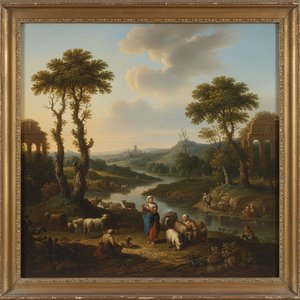
Cuyp’s artistic focus consistently returned to scenes of everyday life along the rivers and waterways surrounding Dordrecht. These weren’t idealized pastoral fantasies, but rather realistic depictions of working life—shepherds tending their flocks, boats navigating the currents, figures engaged in commerce or leisurely pursuits. However, even these seemingly mundane subjects were imbued with a sense of tranquility and harmony. He possessed an exceptional ability to elevate the ordinary, finding beauty in the simple rhythms of rural existence. Piping Shepherds, for example, isn’t just a painting of shepherds; it's a celebration of community, peace, and the inherent dignity of labor. The warm tones and atmospheric realism create an idyllic vision, yet one grounded in observable reality. Similarly, his depictions of boats often feature meticulously rendered details—the texture of sails, the reflections on the water—demonstrating a deep respect for the natural world and the people who interacted with it.
Cuyp and His Influences: Van Goyen, Both, and the Italianate Tradition
While Cuyp’s style is distinctly his own, it wasn't formed in a vacuum. He absorbed influences from various sources, skillfully synthesizing them into something entirely new. Early in his career, he was significantly impacted by Jan van Goyen, whose monochromatic landscapes and emphasis on tonal values provided a crucial foundation. Cuyp adopted van Goyen’s broken brush technique and subtle color palette, but quickly moved beyond mere imitation. Later, the work of Jan Both, who had traveled to Italy and brought back a distinctly Italianate sensibility, exerted a powerful influence. Both's use of diagonal lighting and expansive compositions encouraged Cuyp to experiment with depth and luminosity in new ways. This fascination with light and space can be traced back to the broader tradition of Italian landscape painting—particularly the works of Claude Lorrain—which was highly admired by Dutch artists during this period. However, Cuyp didn’t simply copy these influences; he adapted them to his own unique vision, creating a distinctly Dutch interpretation of the classical landscape.
Beyond Representation: The Spiritual Dimension of Cuyp’s Landscapes
To view Cuyp's work solely as realistic depictions of the Dutch countryside would be a disservice. There is a subtle but profound spiritual dimension to his paintings that elevates them beyond mere topographical representation. His scenes often evoke a sense of quiet contemplation, inviting viewers to reflect on their relationship with nature and the divine. This wasn’t necessarily explicit; Cuyp was a devout Calvinist, and overt religious symbolism is largely absent from his work. Instead, the spirituality resides in the atmosphere itself—the golden light, the serene compositions, the harmonious balance between humanity and the natural world. The vastness of the skies, the gentle curves of the rivers, and the peaceful activities of the figures all contribute to a sense of awe and reverence. The Avenue at Meerdervoort, for instance, with its long receding perspective and soft light, feels less like a specific location and more like an invitation to contemplate the infinite.
A Lasting Influence: Cuyp’s Place in Art History & Modern Appreciation
Although his period of active painting was relatively short—roughly two decades between 1639 and 1660—Aelbert Cuyp left an indelible mark on Dutch art history. He became known as the “Dutch Lorrain,” a testament to his mastery of light and landscape, and his work continues to captivate audiences today. While largely forgotten for a period after his death, his paintings experienced a revival in the 19th century, inspiring artists like the Impressionists who sought to capture fleeting moments of light and atmosphere. Today, Cuyp’s works are held in major museums around the world, and continue to be celebrated for their beauty, tranquility, and technical brilliance. At OriginalUniqueArt.com, we offer high-quality reproductions of Cuyp's masterpieces, allowing you to bring the golden light of the Dutch Golden Age into your own home. Explore our collection and discover the enduring appeal of this remarkable artist.