Early Life & Apprenticeship: From Lorraine to Rome
The story of Claude Gellée, known universally as Claude Lorrain, begins not amidst the grand villas and sun-drenched landscapes he would later immortalize, but in the humble village of Chamagne, nestled within the contested duchy of Lorraine around 1600. Details of his early life remain somewhat shrouded in legend, a testament to the romantic aura that surrounds this pivotal figure in Baroque painting. Unlike many artists who benefited from established family patronage, Claude’s beginnings were marked by hardship; orphaned at a young age, he found himself apprenticed not to a painter's studio but to a pastry baker. This seemingly unlikely start foreshadowed his later mastery of light and texture – skills honed through the delicate art of confectionary that would unexpectedly inform his artistic vision.
Driven by an ambition that transcended his modest circumstances, Claude journeyed towards Rome, then the epicenter of artistic innovation. His initial years in the city were far from glamorous; accounts vary, but he worked as a servant and cook for various artists, most notably Agostino Tassi, a prominent fresco painter whose workshop provided a crucial proving ground. Tassi’s studio exposed Claude to the fundamentals of landscape painting, though his true artistic awakening would come through rigorous self-study and an unwavering dedication to observing nature directly. This period was formative, laying the groundwork for a style that would distinguish him from his contemporaries and establish him as a leading landscapist.
The Roman Landscape: Claude’s Artistic Vision & Techniques
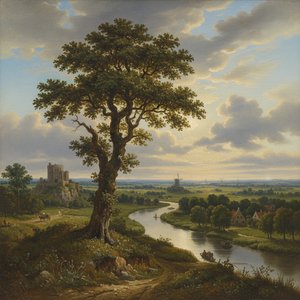
Claude Lorrain didn't simply *paint* landscapes; he constructed idealized visions of the Roman countryside. He wasn’t interested in topographical accuracy, but rather in evoking a sense of harmony, tranquility, and classical grandeur. His canvases are populated with ruins – fragments of ancient temples, aqueducts, and villas – not as historical records, but as evocative symbols of time's passage and humanity’s enduring legacy. These architectural elements provided structure and depth to his compositions, anchoring the natural world within a framework of cultural significance.
His technique was meticulous and layered. Claude began with a carefully sketched underdrawing, often using brown ink washes to establish tonal values. He then built up layers of oil paint, employing a glazing technique that created luminous effects and subtle gradations of color. He favored warm earth tones – golds, ochres, and siennas – which he blended with delicate blues and greens to capture the atmospheric perspective of the Italian countryside. Claude’s compositions were often carefully planned, utilizing repoussoir—the placement of dark elements in the foreground to enhance the sense of depth—and a high horizon line that emphasized the vastness of the sky.
Light and Atmosphere: Defining Characteristics of Lorrain's Style
What truly sets Claude Lorrain apart is his unparalleled mastery of light. Before him, landscape painting often lacked the atmospheric realism he brought to bear. He wasn’t merely depicting sunlight; he was capturing its *effects* – the way it filtered through trees, reflected off water, and cast long shadows across the land. This obsession with light wasn't accidental. Claude spent countless hours observing nature, meticulously studying the changing effects of illumination at different times of day.
His paintings are suffused with a golden glow, creating a sense of serenity and timelessness. He understood that light not only reveals form but also shapes emotion. The soft, diffused light in his earlier works evokes a feeling of peaceful contemplation, while the more dramatic chiaroscuro effects in his later canvases suggest a heightened sense of spirituality. This ability to manipulate light and atmosphere transformed landscape painting from a descriptive genre into an expressive medium.
Patronage, Popularity & Influence on Baroque Painting
By the 1630s, Claude Lorrain had firmly established himself as the leading landscapist in Italy. His clientele included prominent cardinals, noble families, and even foreign dignitaries, all eager to possess his luminous visions of the Roman countryside. His success stemmed not only from his artistic skill but also from his ability to cater to the tastes of his patrons. He often incorporated mythological or biblical scenes into his landscapes, elevating them beyond mere depictions of nature.
Claude’s influence on Baroque painting was profound. Artists like Herman van Swanevelt and Jan Frans van Bloemen directly emulated his style, popularizing the Italianate landscape throughout Europe. However, Claude's impact extended far beyond direct imitation. His emphasis on observation, atmospheric perspective, and the expressive power of light paved the way for later generations of landscape painters, including the Impressionists who would similarly prioritize capturing fleeting moments of natural beauty.
Key Works: Exploring Masterpieces like ‘Landscape with a Piping Shepherd’
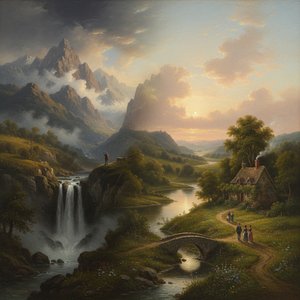
‘Landscape with a Piping Shepherd’ (1667), exemplifies Claude Lorrain's mature style. The painting depicts a serene rural scene bathed in golden light, featuring classical ruins, figures engaged in leisurely activities, and a vast expanse of sky. The composition is carefully balanced, with the shepherd and his flock serving as focal points within a broader landscape that extends into the distance. Note the meticulous detail in the rendering of the trees, the subtle gradations of color in the sky, and the way light illuminates the ruins, creating a sense of depth and atmosphere.
Other notable works, such as ‘Mill on the Tiber’ (ca. 1650) and ‘Ideal Landscape with the Flight into Egypt’, demonstrate his ability to seamlessly blend naturalistic observation with classical mythology and religious themes. These paintings are not simply beautiful depictions of nature; they are carefully constructed allegories that reflect Claude's humanist worldview.
Claude Lorrain’s Legacy: Drawings, Liber Veritatis & Enduring Appeal
Beyond his finished paintings, Claude Lorrain left behind a vast body of drawings—over 2,000 sketches and studies—that offer invaluable insights into his artistic process. These drawings reveal his meticulous approach to observation, his experimentation with different compositions, and his unwavering dedication to capturing the nuances of light and atmosphere.
Perhaps most significantly, Claude compiled a collection of drawings known as the Liber Veritatis, which he meticulously annotated and organized throughout his career. This “book of truth” served as a visual record of his artistic achievements and provided a source of inspiration for future generations. Today, Claude Lorrain’s paintings continue to captivate audiences with their luminous beauty, timeless elegance, and profound sense of harmony. His work remains a testament to the power of observation, the expressive potential of light, and the enduring appeal of the classical landscape.
Discover more exceptional artworks and explore the world of fine art at OriginalUniqueArt.com, where masterpieces are brought to life through handmade oil paintings and museum-quality prints.