

 Preview
 Send
Send Share
Share
 Details

 Download
 Similars
 X-Ray
X-Ray Diaporama
LANDSCAPE
 25.0 x 438.0 cm
 Read More
Hand Made Oil Reproduction
Hand-painted oil on canvas in your size and frame, made to order by our artists. ( Buy Print Buy Image)




































Pick from our preset sizes that match the artwork's original proportions.

You may enter your own dimensions to fit a specific frame or space. If your selected size does not match the original image's proportions, we will either crop the artwork or extend the painting with additional hand-painted elements. A digital mockup will be sent for your approval before production begins.
Please note that the on-screen preview does not reflect the actual cropping or extension. Only the mockup will accurately show the final composition.
While custom sizes are available, we recommend selecting a dimension from the predefined list to preserve the original proportions.
After order, OriginalUniqueArt.com team will email client for instructions and provide a mockup preview
Worldwide Delivery () in 3/4 weeks instead of standard 5 weeks. (25 August). No compromise on quality.

Free Worldwide Express Shipping

High-Quality Linen Canvas

Full Shipping Insurance

Customs Tax Refund Guarantee

True Color Matching Guarantee

60-Day Return Policy (Defects Only)

100% Money-Back Guarantee

Bulk Discount Offer
 Glass option is only available in size under 110 CM

LANDSCAPE
Reproduction Medium
Reproduction Size
-


Total Price
$ 300
Artist Biography
Xiao Yuncong: Pioneer of Dry Brushstrokes and Ming Loyalty
Xiao Yuncong (蕭雲從), born around 1596 in Wuhu, Anhui Province, stands as a singular figure in Qing dynasty art history—a master whose stylistic independence cemented his place as the founder of the Gushu school (姑孰派) and profoundly shaped the landscape tradition. Unlike many artists of his era who diligently imitated established styles, Xiao Yuncong forged his own path, prioritizing direct observation of nature and employing a distinctive technique characterized by “gui shu pai” – dry brushstrokes—that continues to inspire admiration today.Early Life and Artistic Formation
Xiao Yuncong’s upbringing instilled in him a deep appreciation for Confucian ideals and scholarly pursuits. His family belonged to the Hanlin Academy, providing him with access to elite education and fostering an environment conducive to artistic development. Although biographical details remain scarce, records indicate he traveled extensively during his lifetime, absorbing influences from various artistic centers within China—particularly Nanjing and Yangzhou—where he engaged in dialogues with fellow luminaries of the Ming dynasty. These encounters undoubtedly broadened his understanding of artistic principles and fueled his commitment to capturing the essence of the natural world.The Gushu Style: A Revolutionary Approach
Xiao Yuncong’s contribution to Chinese painting lies primarily in his pioneering adoption of “gui shu pai,” a technique that eschewed lavish color palettes and intricate ornamentation for simplicity and directness. This method involved applying brushstrokes with minimal pigment, allowing the texture of the paper itself to contribute significantly to the visual impact of the artwork. Unlike preceding generations who meticulously blended colors to achieve idealized representations of landscapes, Xiao Yuncong sought to convey a sense of immediacy and spontaneity—a reflection of his belief that true beauty resided in capturing the subtle nuances of natural phenomena. His monumental landscape painting “Taiping Shanshui Tu Hua” (太平山水圖畫), spanning over 23 feet, exemplifies this approach perfectly, demonstrating remarkable compositional balance and masterful execution.Notable Works and Legacy
Xiao Yuncong produced a prolific body of work encompassing landscapes, calligraphy, and poetry—all united by his unwavering devotion to the Ming dynasty’s artistic heritage. His landscape paintings are celebrated for their serene compositions, evocative tonal harmonies, and unparalleled sensitivity to atmospheric conditions. Particularly noteworthy is “Pure Tones Among Hills and Waters,” which showcases Xiao Yuncong's ability to distill complex visual information into a harmonious whole—a testament to his mastery of the gui shu pai technique. Furthermore, his posthumous manuscript (“Mei Hua Tang Yu Gai”) – a collection of calligraphy pieces – stands as an enduring symbol of artistic integrity and unwavering commitment to tradition.Historical Significance and Influence
Xiao Yuncong’s legacy extends far beyond his individual achievements; he fundamentally altered the trajectory of Chinese landscape painting. By rejecting stylistic conventions and prioritizing natural observation, he established a precedent for future generations of artists—inspiring them to embrace simplicity and authenticity as guiding principles. His influence can be discerned in the works of numerous painters who followed him, solidifying his position as one of the most important figures in Qing dynasty art and ensuring that his distinctive style continues to resonate with audiences worldwide. He remains an exemplar of artistic innovation rooted in profound respect for tradition.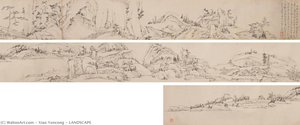
xiao yuncong
1596 - 1673
Quick Facts
- Artistic Movement Or Style: Gushu School
- Date Of Death: 1673
- Full Name: Xiao Yuncong
- Nationality: Chinese
- Notable Artworks: ['Taiping Shanshui Tu Hua']
- Place Of Birth: Wuhu, Anhui Province



